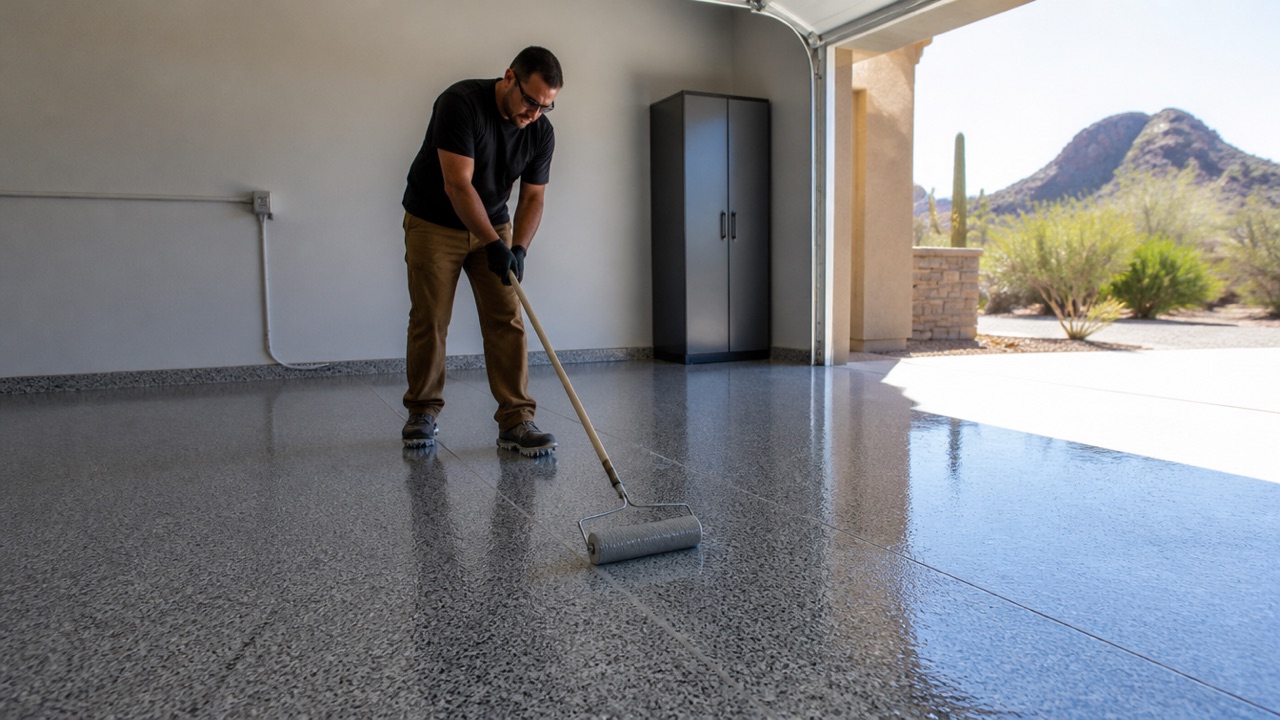
Most epoxy floors need a topcoat, and a flake floor cannot be finished without one. The topcoat is the clear layer that takes the abrasion, the sun and the chemicals so the colored base coat underneath does not have to. If you are comparing quotes for a polyaspartic floor coating system in Phoenix, you will see that layer listed as a polyurea top coat, a polyaspartic clear or a urethane clear, and it is often the line item buyers are tempted to cut. This guide explains what the layer does and what you give up when it is left out.
Quick answer: A flake epoxy floor needs a clear topcoat, because the topcoat buries the flake and creates the smooth, cleanable surface. A solid color epoxy can technically go without one, but it loses abrasion resistance, UV stability and the option to renew the surface later. For a Phoenix garage, a UV-stable polyaspartic or polyurethane topcoat is the standard specification.
This post treats the topcoat as a separate layer with its own job. It does not cover sealers on grind and seal floors, which follow different rules and are explained in our guide to grind and seal sealer types. It also leaves the chemistry of ambering to a dedicated article. What follows is the buyer's view: what each layer does, which topcoat chemistries exist, and how to read a quote that lists one.
| Layer | Main job | What it protects against |
|---|---|---|
| Concrete preparation | Profile for adhesion | Peeling and delamination |
| Base coat | Bond, film build and color | Moisture vapor and slab imperfections |
| Flake broadcast | Decorative texture | Nothing, it is cosmetic |
| Clear topcoat | Wear surface and UV shield | Abrasion, chemicals, sun and scuffing |
1. What a Topcoat Does That the Base Coat Cannot
A topcoat is the sacrificial wear surface of the floor. The base coat is chosen to bond to concrete and to carry color, and it does that job well. It is not chosen to take years of tire grit, spilled chemicals and direct sun, and a standard epoxy left exposed in those conditions dulls, scratches and ambers sooner than a protected one.
The topcoat takes that exposure instead. When a fine scratch forms, it forms in the clear layer, and the colored layer beneath stays intact. That is the practical meaning of sacrificial: the wear is deliberately placed in a layer that can be replaced, so the expensive parts of the system never face it directly.
On a flake floor the topcoat has a second job that is not optional. Broadcast flake leaves a rough, uneven surface, because each chip stands slightly proud of the base coat. The clear coat fills the gaps between the chips and buries them under a continuous film. Without it the floor feels like coarse sandpaper and is almost impossible to clean. The number of clear coats decides how smooth the finished floor feels, and a quote that lists a single thin coat over heavy flake will give a rougher result than one that lists two.
The topcoat also sets how cleanable the floor is. A continuous, nonporous film wipes clean of oil, brake dust and tire marks. Gaps in that film hold dirt. This is the same layer that keeps the floor looking like the day it was installed, which is why our guide on what an epoxy garage floor looks like after five years in Arizona reads the condition of the topcoat first and the base coat second.
Two things a topcoat cannot do are worth stating. It cannot rescue a poor bond, because a clear coat on top of a failing base coat fails with it. And it cannot hide a moisture problem in the slab. It protects the layers below from surface wear, not from conditions beneath them.
2. Polyaspartic, Polyurethane and Polyurea Topcoats Compared
Three clear chemistries are in common use, and the right one depends on how quickly you need the floor back in service. Polyaspartic is the usual choice for Phoenix garages, polyurethane is a durable alternative with a longer cure, and a clear epoxy is the budget option that gives up UV stability.
The terms overlap, which is where quotes become confusing. Polyaspartic is a type of aliphatic polyurea, so a polyurea top coat in a flooring quote usually means a polyaspartic clear. A pure polyurea is faster still and is mostly used as a base or in commercial work where hours matter. Our comparison of polyurea vs polyaspartic coatings in Phoenix covers that distinction in depth, and the guide to epoxy vs polyaspartic covers the system-level trade-offs.
| Topcoat | UV stability | Typical return to service | Abrasion resistance |
|---|---|---|---|
| Polyaspartic (aliphatic polyurea) | High | Foot traffic in hours, vehicles often next day | High |
| Polyurethane (aliphatic) | High | Foot traffic overnight, vehicles in a few days | High |
| Clear epoxy | Low, ambers in sun | Foot traffic in a day, vehicles in several days | Moderate |
The cure times above are typical ranges. Each product has its own data sheet, and temperature, humidity and film thickness all move them, so treat the table as a comparison and not as a promise for one job.
Heat matters more here than in most cities. Polyaspartic cures quickly, and in a hot Arizona garage the working time before it starts to set is short. That is why application skill is part of the specification, and why the timing between coats is its own subject, covered in our guide to polyaspartic recoat windows in Phoenix.
Abrasion resistance is compared under ASTM D4060, the Taber abraser test, which reports the weight a coating loses after a fixed number of wheel cycles. A lower loss means a harder wear surface. If a contractor quotes a number from that test, ask which product and which wheel it applies to, because results vary with the formulation.
3. UV Stability and Why It Matters on a Phoenix Garage
UV stability decides whether the floor holds its color near an open garage door. A standard epoxy ambers when sunlight reaches it, and an aliphatic polyaspartic or polyurethane clear over it blocks that change. In a garage where the door stays open to Arizona sun for part of every day, that difference shows up in the first few seasons.
The effect is local. Most of a garage floor never sees direct sun, so the amber band appears just inside the door and nowhere else. That is why a floor can look perfect under the shelving and tinted by the entry. A UV-stable topcoat keeps the whole floor uniform, which matters most on light colors, where any shift is visible.
ASTM G154 is the standard used to compare topcoats here. It exposes coatings to controlled cycles of ultraviolet light and moisture and measures how color and gloss change. If a data sheet cites G154 results, it tells you how a product is expected to behave relative to others in strong sun. It is a laboratory comparison and not a forecast for your particular garage.
The chemistry behind ambering is covered in detail in our article on whether epoxy floors yellow in Phoenix sun, so it is not repeated here. The buying takeaway is simple: ask what the clear coat is made of, and do not accept a system described only as epoxy if the garage door faces the sun.
4. Sheen Control: Gloss, Satin and Matte From the Same Base
The topcoat sets the sheen, and the base coat does not. The same flake and base coat can finish as high gloss, satin or matte, depending on the clear coat and any matting additive used. That makes sheen a choice you make at the topcoat stage, not a feature of a particular color.
The trade-offs are practical. Gloss looks bright and shows scratches and dust. Satin hides light wear and is the common middle choice. Matte reduces glare and shows fewer scratches but can hold oil marks. Our guide to epoxy floor finish options compares each in detail, including how texture changes traction.
Ask to see a sample board with the actual flake and the actual sheen. Photos flatten the difference, and a satin that looks right on a screen can look flat in a sunlit garage.
5. The Recoat Path: How a Topcoat Makes a Floor Renewable
A topcoat turns a floor from a disposable surface into a renewable one. When the clear layer dulls, the floor does not need to be removed. It is cleaned, abraded and given a new clear coat, which restores the sheen and adds years, and the base coat underneath is never touched.
That is the standard way to renew a worn but sound floor. A one-day clear coat costs a fraction of replacing a system, and it only works if the floor was built with a topcoat in the first place. A floor with no topcoat has no sacrificial layer to renew, so the wear lands in the color coat, and fixing it means grinding and starting over.
How often the layer needs renewing depends on use. In a residential garage with one or two vehicles, it is often not needed for a decade. In a commercial space with heavy foot traffic or forklifts, planning a renewal clear coat every few years keeps the wear in the clear layer and out of the color coat. These are planning figures, not guarantees, and a visual check of the tire lanes tells you more than a calendar does.
A recoat is the right fix for surface wear. It is not the right fix when the base coat is lifting from the slab. Our guide to epoxy floor delamination and when to recoat explains how to tell the two apart.
6. What Skipping the Topcoat Actually Costs Over Ten Years
Skipping the topcoat saves money on day one and costs more over ten years. The savings are real but small compared with the total project, and the costs show up as wear in the color coat, amber bands near the door and the loss of the cheap renewal option.
Consider what happens in sequence. In the first few years the floor looks fine, because a new base coat is hard and glossy. By the middle years, the tire lanes dull and scratch directly through the color layer, and any sun band starts to amber. By year ten, the only repair that restores the floor is grinding the surface back and starting again. A floor built with a topcoat reaches the same point with a one-day clear coat available at any time.
This is why the topcoat is the line least worth cutting when a quote comes in high. It is a small share of the price and a large share of the result. When you compare bids for an epoxy garage floor Phoenix homeowners can rely on, check these points on each quote:
- The topcoat chemistry, named as polyaspartic, polyurethane or clear epoxy.
- The number of clear coats over the flake.
- The film thickness of the topcoat, from the data sheet.
- The sheen, with a sample board you have seen.
- A UV or weathering claim backed by a data sheet, not a sales line.
- A plan for renewing the clear coat when it wears.
A quote that cannot answer those six points is a quote where the topcoat has been underspecified. Asking the questions before you sign costs nothing, and it is the quickest way to tell a considered system from a minimal one.
7. Frequently Asked Questions
Get a Free Quote With the Topcoat Specified
Tell us how you use your garage, and we will quote a system with the clear coat, sheen and renewal plan written out.