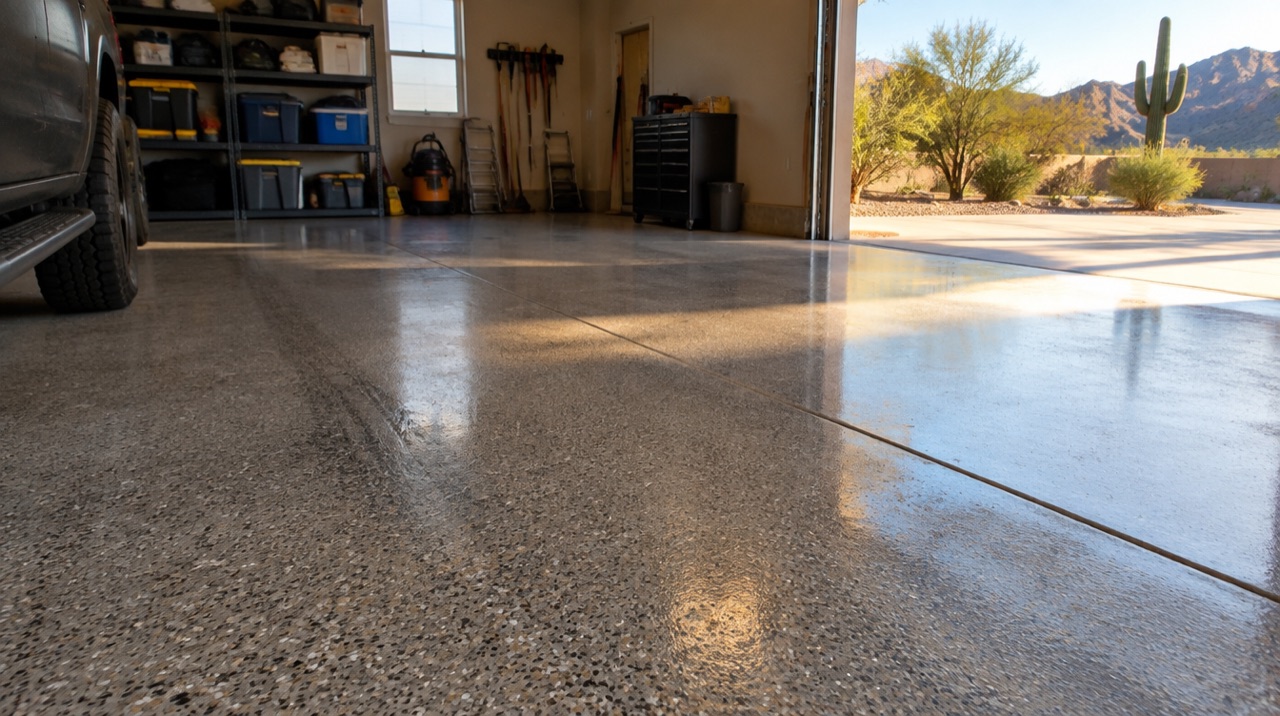
A five year old epoxy garage floor in Arizona usually looks intact, clean and a little duller in the places where the tires and feet travel. That is the honest answer to the question every skeptical buyer asks before spending money on a garage. If you are weighing a garage epoxy floor in Phoenix, this guide describes what five years of desert sun, hot tires and daily use actually change on a well installed system, what they do not change, and how to read an aging floor so you know whether it needs a clear coat or a replacement.
Quick answer: After five years, a well installed epoxy garage floor in Arizona typically keeps its bond and its color. The visible change is lost gloss in the tire tracks and the walking path, a faint amber band near the garage door if the topcoat was standard epoxy, and light scuffing where cars turn. Most of that is surface wear, and a single clear coat usually restores it.
This post is about what the floor looks like, not how long it should last. For the expected service life by system type, see our guide to how long epoxy flooring lasts in Arizona heat. Here the focus is observable aging: where wear concentrates, what stays the same and which changes can be reversed.
| What you inspect | Typical look at year five | Usually fixed by |
|---|---|---|
| Gloss in tire tracks | Duller, with fine scratches | Clean, abrade, clear coat |
| Path from car door to house | Narrow dull lane | Clean, abrade, clear coat |
| Band near the garage door | Faint amber if the topcoat was standard epoxy | UV-stable topcoat over the existing floor |
| Flake and base color | Close to original | No work needed |
| Edges, cracks and joints | Hairline movement possible | Fill and seal at the joint |
| Bond to the slab | Intact on a sound installation | Not applicable |
1. What Changes First on a Five Year Old Floor
Sheen changes first, and it changes in a pattern. A new floor has an even, glassy surface because the topcoat is unbroken. Over the first few years, fine scratches build up wherever grit meets the surface, and each scratch scatters a little light. The result is a floor that looks slightly duller in some areas and almost new in others. What the topcoat does as its own layer, and which chemistries are available, is covered in our guide to epoxy floor sealers and topcoats.
Color changes last. Quartz and vinyl flake are inert, so a gray or tan broadcast keeps its look because the pigment never moves. The base coat sits beneath the flake and the topcoat, so it never faces direct wear. What you see at year five is almost entirely the condition of the clear topcoat, not the epoxy beneath it.
The floor also keeps its function. A sealed, seamless surface still wipes clean, still resists oil and still sheds water, because those properties come from an unbroken film, and a film can be dull without being broken. Dull and failed are two different conditions, and most five year old floors are only dull.
Expect small differences between garages. A floor that sees one commuter car and little foot traffic ages more slowly than a workshop garage with tool carts, jack stands and daily use. A floor under a covered, shaded door ages differently from one facing the afternoon sun. Those variables are why two five year old floors from the same installer can look different, and why the useful test is bond and sheen, not age alone.
2. Wear Patterns: Where the Traffic Actually Concentrates
Wear concentrates in narrow lanes, not across the whole floor. In a typical two car garage, two parallel tire tracks carry most of the load, a short path connects the driver side door to the house entry, and the area just inside the garage door takes the most grit.
Tires drag fine sand and road grit across the surface every time a vehicle enters, and the same two strips take the abrasion thousands of times. The path to the house is worn by shoes carrying the same grit. The rest of the floor, including the parts under shelving and the far wall, may look nearly untouched. That is why a floor can look worn from the driveway while most of its area is in good condition.
Abrasion resistance is measured under ASTM D4060, the Taber abraser test, which reports the weight lost from a coating after a set number of wheel cycles. The number matters because topcoat chemistry changes how fast a lane dulls. A harder, cross-linked clear coat resists scratching better than a base epoxy left exposed, which is one reason a topcoat is part of a well specified system rather than an optional extra.
Two habits visibly change the pattern. Parking in the same spot every day keeps the tire tracks narrow and dull, while rotating the vehicle position a few inches spreads the wear. Sweeping the grit out, rather than letting it sit under the tires, also reduces fine scratching. Our guide to maintaining epoxy floors in Arizona covers cleaning products and routines in detail.
3. Color, Gloss and the Effect of Five Arizona Summers
Five summers affect the topcoat far more than the flake. Garage floors in Arizona rarely see the sun directly except in one place, the band just inside the open garage door, where the sun reaches the floor for part of the day. That band is where any color change shows up.
A standard epoxy topcoat can take on a faint amber tone in that band, because epoxy is sensitive to ultraviolet exposure. The effect is cosmetic and limited to the sunlit strip, so the rest of the floor is not affected. A UV-stable polyaspartic topcoat avoids it. The reasons behind that difference are covered in our guide on whether epoxy floors yellow in Phoenix, so this post does not repeat the chemistry.
Accelerated weathering standards such as ASTM G154 expose coatings to controlled UV and moisture cycles to compare how topcoats hold color and gloss. If a specification cites G154 results, the number tells you how a topcoat is expected to behave in strong sun. It is a laboratory comparison, not a prediction for one specific garage, so treat it as a way to compare products.
Gloss loss in the sun band is usually slightly faster than elsewhere, because heat and UV age the surface together. A garage with a north-facing door may show almost no band at all, while a west-facing door shows a clear one. Door orientation, window light and how often the door stays open all change what year five looks like.
4. Hot Tire Contact After Five Years of Daily Parking
Hot tire pickup is a bond failure that shows up early, not a slow aging effect, so a floor that survived five years of daily parking has already passed that test. A properly prepared, correctly cured system keeps its grip on the slab under hot tires. Where pickup does happen, it appears as small lifted patches or tire-shaped marks in the first months, not at year five.
What year five does show is the cumulative effect of heat on the tire lanes. Repeated warming and cooling, plus the weight of the vehicle, polish and scratch the topcoat in those two strips. The surface looks worn there, but the film below can be sound. The difference between a dull lane and a failing lane is adhesion. A dull lane still has the coating firmly bonded to the slab, and a failing lane has the coating lifting at the edges or sounding hollow when tapped.
If you see lifted patches rather than dullness, that points to a bond problem and not aging. Our guide to hot tire pickup and peeling on Phoenix garage floors explains the causes and the fixes.
5. What a Well Maintained Floor Looks Like Versus a Neglected One
The same system can look noticeably different at year five depending on care. The difference comes from grit, chemicals and moisture left on the surface, not from the coating itself.
| Condition | Well maintained | Neglected |
|---|---|---|
| Surface grit | Swept or rinsed regularly | Left under tires and shoes |
| Spills | Wiped up the same day | Allowed to dry and stain |
| Cleaning products | Neutral, non-abrasive | Harsh or acidic cleaners |
| Overall look | Uniform, clean, mild sheen loss | Patchy dull spots and ground-in dirt |
A maintained floor looks clean and uniform, with sheen loss only in the lanes. A neglected floor shows ground-in dirt, patchy dull areas and chemical rings where spills sat. Neglect rarely damages the bond, so a dirty floor is usually cleanable, though a surface left dull by years of grit needs a recoat to look uniform again.
Arizona adds two factors. Fine desert dust enters the garage constantly and acts as an abrasive when it is walked or driven over. Heat also softens the surface slightly, so grit presses in more easily on a hot afternoon. A quick sweep or a blower pass before the car comes in does more for the floor than any product.
Cold nights in winter have the opposite effect, and the seasonal care is covered in our winter prep checklist for Arizona garages.
6. Recoat or Replace: Reading a Five Year Old Floor
Most aging floors need a recoat, not a replacement. The deciding question is whether the coating is still bonded to the concrete. Surface wear is a recoat, and loss of adhesion is a replacement.
A recoat means the floor is cleaned, degreased, abraded to give the new coat something to grip, and sealed with a fresh clear topcoat. It restores the sheen across the whole surface, covers the fine scratches and can add UV protection if the original topcoat lacked it. It is a one day job, which makes it far less disruptive and costly than replacing a system that is still sound.
These checks help you read your own floor before you call anyone:
- Tap test: tap the floor with a coin or the handle of a screwdriver. A solid sound means the bond is intact, and a hollow sound over a patch suggests debonding.
- Edge check: look along the walls, the door threshold and any cracks for lifting edges or curling.
- Blister check: raised bubbles point to vapor pressure from beneath, which is a slab problem rather than wear.
- Water test: spill a little water. On an intact topcoat it beads or sheets evenly, and on a worn lane it spreads and darkens slightly.
Widespread blistering, peeling in sheets or a floor that sounds hollow across large areas means the system has lost adhesion and needs removal, not a clear coat. Our guide on epoxy floor delamination and when to recoat in Phoenix explains how the two cases are told apart. If you are planning a new floor now and want to see how installers describe real results, our garage epoxy transformations page shows what the finished surfaces look like when new.
The practical takeaway is simple. Judge a floor on year five by its bond and its sheen, not by a few dull strips. A well installed, well prepared system with a UV-stable topcoat is built to look much the same in year five as it did in year one, apart from the lanes that carry the traffic.
7. Frequently Asked Questions
Get a Free Quote for a Garage Floor Built to Age Well
Tell us how you use your garage, and we will recommend a system and topcoat that holds its look through Arizona summers.