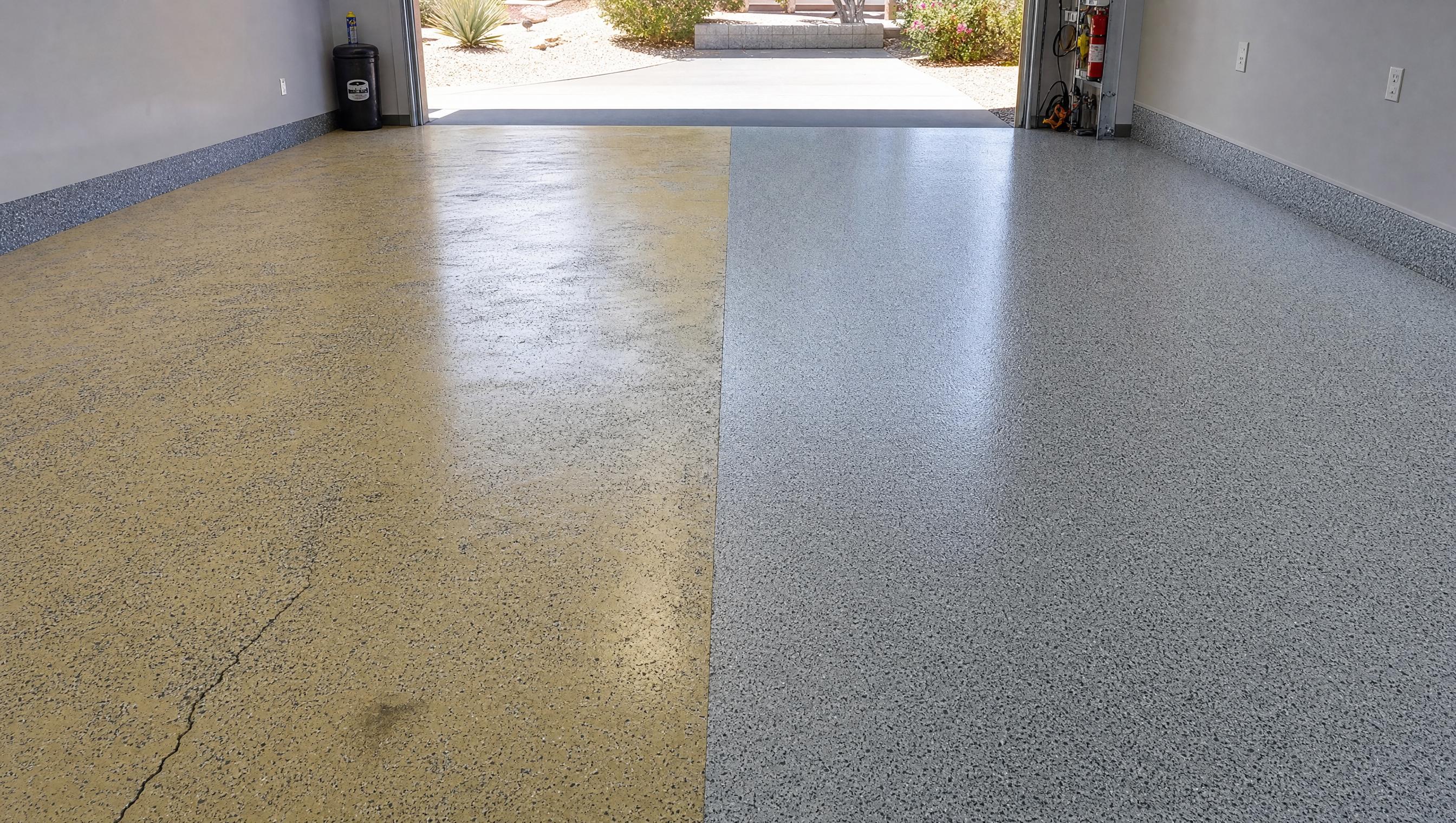
Yes - bare epoxy will yellow in Phoenix sun, usually within 6–18 months. That's not a scare tactic, it's chemistry. Epoxy resin is not UV-stable, and Phoenix delivers more annual UV radiation than almost any city in the country. The fix isn't complicated: cap your epoxy with a UV-stable polyaspartic topcoat, and yellowing stops being a problem. That's the whole story.
Why Epoxy Yellows: The Simple Chemistry
Two mechanisms cause epoxy yellowing - and both happen faster in Arizona than almost anywhere else in the US:
Amine blush: Epoxy cures through a reaction between resin and a polyamine hardener. Under humidity swings or temperature extremes, a waxy byproduct called amine blush can rise to the surface and react with UV and moisture - causing a yellow or cloudy tint before the floor is even a year old. Phoenix's extreme temperature swings between night and noon accelerate this.
UV photo-oxidation: Epoxy resin is built from aromatic compounds that absorb UV energy. Sunlight breaks those chemical bonds apart through photo-oxidation - discoloring, chalking, and eventually embrittling the resin. Every clear or pigmented epoxy has this weakness. It's the base chemistry, not a bad batch or a cheap product.
Why Phoenix Accelerates Yellowing
Sunny days per year in Phoenix - near-constant UV exposure with almost no cloud cover buffer
Surface temps on exposed garage slabs in summer - heat accelerates every chemical degradation process
Typical window before visible yellowing appears in a south/west-facing Phoenix garage without UV topcoat
Time for equivalent yellowing in Seattle - same bare epoxy, same process, just far less UV intensity
South- and west-facing Phoenix garages are the worst cases - direct afternoon sun through the door for hours every day in summer. We see yellowed and chalky bare epoxy on tear-out jobs weekly. It's the most common cause of premature epoxy failure in the Valley.
Field observation: A floor that might take 3–4 years to yellow visibly in Seattle can show the same discoloration in under 12 months in a Phoenix garage. When a contractor quotes you a bare epoxy finish with no UV-stable topcoat, they're selling you a floor that will need replacement or major recoat within 2–3 years.
The Solution: UV-Stable Polyaspartic Topcoat
Polyaspartic is aliphatic, not aromatic - it doesn't have epoxy's UV-reactive molecular structure, so it doesn't yellow, chalk, or break down in sunlight. Standard polyaspartic topcoats carry 10–15 year UV stability ratings, which is exactly what Phoenix floors need.
Beyond UV resistance, polyaspartic topcoats also:
- Cure in hours rather than days (walk-on same day)
- Resist hot tire pickup - critical for Phoenix garages in summer
- Add scratch and chemical resistance over the base coat
- Maintain color stability - the floor looks the same in year 10 as day one
This is also why the right epoxy system uses both: epoxy base coat for build, bond strength, and decorative broadcast, topped with polyaspartic for UV protection and surface durability. Not one or the other - both, in that order. See our garage epoxy page for how we spec every residential job.
Questions to Ask Any Epoxy Contractor About UV Resistance
Before You Sign Any Quote
Is the topcoat UV-stable, and is it polyaspartic or aliphatic polyurethane? These are the two UV-rated options. If they say "epoxy topcoat" - that's bare epoxy on top of bare epoxy, and it will yellow.
Is this a single-coat epoxy system with no topcoat? If yes, walk away. Any contractor selling a no-topcoat system in Phoenix is either uninformed or cutting cost at your expense.
What's the warranty on color and UV stability specifically? A contractor confident in their system will commit to color stability in writing. Vague warranties mean the topcoat isn't UV-rated.
Can I see a Phoenix installation that's at least 3 years old? Any established contractor with UV-stable systems should be able to point to local jobs that have aged well in Phoenix sun.
What ProEpoxy Uses
Every epoxy floor we install gets a UV-stable polyaspartic topcoat as standard - not an upsell, not an add-on. It's part of the base spec on every residential and commercial garage job we run in Phoenix, Scottsdale, Chandler, and across the Valley. We've been installing floors since 2010, 900+ projects completed with our own Arizona-based crew, no subcontractors.