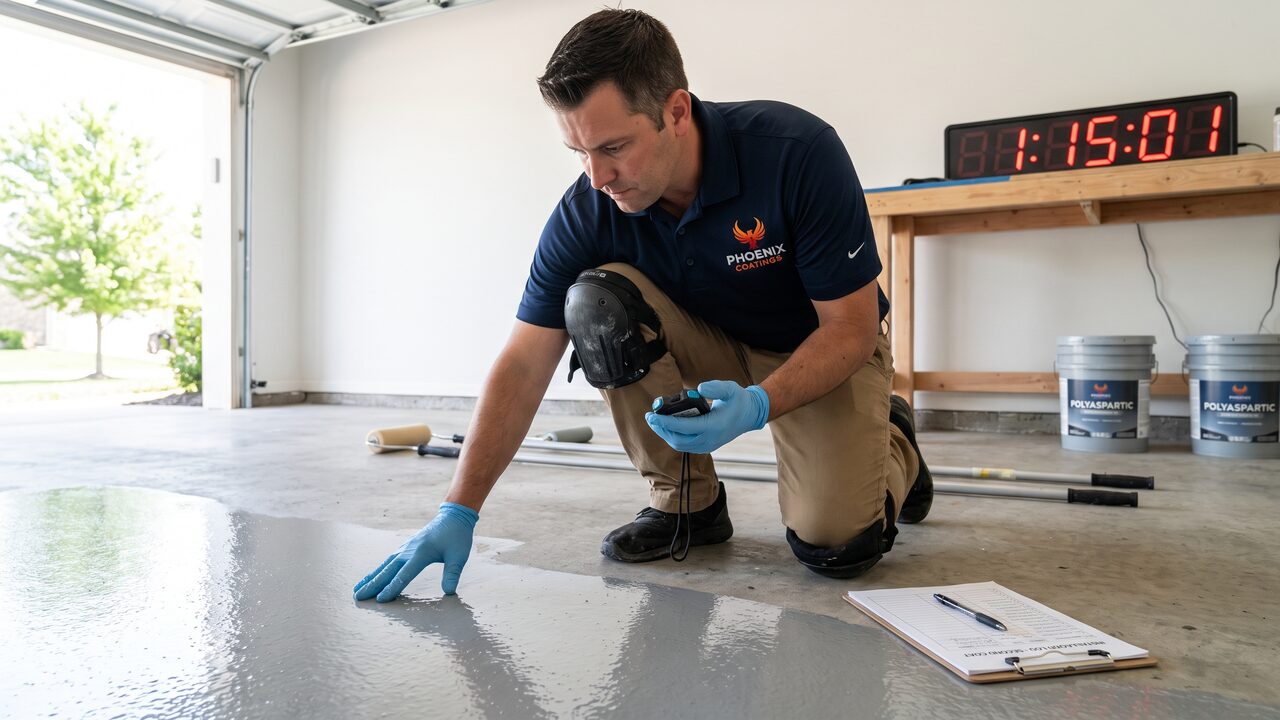
One of the least visible but most important details in a quality polyaspartic floor coating Phoenix install is something a homeowner will never see happen: the precise timing window between coats. Get it right, and the layers chemically bond into a single unified system. Miss it, and you can end up with a floor that looks fine on install day but delaminates months or years down the road.
This guide explains what a recoat window actually is, why Phoenix's extreme heat compresses it more than in milder climates, and how to tell whether an installer is managing this critical step correctly.
Most homeowners and business owners evaluating a flooring contractor focus entirely on the visible parts of the process - color, sheen, finish - without ever asking about recoat management, simply because it's not something anyone would think to ask about. That's exactly why it's worth understanding: it's one of the few install details that can genuinely make or break a floor's long-term durability while remaining completely invisible until something goes wrong.
1. What Is a Recoat Window and Why It Exists
A recoat window is the specific span of time after one coat has cured to the right degree during which the next layer can be applied and still form a proper chemical and mechanical bond with the layer beneath it - apply too early and the fresh coat can disturb or mix with the still-soft first layer, apply too late and the cured surface becomes too hard and too smooth (chemically inert) for the next layer to bond well.
Polyaspartic systems cure through a chemical reaction, not simple evaporation, and that reaction continues to progress on a specific timeline the manufacturer's data sheet defines. Multi-coat systems - a base coat, a color or flake layer, and a clear topcoat - depend on each layer bonding to the one before it at exactly the right point in that curing timeline.
Chemical Bond vs. Mechanical Bond
Within its recoat window, a fresh polyaspartic layer partially dissolves and fuses with the still-reactive surface of the coat beneath it, creating what's essentially a single continuous material rather than two distinct layers stacked on top of each other. Once that window closes, the underlying surface has fully cross-linked and become chemically inert - the next coat can still adhere, but only mechanically, gripping a physically roughened surface rather than fusing at the molecular level. A mechanical bond is weaker and more prone to eventual separation than a true chemical bond, which is the core reason recoat timing matters so much.
2. Phoenix Heat's Effect on Recoat Timing
Phoenix heat shrinks the ideal recoat window because higher ambient and surface temperatures accelerate the chemical cure reaction, meaning a coat that might stay in its recoat-ready state for several hours in a cooler climate can pass through that same window in a fraction of the time on a hot Phoenix afternoon.
| Condition | Typical Recoat Window | Risk of Rushing |
|---|---|---|
| Cool morning (65-75°F) | Longest - several hours | Low |
| Moderate afternoon (85-95°F) | Moderate - shorter window | Moderate - requires close monitoring |
| Peak summer heat (100°F+ slab surface) | Shortest - can close quickly | High - easy to miss without careful timing |
This is one of several reasons we schedule multi-coat polyaspartic installs around cooler parts of the day whenever possible during Phoenix's hot months, and why fall and winter installs - discussed in our epoxy garage floor fall installation guide - tend to give crews more comfortable margin for hitting recoat timing precisely.
A west-facing garage door left open during a midday Phoenix summer install can push slab surface temperature well past 120°F, which compresses an already-tight recoat window even further than ambient air temperature alone would suggest. Experienced crews account for this by measuring the actual coated surface, not the forecast high, and by timing multi-coat sequences to work around the sun's path across a specific garage or bay rather than a generic daily schedule.
3. What Happens If You Miss the Window
Missing the recoat window means the previous coat has cured too far for the next layer to bond chemically, which typically requires a mechanical fix - light sanding or scuffing of the surface to create a physical texture the next coat can grip - before the recoat can proceed safely.
Skipping that correction step and simply applying the next coat anyway is the root cause of a large share of polyaspartic delamination failures we're called in to repair. The floor can look completely normal on the day it's finished; the bonding problem only becomes visible months or years later when a section starts lifting or peeling, often in a pattern that traces back to exactly where and when the recoat timing was missed.
4. How Professional Crews Manage Multi-Coat Timing
Professional crews manage recoat timing by tracking each coat's application time precisely, monitoring ambient and surface temperature throughout the day, and sequencing the job so each subsequent coat lands within the manufacturer's specified window rather than working on a generic same-day assumption.
- Surface temperature monitoring: A hot slab cures faster than ambient air temperature alone would suggest - experienced crews measure the actual floor surface, not just the weather.
- Tack testing: A quick touch test on a discreet section confirms the surface has reached the right tackiness level for recoat, rather than relying on a fixed clock time alone.
- Sequenced scheduling: Multi-bay or multi-room projects are sequenced so each area's recoat timing can be managed individually rather than forcing every section onto the same rigid schedule.
- Manufacturer data sheet adherence: Every polyaspartic product has its own specific recoat window documented by the manufacturer - a crew unfamiliar with your specific product is guessing rather than following verified guidance.
If your project needs a same-day polyaspartic turnaround, this kind of careful timing management is exactly what makes that fast cure safe rather than risky - a rushed crew trying to hit a deadline without managing recoat windows properly is a red flag regardless of how good the final finish looks on install day.
Crew staffing matters here too. A same-day, multi-coat project genuinely requires enough hands on-site to apply each coat quickly across the full floor area before that section's window starts closing - a two-person crew tackling a large commercial floor on an aggressive same-day timeline is set up to miss windows on the later-finished sections simply due to the math of how much square footage one crew can physically coat per hour.
5. Signs Your Installer Rushed or Missed a Recoat Step
A few warning signs can indicate a rushed or mismanaged recoat process, though some only become apparent well after installation - which is exactly why choosing an experienced crew upfront matters more than trying to catch a problem after the fact.
Streaking or uneven texture where coats meet can indicate timing or application issues, though not always a bonding problem specifically.
A multi-coat job completed in an implausibly short total time for the conditions may mean recoat windows were compressed rather than properly managed.
Delamination appearing within the first year, especially in patches rather than across the whole floor, often points back to a bonding issue from install.
A crew that can't describe how they track recoat timing (temperature checks, tack tests) is more likely working off assumption than verified process.
If you're dealing with a floor showing signs of premature delamination, our epoxy floor repair team can assess whether a bonding failure is the root cause and what the right correction path looks like - sometimes a full regrind and recoat, sometimes a more targeted repair depending on how extensive the issue is. For anyone comparing systems, our polyurea coating and commercial epoxy guides cover how recoat timing considerations differ across other coating chemistries.
6. Frequently Asked Questions
Get It Done Right the First Time
Free estimate from a crew that manages recoat timing correctly, every install.