Home
About
About Us FAQ
Epoxy Flooring
Garage Epoxy Residential Epoxy Commercial & Industrial Warehouse Epoxy Automotive Epoxy Aircraft Hangar Epoxy Healthcare Epoxy Restaurant & Kitchen Metallic Epoxy Basement Epoxy Parking Garage Epoxy Epoxy Repair
Concrete Services
Concrete Polishing Polished Concrete Floors Concrete Grind & Seal Stained Concrete Floors
Floor Coatings
Polyaspartic Coating Polyurea Coating Urethane Cement ESD Anti-Static Epoxy Epoxy Flake System Get a Free Quote
About Us FAQ
Epoxy Flooring
Garage Epoxy Residential Epoxy Commercial & Industrial Warehouse Epoxy Automotive Epoxy Aircraft Hangar Epoxy Healthcare Epoxy Restaurant & Kitchen Metallic Epoxy Basement Epoxy Parking Garage Epoxy Epoxy Repair
Concrete Services
Concrete Polishing Polished Concrete Floors Concrete Grind & Seal Stained Concrete Floors
Floor Coatings
Polyaspartic Coating Polyurea Coating Urethane Cement ESD Anti-Static Epoxy Epoxy Flake System Get a Free Quote
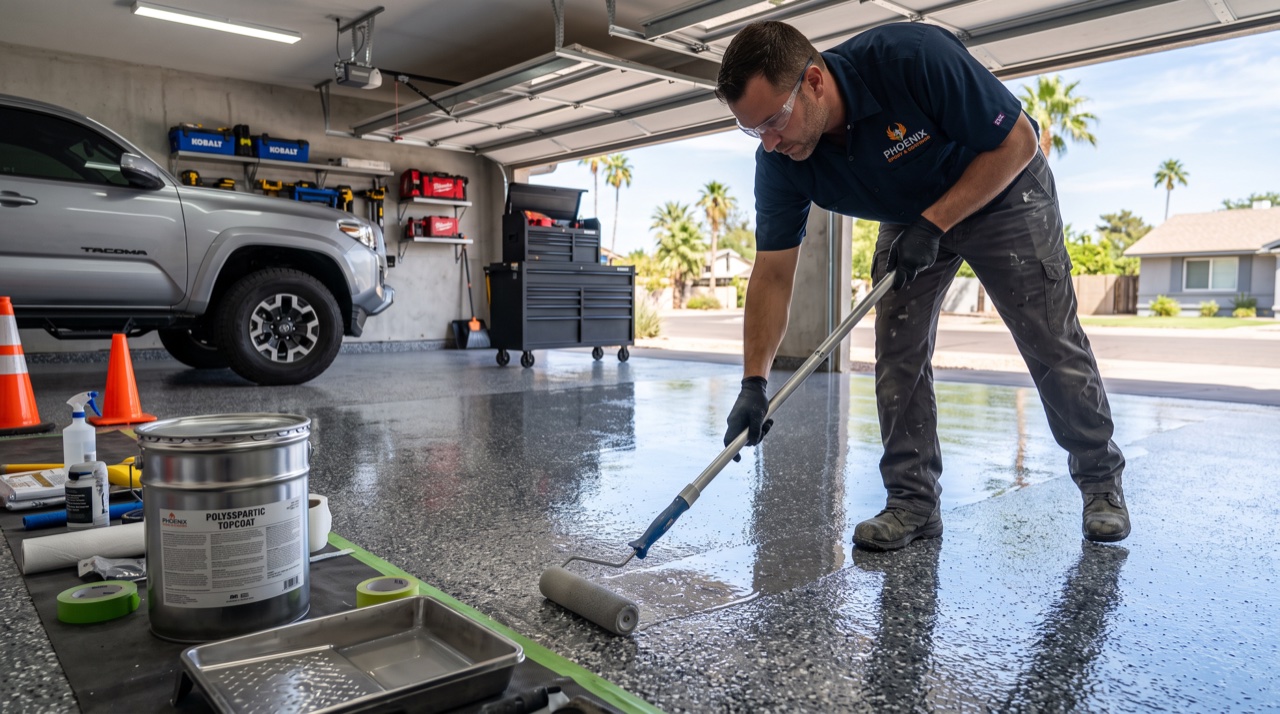
Professional epoxy flooring contractor in Phoenix Arizona applying polyaspartic topcoat with roller in clean garage
Floor Coatings

Polyurea vs Polyaspartic: Which Lasts Longer?

August 1, 2026 · 7 min read · By Chris Leebrock
Quick Answer

Both polyurea and polyaspartic are elite topcoats that last 10–20+ years when applied over a proper epoxy base. The main differences are cure speed (polyurea is faster), flexibility (polyurea wins), UV resistance (both excellent), and application in heat (polyaspartic handles Phoenix summers better). Neither outlasts the other when installed correctly - durability comes down to prep and base coat, not which topcoat you pick.

What Is Polyurea?

Polyurea is a fast-reacting polymer coating formed by combining an isocyanate component with an amine-terminated compound. In floor coating applications, it is typically sprayed or rolled as a topcoat over a cured epoxy base system.

Key characteristics:

  • Cure time: 30–60 minutes to touch; full cure in 24 hours
  • Flexibility: Highest of any floor coating - elongates up to 300% before failure
  • Temperature range: Applies and cures from -20°F to 350°F substrate temps
  • UV resistance: Aliphatic polyurea is highly UV-stable; aromatic versions yellow (avoid the latter)
  • Thickness: Typically 10–20 mils when used as a topcoat
  • Cost: Slightly higher material cost than polyaspartic

Polyurea's extreme flexibility makes it ideal for concrete with minor movement, large outdoor slabs, and environments with dramatic temperature swings. It will flex with the concrete rather than crack.

What Is Polyaspartic?

Polyaspartic is a subset of polyurea chemistry - specifically, an aliphatic polyurea made with an ester compound. It shares polyurea's UV stability and fast cure but with a longer working time that makes it easier to apply as a topcoat on large surfaces.

Key characteristics:

  • Cure time: 2–4 hours to recoat; drive-ready in 24 hours
  • Flexibility: High - elongates 50–100% before failure
  • Temperature range: Excellent in heat; wide application range including Arizona summers
  • UV resistance: Aliphatic chemistry - non-yellowing, color-stable long-term
  • Thickness: Typically 8–15 mils as a topcoat
  • Cost: Slightly less than polyurea; still premium over standard urethane

The longer pot life is a practical advantage for crews applying it in a large garage - you have time to work the product properly without it gelling mid-roll.

Head-to-Head Comparison

Feature Polyurea Polyaspartic
Cure to touch 30–60 min 2–4 hours
Full cure 24 hours 24 hours
Flexibility / elongation Up to 300% 50–100%
UV resistance Excellent (aliphatic) Excellent (aliphatic)
Hot climate application Good Very good (wider window)
Abrasion resistance Excellent Excellent
Chemical resistance Excellent Excellent
Ease of application Moderate (fast set) Easier (longer pot life)
Material cost $$–$$$ $$
Best use case Outdoor slabs, cold climates, large joints Garage topcoats, hot climates, standard installs
Choose Polyurea When…

Maximum Flexibility Needed

Large outdoor slabs, driveways, areas with expansion joints, or climates with extreme temperature swings. Also ideal when cure speed is critical - return to service in under an hour.

Choose Polyaspartic When…

Standard Garage or Commercial Floor

Indoor garages, commercial kitchens, showrooms. Better application window in Phoenix summer heat. Easier for crews to apply on large surfaces. Slightly lower cost with equivalent longevity.

The One-Day Install Marketing Myth

Industry Warning

"One-Day Polyurea" - What They Are Not Telling You

You have probably seen ads: "New floor in one day!" or "Lifetime warranty polyurea installed in hours." Here is what those ads leave out:

Fast-cure polyurea makes a one-day install physically possible. The problem is what gets skipped to make it happen: the epoxy base coat.

A proper floor system is multi-layer: diamond grind → primer → thick epoxy base (100+ mils) → topcoat. The epoxy base is what bonds to the concrete, provides thickness, resists hot tire pickup, and gives the floor its structural integrity. Skipping it saves 1–2 days of install time and significant material cost.

The result is a thin polyurea skin - often 15–20 mils total - directly on concrete. It looks great on day one. Within 1–3 years under normal Phoenix garage conditions: hot tire delamination, peeling at joints, bubbles from outgassing. This is the number-one source of epoxy floor failures and callbacks in the industry.

The fix: Ask any contractor what their total system thickness is and whether an epoxy base coat is included. A legitimate premium system is 60–120+ mils. A one-day job is usually 15–25 mils.

What ProEpoxy Recommends

For most Phoenix residential garage epoxy and commercial floor projects, ProEpoxy uses polyaspartic as the topcoat over our full epoxy base system. Here is why:

  • Polyaspartic handles Phoenix summer application temps better than most coatings
  • The longer pot life lets crews work large 3- and 4-car garages without rushing
  • Aliphatic chemistry means zero UV yellowing - critical in Arizona sun
  • Cost is slightly lower than polyurea, passing savings to the client without sacrificing quality

When we choose polyurea instead: Projects with large outdoor concrete areas, slabs crossing expansion joints, or clients who need the space back same day. The extra flexibility and speed justify the higher cost in those scenarios.

In both cases, the system includes diamond grinding, a moisture barrier where needed, a full epoxy base coat (60–80 mils), and the topcoat layer. The topcoat choice matters - but it is the last 20% of the job. The first 80% is prep and base.

Frequently Asked Questions

What is the difference between polyurea and polyaspartic floor coatings?
Both are fast-curing, UV-stable protective topcoats used over epoxy base coats. Key differences: polyurea cures slightly faster (30–60 min vs 2–4 hours for polyaspartic), is more flexible, and costs slightly more. Polyaspartic offers a wider application temperature range and is easier to apply in hot climates like Phoenix.
Which lasts longer - polyurea or polyaspartic?
When properly applied over a prepared epoxy base, both last 10–20+ years. Durability depends more on prep quality and base coat thickness than topcoat choice. A well-installed polyaspartic over a full epoxy base will outlast a thin polyurea applied directly to bare concrete.
What is the one-day epoxy install myth?
Many companies apply polyurea directly to concrete the same day, skipping a proper epoxy base coat. Because polyurea cures in under an hour, the whole job is done in a day. Without a thick epoxy base, you get a thin, brittle coating that delaminates under hot tires and heavy use within 1–3 years. A proper multi-coat system takes 2–3 days but lasts decades.
Can polyaspartic be applied in Phoenix summer heat?
Yes - polyaspartic is better suited to hot climates than standard epoxy topcoats. It has a wider application temperature range and cures well even in Phoenix summer conditions. ProEpoxy uses polyaspartic topcoats on all summer installs.
Which does ProEpoxy recommend - polyurea or polyaspartic?
For most Phoenix residential and commercial projects, ProEpoxy recommends polyaspartic. It performs exceptionally in Arizona heat, applies cleanly over our epoxy base systems, and costs slightly less than polyurea. For projects requiring maximum flexibility or very fast return to service, polyurea is the better choice.
How much does polyaspartic vs polyurea flooring cost in Phoenix?
As part of a full multi-coat system, expect $4–$8/sqft for polyaspartic and $5–$9/sqft for polyurea, all-in. Both include diamond grinding, epoxy base, and topcoat. One-day polyurea-only jobs are cheaper upfront but typically fail within 1–3 years.

Ready for a Floor That Actually Lasts?

ProEpoxy uses full multi-coat systems - not one-day shortcuts. Free on-site quote in Phoenix, Scottsdale, and surrounding areas.