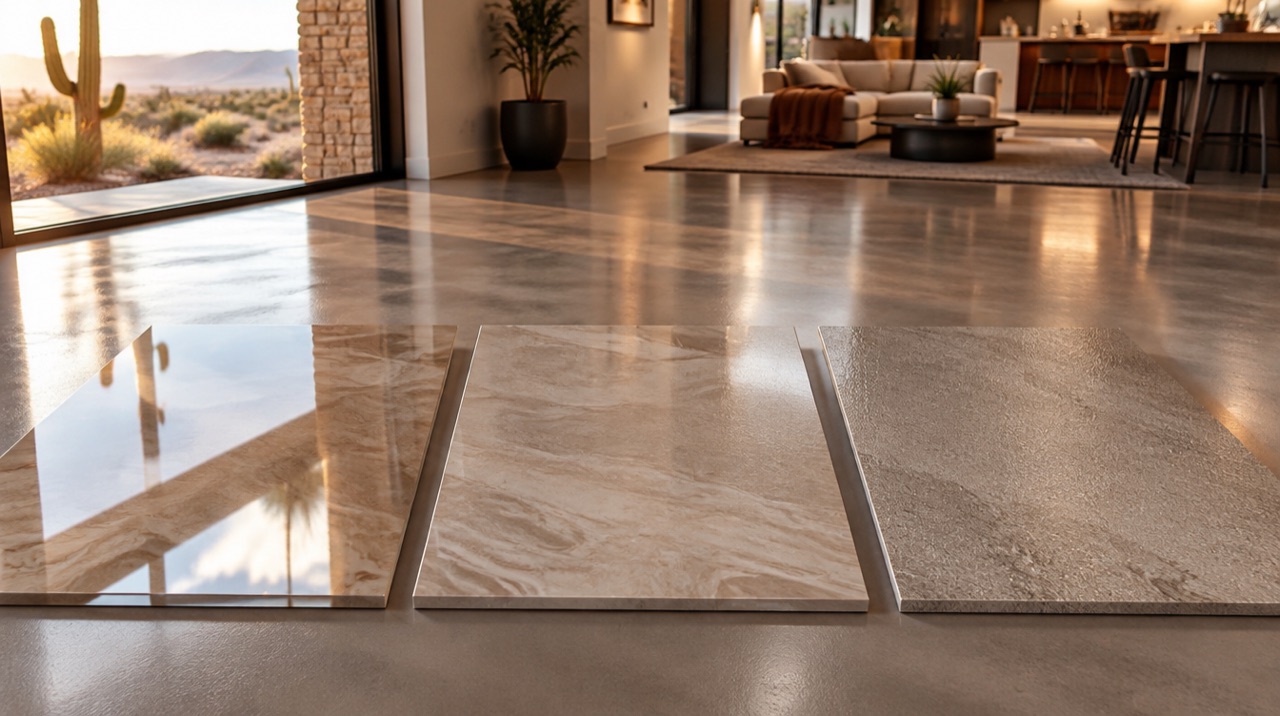
Epoxy floor finish options come down to three sheen levels: high gloss, satin and matte or textured. The sheen is set by the clear topcoat, not by the color or flake underneath, so the choice changes how a floor reflects light, how it shows dust and scratches, and how it feels underfoot. Metallic systems are the exception where the finish is part of the design, and our metallic epoxy flooring in Phoenix page covers how sheen interacts with pigment and depth. This guide treats sheen as a practical decision you make at the quote stage. For the clear layer itself, and whether a floor needs one at all, see our guide to epoxy floor sealers and topcoats.
Quick answer: Pick high gloss when appearance leads and the floor is cleaned often. Pick satin for a daily-use garage, shop or home, because it keeps some brightness without showing every footprint. Pick matte or a textured topcoat where traction or hiding scratches matters more than shine. Because the base coat and flake stay the same, the sheen can be changed later with a new topcoat.
| Finish | Typical 60 degree gloss (GU) | Shows dust and prints | Wet traction without added aggregate |
|---|---|---|---|
| High gloss | 70 to 95 | Most visible | Lowest |
| Satin | 25 to 50 | Moderate | Moderate |
| Matte | 5 to 15 | Least visible | Moderate to good |
| Textured (aggregate in topcoat) | 5 to 30 | Hides marks, collects grit | Highest |
The gloss ranges above are typical manufacturer figures for floor topcoats, and they vary by product, so ask for the data sheet of the exact topcoat on your quote.
1. What Sheen Actually Measures
Sheen is the share of light that a surface reflects straight back at the viewer, and it is measured in gloss units with a gloss meter. The method is ASTM D523, which reads specular gloss at 20, 60 or 85 degrees, and 60 degrees is the geometry most floor and coating data sheets quote.
A high gloss floor reads in the 70s to 90s at 60 degrees, a satin lands roughly between 25 and 50, and a matte sits near 15 or below. Those numbers matter because they predict what you will see on the floor. A high reading means a mirror-like surface that shows reflections of the garage door and the ceiling lights. A low reading means the light scatters, and the floor looks flat and uniform.
Sheen is a property of the topcoat surface, which is why two floors with the same base color and the same flake can look completely different. In Phoenix the effect is amplified by strong, low-angle sunlight through an open garage door or a west-facing window, because raking light exaggerates every reflection, footprint and scratch on a high gloss surface. If you are still choosing the color itself, our guide to epoxy flooring colors in Phoenix covers that decision, and this page only covers what sits on top of it.
Polished concrete is graded on a separate sheen scale that is set by grit and densifier rather than by a coating, so the numbers in this guide apply to coated floors only. If you are weighing a coating against a polished slab, the grit levels and sheen grades are explained in our guide to concrete polishing design options in Phoenix.
2. High Gloss: Light Reflectance and What It Reveals
High gloss gives the brightest, deepest-looking floor, and it also reveals the most: dust, footprints, scratches and even a slightly uneven slab. It suits spaces where appearance leads and the floor is cleaned often.
The reflectance is a real functional advantage in a dim space. A glossy floor bounces light up onto walls and cars, which can make a windowless garage or a back-of-house room look noticeably brighter without adding fixtures. That is why showrooms, display garages and some retail floors choose it. The same property works against you in a working shop. Every drag mark from a tool chest and every pale line of dust from a desert wind shows against a mirror finish.
Gloss also has the lowest wet traction of the three on a smooth film. A polished-looking surface with no aggregate can feel slick underfoot when wet, and the slip tradeoff is covered in detail in our guide on epoxy floor slip resistance and COF. One more factor is the slab itself. A glossy topcoat follows the surface beneath it, so small trowel marks, patched cracks and grind lines that a satin finish hides will show through gloss, and a good installer will tell you that before you choose it. If a glossy floor is the goal, a light dusting of fine anti-slip aggregate in the topcoat is the usual way to keep the look and add grip near doors, wash areas and any spot that gets wet.
3. Satin: The Middle Ground Most Homeowners End Up Choosing
Satin keeps a soft, even sheen that looks finished without turning every footprint into a feature. For a floor that is used daily and not cleaned daily, it is the finish most homeowners settle on.
The reason is practical. A satin topcoat diffuses light, so the floor reads as a smooth, uniform color, and fine dust, light scratches and tire marks blend into the surface instead of standing out. It still has enough reflectance that the flake or color looks rich rather than flat. In a Phoenix garage, where an open door lets in fine desert dust all year, that forgiving behavior is the main selling point. Cleaning is also easier to schedule: a satin floor stays presentable with a dust mop and an occasional damp mop, where a gloss floor in the same garage usually wants attention every few days to look its best.
Satin also behaves better than gloss on a floor that sees mixed use. It is bright enough for a home gym or a living-area floor, and it is easy to wipe clean. For a flake system, the pairing of a full-broadcast flake with a satin topcoat is common, and the flake choices are covered in epoxy garage floor colors and flake patterns in Phoenix. If you are specifying a garage, the broader system choice is laid out on our epoxy garage floor Phoenix page.
4. Matte and Textured Finishes
A matte topcoat removes almost all reflection, and a textured topcoat adds fine aggregate so the surface grips as well as looks flat. Choose either where traction or hiding wear matters more than shine.
Matte is often the right answer in a workshop, a commercial back room or a floor that will take daily abuse, because it is the most forgiving of scratches and scuffs. It does not look as rich as gloss, and heavy cleaning can burnish a matte surface in high-traffic lanes, so the sheen can drift slightly over years.
The important distinction is that a matte surface is not automatically a grippy surface. Sheen and traction are separate properties. Real slip resistance comes from aggregate, and the common benchmark is the dynamic coefficient of friction measured under ANSI A326.3. For interior wet-use hard surfaces, a value of 0.42 or higher is the figure usually cited for acceptable wet traction. A textured finish with aggregate is the dependable way to reach it, and the aggregate can be added at any sheen level.
- Light texture: A fine aggregate gives a soft, sand-like feel that is easy to mop and suits most garages and entries.
- Medium texture: A coarser aggregate for ramps, wash bays, pool decks and loading areas.
- Trade-off: More texture means more grip but slower cleaning, because grit holds dirt that a smooth surface sheds.
5. How Each Finish Hides or Shows Dust, Scratches and Tire Marks
The rule of thumb is that the higher the gloss, the more every surface flaw shows. Tire marks, dust, scratches and hot tire pickup all read differently at each sheen level.
| What lands on the floor | High gloss | Satin | Matte or textured |
|---|---|---|---|
| Fine desert dust | Shows as a visible film | Blends in | Hardly visible |
| Footprints and wet prints | Very visible | Slightly visible | Rarely visible |
| Fine scratches and scuffs | Highly visible | Moderate | Least visible |
| Tire marks | Visible, wipe off easily | Visible, wipe off easily | Can hold in texture |
| Chemical or oil spots | Easy to see and clean | Easy to clean | Harder to clean in texture |
Sheen does not change how well the floor resists hot tire pickup, because that depends on the cure and the bond of the system rather than on gloss. What changes is how obvious the marks are. Texture is the one case where a finish makes cleaning harder: grit in the surface holds oil and tire residue that a smooth topcoat would release with one pass of a mop.
For a home garage that is swept weekly, satin is the usual compromise. For a show floor that is cleaned daily, gloss earns its keep. For a floor that is worked on, matte or a light texture makes the daily wear invisible. If the floor is residential and you want to look at interior options beyond the garage, our residential epoxy flooring in Phoenix page shows where each finish tends to be used.
6. Changing the Sheen Later Without Replacing the Floor
You can change the sheen later by abrading the existing topcoat and applying a new one at the sheen you want. The base coat, flake and color underneath are not disturbed, so it is a surface-level change rather than a replacement.
The process is a light sanding or screening of the cured surface to give the new coat a mechanical bond, followed by cleaning and one coat of the new topcoat. A floor that was installed gloss and now looks too busy can be taken to satin. A floor that is too flat can be brought up to gloss. It is a fraction of the cost of recoating a whole system, and it is a reason not to agonize over the first decision.
Two cautions apply. A floor with failing bond or peeling cannot be fixed by a new topcoat, and a floor that has been treated with silicone-based polishes or sealers needs a more thorough cleaning first, because the new coat will not stick to a contaminated surface. Our guide on epoxy over tile, paint or an existing sealer explains the surface preparation any recoat over an existing coating needs.
7. Frequently Asked Questions
Get a Free Quote on Your Epoxy Floor Finish
Tell us how the floor is used and we will recommend a sheen and traction level, and quote it.