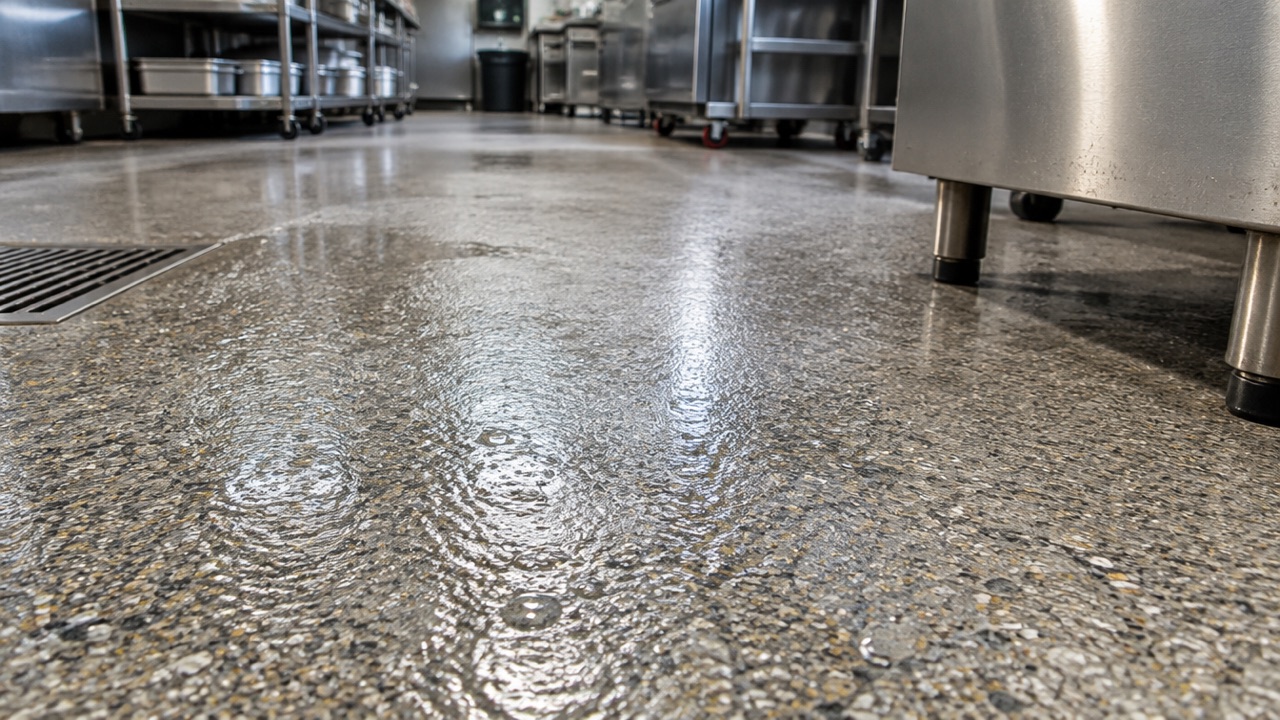
Epoxy floors can be slippery when wet, but the finish decides it: a smooth high-gloss coat is slick, and a coat with anti-slip aggregate broadcast into the topcoat grips well. For non-slip kitchen flooring in Phoenix the answer is to specify a measured friction value and a grit size matched to the room, rather than hoping the floor will be grippy enough. Our restaurant epoxy flooring service builds kitchen floors this way, and this guide explains the numbers, the additives and the tradeoffs behind it.
1. Are Epoxy Floors Slippery? The Honest Answer
A smooth, glossy epoxy floor is slippery when wet, just like polished tile, sealed concrete or glazed ceramic. The same coating with the right aggregate in the topcoat is not, and that is the version used in kitchens, garages and wet areas.
Three things make a floor slippery: a smooth surface, a contaminant such as water, oil or soap, and a shoe sole that cannot displace the film. Epoxy by itself controls only the first. A bare gloss epoxy in a garage feels fine dry and turns slick the moment a car drips snowmelt or a hose runs across it, which is why Phoenix owners are surprised by the first monsoon day.
- Smooth gloss: Looks best, cleans easily and is the slipperiest when wet.
- Light texture: A fine aggregate gives grip for most dry and occasionally wet areas.
- Heavy texture: A coarse aggregate for ramps, wash areas and anywhere falls carry a high cost.
OSHA 1910.22(a)(2) requires workroom floors to be kept clean and, as far as feasible, dry, with drainage and dry standing places provided where wet processes are used. A non-slip floor is part of meeting that duty but does not replace drainage, mats and clean-up routines.
2. Dynamic Coefficient of Friction and What the Numbers Mean
Dynamic coefficient of friction, or DCOF, is a number that describes how much grip a floor gives a moving foot when the surface is wet, and a higher number means more grip. ANSI A326.3 is the test method for hard-surface flooring, and 0.42 is the commonly cited threshold for level interior floors expected to be walked on wet.
| DCOF result | What it generally means | Typical use |
|---|---|---|
| Below 0.42 | Below the common wet-floor threshold | Dry interior areas only |
| 0.42 or higher | Meets the common level-floor wet threshold | Entries, corridors, general interior |
| Well above 0.42 | Extra margin for higher-risk areas | Commercial kitchens, wash bays, ramps |
The number belongs to a specific finished floor, so it has to be measured on a sample of the actual system rather than copied from a product brochure. Older static tests such as ASTM C1028 still appear in some specifications, but the dynamic method is the one used for wet performance today. Ask for a test result on a mockup built with your chosen aggregate and grit size.
3. Non-Slip Additives: Aluminum Oxide, Silica and Polymer Grit Compared
Three additives cover most jobs: aluminum oxide for durability, silica sand for economy and polymer grit for comfort underfoot. Each is broadcast into or mixed with the topcoat and sealed in place, and the choice comes down to wear, feel and budget.
| Additive | Durability | Feel underfoot | Best for |
|---|---|---|---|
| Aluminum oxide | Very high | Hard, sharp | Garages, industrial floors, ramps |
| Silica sand | Moderate | Medium | General use where cost matters |
| Polymer grit | Moderate | Soft, comfortable | Barefoot areas, pool decks, patios |
Aluminum oxide is very hard and keeps its edge under traffic, so it holds friction longest. Polymer grit is softer and kinder to bare feet and knees but wears faster. Silica sand is inexpensive and works well, though crews follow dust controls when handling it, since dry silica dust is a respirable hazard on a job site.
4. Matching Grit Size to the Room: Kitchen, Garage, Pool Deck and Ramp
Grit size should match the room: fine for a garage, medium for a commercial kitchen, a soft grit for pool decks and a coarse grit for ramps. Mesh numbers are a starting point, and the finished sample on your own floor sets the final choice.
| Room | Typical starting point | Priority |
|---|---|---|
| Residential garage | Fine to medium, roughly 60 to 100 mesh | Easy cleaning, grip when damp |
| Commercial kitchen | Medium, roughly 36 to 60 mesh | Wet and greasy conditions, cleanability |
| Pool deck or patio | Polymer, medium grit | Barefoot comfort, wet grip |
| Ramp or loading slope | Coarse, roughly 20 to 36 mesh | Maximum grip under load |
For kitchens, the right grit depends on how greasy and wet the floor gets, and our guides to restaurant kitchen flooring and commercial kitchen epoxy flooring cover system selection for those spaces. For garages, texture is usually added in the decorative layer, and our guide to garage floor colors, flake and patterns explains how flake choice affects feel, while our epoxy garage floor Phoenix page covers the full system.
5. The Cleanability Tradeoff of a More Aggressive Texture
More texture means more grip but also more places for soil, grease and bacteria to settle, so the right texture is the smallest one that meets your friction requirement. Maximum grit everywhere is a cleaning problem, not a safety win.
A flat mop slides over the peaks of a textured floor and leaves the valleys dirty, so textured areas need a deck brush or a scrubber with the right pad. Kitchens that run heavy grease need a daily scrubbing routine, and a coarse floor that is not scrubbed can end up with a film of grease that lowers grip below what a finer, cleaner floor would give.
- Use the finest grit that passes: Test finer grits first and move coarser only if the DCOF result needs it.
- Zone the floor: Put the coarse grit at the fryer, dish area and drains, and a finer grit in dry prep zones.
- Plan the cleaning: Specify a deck brush or scrubber and the daily routine along with the floor.
- Seal the aggregate: A fully encapsulated aggregate resists pull-out and is easier to clean than loosely bonded grit.
Texture is also a design variable on decorative floors. Stamped and patterned overlays add their own relief, covered in our guide to stamped epoxy flooring in Phoenix, and deep grout lines can hold water, so those surfaces often still need an aggregate in the topcoat.
6. Fixing a Floor That Is Already Too Slick
A slippery epoxy floor can usually be fixed without replacing it: the surface is abraded and a new topcoat carrying anti-slip aggregate is applied over the sound coating. That is a single-day job on most residential floors and avoids the cost of removing what is already bonded.
- Assess: Check that the existing coating is bonded and not peeling. A failing coating has to come off first.
- Abrade: Mechanically scuff the surface so the new topcoat can bond.
- Apply: Roll a topcoat and broadcast or mix in the chosen aggregate.
- Test: Measure a sample or the finished floor against the target value before releasing it.
Short-term measures help while you wait for the work: mats at entries and sinks, keeping the floor dry, wearing slip-resistant footwear and cleaning with a product that does not leave a soap film. Those are patches, not fixes, and the long-term answer is a measured floor with texture matched to the use. We scope each job after a walkthrough and a sample, and do not publish a single price because grit, build and prep change it.
7. How Slip Resistance Is Tested and Documented
Slip resistance is documented by measuring a finished sample or the installed floor with a portable tribometer and recording the wet DCOF result. A measured number is the only reliable way to compare two bids that both claim a non-slip finish.
- Mockup first: Build a sample panel with the exact aggregate, grit size and topcoat, and test it wet before the full floor is coated.
- Test method: Use the ANSI A326.3 procedure, which measures the dynamic coefficient of friction on a wetted surface.
- Record conditions: The result should note the contaminant, the test device and the location on the floor.
- Retest after install: A post-install reading confirms the finished floor matches the sample.
Put the target value in the specification as a minimum, and ask each bidder to state how they will prove it. A bid that cannot say how the friction will be measured is quoting a feeling rather than a result.
8. Phoenix Conditions That Affect Slip Resistance
Phoenix is dry most of the year, but the conditions that make floors slippery here are specific: monsoon rain blown into open garages, hosed-down patios, pool splash and the oil and grease of commercial kitchens. Each calls for a different texture, and a floor that suits one can fail in another.
| Condition | Where it shows up | What helps |
|---|---|---|
| Monsoon rain and runoff | Open garages, entries, patios | Fine to medium aggregate, slope to drain |
| Hose-down and washdown | Garages, wash bays, patios | Medium aggregate, brush cleaning |
| Pool splash | Pool decks, outdoor showers | Polymer grit, light colors for heat |
| Grease and oil | Kitchens, shops, garages | Medium aggregate, daily scrubbing |
Oil and grease are the harder case, because a thin film of fat lowers friction far more than clean water does and is not displaced by a shoe sole. In kitchens and shops the grit needs to be sized for greasy conditions, and the cleaning routine matters as much as the coating. A floor that is scrubbed daily with a degreasing product keeps its grip, while the same floor left to build up a film of grease can become slick no matter how coarse the aggregate is.
Heat adds a second concern outdoors. A dark, heavily textured surface in direct Phoenix sun gets very hot underfoot, so barefoot areas favor lighter colors and a softer grit. Outdoor floors also need a UV-stable topcoat so the texture and the color hold up under the sun.
9. Frequently Asked Questions
Free Non-Slip Floor Consultation
Walk your floor with our crew and get a sample with a measured grip value before you commit.