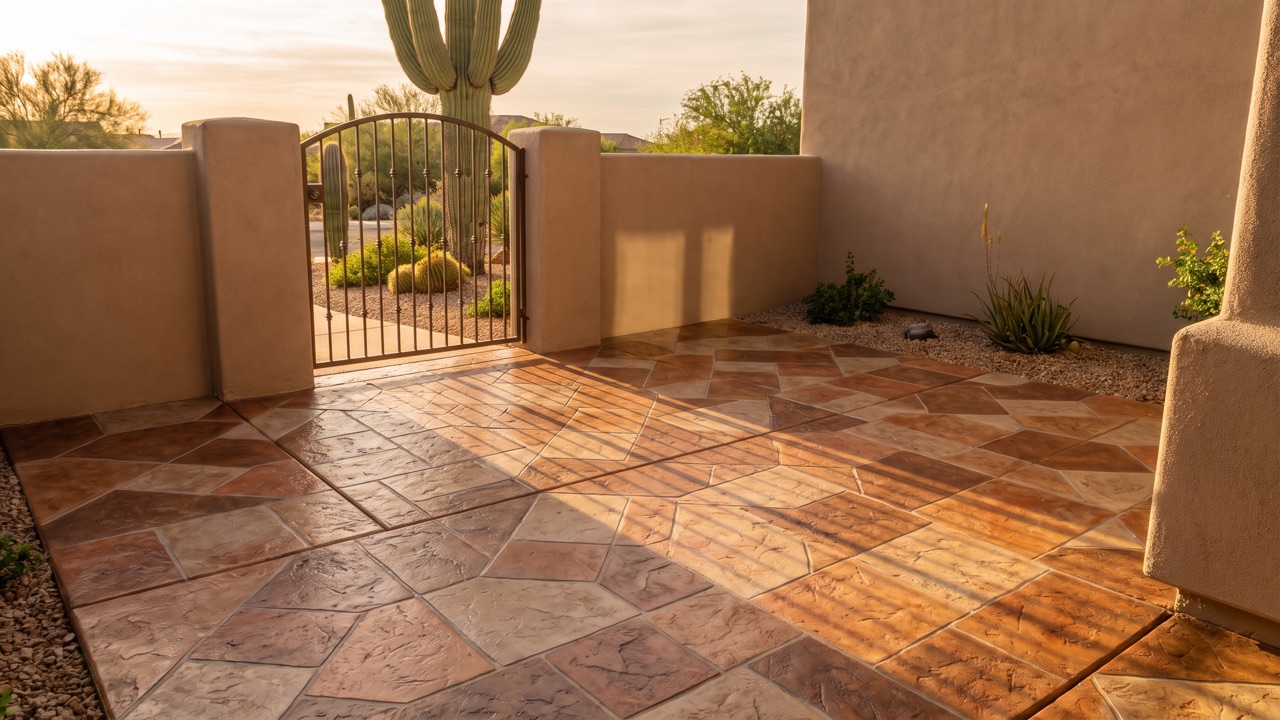
Stamped epoxy flooring is a decorative overlay applied to an existing cured slab, with pattern mats pressed into the material to give it the look of tile, stone or slate. In Phoenix it works well in garages, showrooms, entry courtyards and covered patios, and it sits between plain solid-color floors and the swirled finish of metallic epoxy flooring in both price and visual impact. This guide covers the patterns that suit desert architecture, the places where the system fails, the slip-resistance tradeoff and what to budget.
1. What Stamped Epoxy Flooring Is and How It Differs From Stamped Concrete
Stamped epoxy is a pigmented overlay that is troweled or squeegeed onto cured concrete and then textured with pattern mats while it is still workable. Stamped concrete does the opposite: the pattern goes into the slab itself while the concrete is wet, so the decision is permanent and made on pour day.
That timing difference is the reason many Phoenix owners choose the overlay. A slab that was poured plain, a garage that was finished years ago or a courtyard with a few cracks can all take a stamped epoxy overlay without demolition. The overlay is typically a few millimeters thick, so it adds pattern and color without changing door clearances or drainage slopes in any meaningful way.
| Factor | Stamped Concrete | Stamped Epoxy Overlay |
|---|---|---|
| When the pattern is set | At pour, in wet concrete | Any time, over cured slab |
| Works over existing slab | No | Yes, if sound |
| Added thickness | Full slab depth | A few millimeters |
| Color control | Integral color plus stain | Pigment in the overlay itself |
| Repair path | Patch or replace | Abrade and recoat |
Because the overlay bonds to the slab rather than becoming it, bond strength is the number that decides whether the floor lasts. ASTM D4541 pull-off adhesion testing measures that bond directly, and a reputable installer will test a patch on your slab before committing to a full pattern.
2. Pattern Options That Suit Phoenix Architecture
The patterns that suit Phoenix homes are the ones that echo the materials already around them: large-format tile, flagstone and slate. Southwestern and desert-modern homes tend to pair well with warm tans, terracotta and sand tones, while contemporary stucco-and-steel builds usually look better with cooler grays and a straight-edged geometric layout.
- Large-format tile: Square or rectangular grid with grout lines, the closest match to the stone tile found in many Arizona entries and courtyards.
- Random flagstone: Irregular shapes with varied depth. Hides small slab imperfections better than any regular grid, which is useful on older concrete.
- Slate texture: A shallower, more subtle pattern that reads as natural stone and is easier to keep clean.
- Border and field combinations: A contrasting border around a plain or lightly textured field, often used to frame an entry or define a seating area on a patio.
Color selection matters as much as the pattern. For a broader look at palettes and how they behave in Arizona light, see our guide to epoxy flooring colors in Phoenix. If you want a deeper decorative treatment that is cut into the concrete itself rather than laid over it, that is a different system covered in our stained concrete engraving and overlay guide.
3. Where Stamped Epoxy Works and Where It Fails
Stamped epoxy works best on interior and shaded surfaces over a dry, sound slab, and it fails where moisture, direct sun or heavy mechanical abuse is part of the daily load. Knowing which side of that line your project sits on is most of the decision.
| Location | Fit | Reason |
|---|---|---|
| Showroom or retail floor | Strong | Controlled light, low moisture, visual impact matters |
| Interior entry or great room | Strong | No UV exposure, easy to maintain |
| Residential garage | Good | Pattern hides tire marks, needs a durable topcoat |
| Covered patio | Good with UV topcoat | Shade reduces fading, topcoat still required |
| Open courtyard or walkway | Conditional | Needs a UV-stable topcoat and a slip additive |
| Pool deck | Poor | Constant water and heat, slab moisture and slip risk |
| Forklift aisle | Poor | Point loads and steel wheels cut a textured overlay |
Heat is the Phoenix-specific variable. Dark colors on open exterior slabs absorb a great deal of sun, and surface temperature on a dark overlay in July can be uncomfortable or unsafe for bare feet and pets. Lighter tones reflect more heat, so they are the better choice anywhere people walk barefoot outdoors. If your project is a garage rather than a courtyard, the system and prep requirements are covered on our epoxy garage floor Phoenix page.
4. How a Stamped Epoxy Overlay Is Installed
A stamped epoxy overlay goes down in four stages: surface preparation, base overlay, pattern stamping and a protective topcoat, and the prep stage decides whether the other three last. Skipping or shortening prep is the most common reason a decorative overlay peels within a few years.
- Prep: Diamond grinding opens the slab surface, cracks and spalls are repaired, and the slab is checked for moisture before anything is applied. A damp slab pushes vapor up into the overlay and lifts it from below.
- Base overlay: The pigmented material is spread to an even thickness. Working time is short in Phoenix heat, so crews usually start early and keep the pattern work moving behind the spreading crew.
- Stamping: Pattern mats are pressed into the overlay in a planned layout so seams between mats do not line up with visible grout lines. A release agent keeps the material from sticking to the mats.
- Topcoat: A clear sealer locks in color and sets the sheen. Outdoors this must be UV-stable. Indoors, a standard epoxy or polyurethane topcoat is common.
Cure time depends on the product and the weather, but most overlays are walkable the next day and take longer before they handle vehicles or furniture. Your installer should give you written return-to-service times for foot traffic, furniture and vehicles, not a single vague number.
5. Slip Resistance and Texture: The Tradeoff Nobody Mentions
Pattern texture helps grip on a dry floor, but it does not guarantee slip resistance when the surface is wet, because deep grout lines can hold a film of water and the high points of the pattern can polish smooth under traffic. The only way to know how a finished surface performs is to measure it.
The industry measure is dynamic coefficient of friction. ANSI A326.3 is the test method for hard-surface flooring, and a value of 0.42 or higher is the commonly cited threshold for level interior surfaces expected to be wet. Ask your installer whether they test finished samples or only quote the product data sheet, because the number on a data sheet describes the material, not your installed pattern.
The practical fix on any surface that will get wet, such as an entry, a covered patio or a walkway near landscaping irrigation, is to broadcast a fine aggregate into the topcoat. That adds grip without changing the look of the pattern from normal viewing distance. On pool decks and anywhere with standing water, a textured non-slip system built for wet areas is a better answer than a stamp alone.
6. What Stamped Epoxy Costs Per Square Foot in the Phoenix Metro
Stamped epoxy costs more than a plain flake or solid-color system and less than a full metallic floor, with the exact figure set by pattern complexity, color count and slab repair. We publish solid-color epoxy at $4 to $8 per square foot and metallic systems at $8 to $15 per square foot, and a stamped overlay is quoted between those two anchors once the slab has been walked.
| System | Published range | What drives price |
|---|---|---|
| Solid-color epoxy | $4 to $8 per sq ft | Slab repair, topcoat type |
| Stamped epoxy overlay | Quoted per project | Pattern, colors, repair, topcoat |
| Metallic epoxy | $8 to $15 per sq ft | Pour complexity, topcoat |
We do not publish a single stamped number because the labor swing is wide. A single-color slate pattern on a clean garage slab is a very different job from a three-color flagstone pattern with a contrasting border over a cracked courtyard. The free walkthrough ends with a firm written number for your specific slab. Homeowners comparing decorative options in higher-end neighborhoods may also want our look at luxury epoxy flooring in Scottsdale for how premium finishes are specified.
Three line items most often move a quote: crack and spall repair before the overlay goes down, the topcoat chemistry (a UV-stable polyaspartic or aliphatic urethane costs more than standard epoxy but is mandatory outdoors), and the number of pattern passes. Ask for each as a separate line so you can compare quotes fairly.
7. Maintenance and Recoating a Textured Surface
A stamped epoxy floor needs routine sweeping and a pH-neutral cleaner, and it can be refreshed with a new topcoat long before the pattern layer wears out. Textured surfaces trap more grit than flat ones, so a soft-bristle broom or dust mop does a better job than a flat mop alone.
- Weekly: Sweep or dust mop to remove grit that acts like sandpaper under foot traffic.
- Monthly: Damp mop with a neutral cleaner. Avoid acidic or solvent cleaners, which dull the topcoat.
- Every few years: Inspect high-traffic and sun-exposed areas for dulling. Most wear is in the topcoat, not the pattern.
- At recoat: The surface is abraded, cleaned and sealed with a fresh topcoat. Texture and color stay intact.
Recoating is the main advantage of keeping the wear layer separate from the pattern. If the topcoat is maintained, the pattern underneath does not need replacing. If the overlay itself is damaged, a patch can be blended in by color match, though no repair on a pigmented overlay is completely invisible in raking afternoon light.
8. Frequently Asked Questions
Free Stamped Epoxy Quote
Walk your slab with our crew and get a firm written number for the pattern you want.