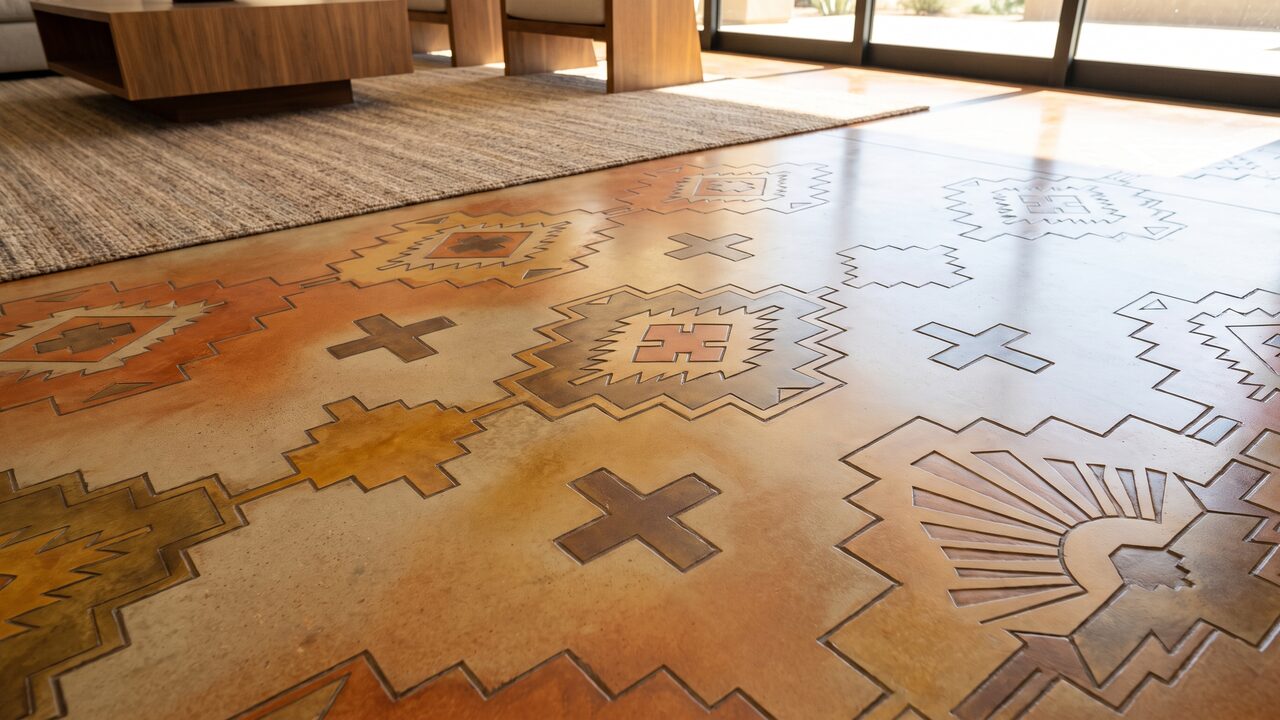
Basic acid staining is just the entry point for stained concrete floors Phoenix homeowners increasingly want more visual complexity - engraved patterns, saw-cut geometric designs, and multi-tone color zones that transform a plain slab into a genuinely custom floor. This guide covers the advanced techniques driving Phoenix's decorative concrete market.
1. Beyond Basic Stain: Advanced Decorative Concrete in Phoenix
Single-color acid staining remains popular for its affordability and natural mottled appearance, but Phoenix homeowners with larger budgets and design-forward projects increasingly want techniques that add structure and visual interest: engraved patterns that mimic natural stone, saw-cut geometric designs that create defined zones, and micro-topping overlays that provide a clean canvas when the existing slab isn't suitable for direct staining.
2. Concrete Engraving: Routed Patterns in Existing Phoenix Slabs
Concrete engraving uses a specialized rotary cutting tool guided by a template to carve decorative patterns directly into hardened concrete - without removing or replacing the existing slab. This makes it ideal for renovating an existing Phoenix patio, driveway, or interior floor that's structurally sound but visually plain.
Common engraving patterns include flagstone simulation (irregular natural-stone-look joints), running bond or herringbone brick layouts, geometric tile grids, and fully custom artistic designs. The engraved grooves are typically 1/4 to 3/8 inch deep - enough to read clearly as a design element after staining without compromising the slab's structural integrity.
3. Saw-Cut Scoring: Geometric Designs and Faux Tile Patterns
Saw-cut scoring uses a diamond blade to cut shallow, straight-line grooves into concrete - simpler and less expensive than engraving but highly effective for geometric and grid-based designs. Common Phoenix applications include faux large-format tile patterns (mimicking the look of 24"x24" porcelain tile at a fraction of the cost), border designs framing a room's perimeter, and expansion joint patterns designed intentionally rather than placed only for structural necessity.
4. Micro-Topping Overlays: Fresh Stainable Surface Over Problem Concrete
Excessive cracking, staining, or patch repairs on existing Phoenix concrete make direct acid staining look blotchy and inconsistent - a micro-topping solves this.
Thin cement-based topping trowel-applied over existing concrete, creating a fresh, uniform surface ready for stain or dye application.
Once cured, micro-toppings accept both traditional acid stain and water-based dye, opening the same design possibilities as original concrete.
5. Combining Stain Colors: Multi-Tone and Layered Phoenix Designs
Engraving and scoring aren't purely decorative - the grooves they create serve a functional purpose in multi-color designs. Once physical borders exist between zones, different acid stain or water-based dye colors can be applied to each section without bleeding into adjacent areas, since the grooves act as physical dams during application.
After staining, grooves are typically filled with a matching or intentionally contrasting epoxy color, then the entire floor is sealed as a unified surface. This layered approach - engrave, stain by zone, fill grooves, seal - is what produces the most visually sophisticated Phoenix decorative concrete floors.
6. Desert-Inspired Design Motifs Popular in Phoenix and Scottsdale
Arizona-specific design motifs have become a signature request for Phoenix and Scottsdale decorative concrete projects: saguaro cactus silhouettes, kokopelli figures, geometric Native American-inspired patterns, and mountain range silhouettes echoing the Phoenix skyline (Camelback, South Mountain, the McDowells). These custom designs are transferred to the concrete via template, then engraved and stained according to the design's color requirements.
For homeowners preferring a cleaner, less literal aesthetic, geometric Southwest-inspired patterns using diamond, chevron, or stepped-terrace motifs achieve a regional design sensibility without literal imagery. Pairs well with polished concrete floors or concrete grind and seal for the surrounding field areas.
7. Cost of Decorative Stained Concrete with Engraving in Phoenix
| Technique | Added Cost | Notes |
|---|---|---|
| Basic Acid Stain (baseline) | $2–$4/sq ft | Single color, no scoring |
| Basic Geometric Scoring | +$1–$2/sq ft | Straight lines only, grid or border patterns |
| Complex Engraved Patterns | +$3–$6/sq ft | Flagstone, brick, tile simulation |
| Custom Artistic Designs | +$8–$15/sq ft | Multi-color, custom motifs, logos |
| Micro-Topping Overlay (if needed) | +$2–$4/sq ft | Required only for damaged/inconsistent slabs |
Fully custom engraved Phoenix floors with multi-color staining typically total $12–$20 per square foot - positioning this as a premium decorative option compared to basic single-color stain, but still well below natural stone or high-end tile installation costs. For homeowners wanting design flexibility without engraving, residential epoxy systems offer comparable visual customization through color and metallic effects instead.
8. Frequently Asked Questions
Design Consultation for Decorative Concrete
Free on-site visit with pattern and color samples for your Phoenix engraved concrete project.