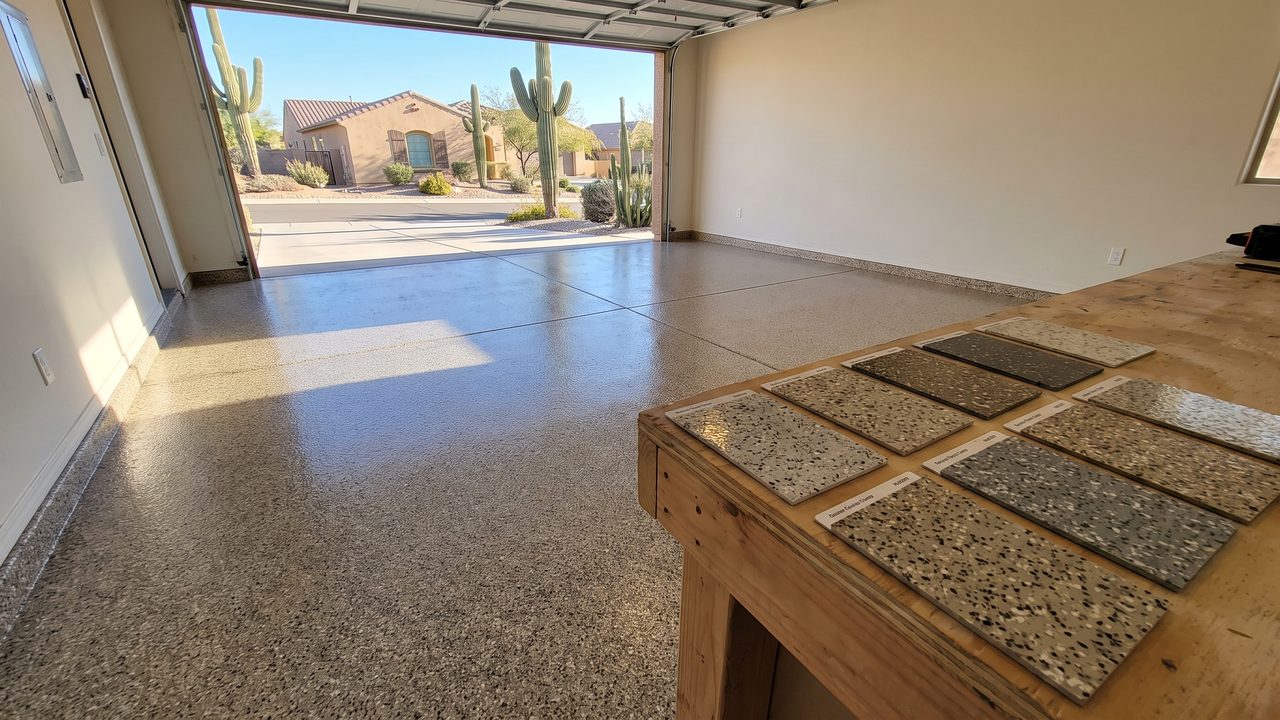
Choosing a color for an epoxy garage floor Phoenix installation is a decision homeowners often underestimate - it's easy to focus entirely on the coating system and treat color as an afterthought, right up until the sample chips are on the table and the choice actually needs to be made.
This guide walks through the color and flake pattern options Phoenix homeowners choose most often, why some options genuinely perform better in our climate than others, and how to think about matching your garage floor to the rest of your home.
Color isn't purely cosmetic here. In a desert climate with fine dust, monsoon-season grit, and daily vehicle traffic, some color and flake choices simply hide wear better than others - which means the "right" choice for a Phoenix garage isn't always the same as what looks best in a showroom sample under studio lighting.
It's also worth separating two decisions that often get blurred together: the coating system itself (epoxy, polyaspartic, or a hybrid base-and-topcoat combination) and the color/flake choice layered on top of it. Nearly any flake blend can be paired with nearly any system, so homeowners shouldn't feel locked into a color decision by whatever system a particular contractor happens to favor. Getting quotes from installers who offer a genuinely wide color range is one of the simplest ways to make sure the visual outcome matches what you actually pictured, rather than settling for whatever swatches happen to be on hand.
1. Solid Color vs. Flake System: Which Looks Better Longer
A solid color coating looks striking on day one but shows dust, tire marks, and fine scratches far more visibly over time than a flake system, which uses a blend of colored chips broadcast into the base coat to create texture and visual depth that naturally camouflages everyday wear.
This is why the overwhelming majority of Phoenix garage installations use a flake system rather than a solid color, even though solid colors cost somewhat less. The upfront savings on a solid color rarely feel worth it once a homeowner is looking at visible dust patterns and scuff marks within the first few months of daily use.
Where Solid Colors Still Make Sense
Solid colors aren't without a place - some homeowners specifically want a clean, uniform look for a showroom-style garage, workshop, or a floor that will be styled with area rugs or floor mats that cover most of the surface anyway. In those cases the extra visibility of dust and wear matters less, since the floor is rarely seen bare.
Solid colors also tend to photograph more dramatically for car enthusiasts who want a specific accent color - a deep red or navy solid floor under studio lighting for a car show or an Instagram post reads very differently than the same color under everyday garage use. Homeowners choosing this route for photographic impact should go in understanding that the tradeoff is real and simply worth it for their specific goals, rather than expecting a solid color to wear like a flake blend does.
2. Popular Flake Blends for Phoenix Homes
Gray and tan flake blends are the most requested colors for Phoenix garages, and for good reason - they closely match the tone of the fine caliche dust and desert grit that inevitably gets tracked in, making everyday dirt far less noticeable between cleanings.
| Blend | Best For | Dust Visibility |
|---|---|---|
| Gray & tan multi-tone | Most Phoenix homes | Lowest - closely matches desert dust |
| Charcoal & black | Modern, high-contrast look | Higher - shows light dust and footprints |
| Earth-tone blend | Southwest/adobe-style homes | Low - warm tones hide dirt well |
| Cool gray & white | Contemporary, bright interiors | Moderate - clean look but shows tracked-in dirt |
Homeowners who've seen a neighbor's finished garage often gravitate toward whatever blend they liked there, but it's worth remembering that lighting, home style, and even the specific brand of flake used can change how a blend actually reads once it's down. Our before and after garage transformations gallery shows a range of real Phoenix installations across different blends, which is a more reliable reference than a small sample chip.
Flake size also affects the final look more than most homeowners expect going in. Smaller, finer flake creates a subtler, more uniform texture that reads almost like natural stone from a distance, while larger flake produces a bolder, more visually busy pattern that some homeowners prefer specifically because it hides imperfections in an older or less-than-perfectly-flat slab. Installers typically carry a standard flake size, but it's worth asking specifically if you have a strong preference either way, since not every contractor stocks multiple sizes by default.
3. Why Lighter Colors Handle Desert Heat and Dust Better
Lighter flake blends handle Phoenix's heat and dust more gracefully than dark solid colors because they don't show the fine, pale caliche dust that settles constantly in our climate, and they don't visually amplify heat the way a very dark floor can feel underfoot on a hot day.
Light, multi-tone blends hide the fine dust that settles daily far better than solid dark colors.
Darker floors can feel warmer underfoot in summer, even though the coating itself insulates similarly.
Multi-tone flake breaks up tire residue far more effectively than a single flat color.
Lighter blends age more gracefully, showing less visible fading or wear pattern over years of use.
None of this means dark floors are a bad choice outright - some homeowners specifically want the dramatic look and are fine with more frequent sweeping. It's simply a tradeoff worth understanding before committing, rather than being surprised by it after the floor is already down.
4. Metallic Epoxy as a Premium Alternative
Metallic epoxy flooring is a premium alternative to standard flake systems that uses metallic pigments suspended in the coating to create a glossy, marbled, three-dimensional effect - no two metallic floors look exactly alike, since the pigment movement during application is partly organic.
This option costs meaningfully more than a standard flake blend, both in material and in the additional installer skill required to achieve a good result, but it delivers a genuinely different look that many homeowners feel is worth the premium for a garage that doubles as a showcase space, a car enthusiast's showroom garage, or an entertaining area. Our epoxy flake flooring guide covers the standard flake option in more depth for homeowners weighing the cost difference directly.
Metallic epoxy also tends to hide the day-to-day dust and wear that shows up on a standard color even better than a flake blend does, since the swirling metallic pattern already reads as visually complex before anything gets tracked in. The tradeoff is that touch-ups or future repairs to a metallic floor are noticeably harder to blend seamlessly than a repair on a standard flake system, since reproducing the exact pigment movement of the original application isn't something even the original installer can guarantee perfectly on a patch years later.
5. Matching Your Garage Floor to Your Home's Exterior
Matching a garage floor color to your home's exterior palette isn't strictly necessary, but many Phoenix homeowners find it creates a more cohesive look, especially in homes where the garage is visible from the street with the door open often.
- Adobe and Southwest-style homes: Earth-tone flake blends complement warm stucco and tile roof colors well.
- Modern desert contemporary homes: Cool gray or charcoal blends tend to match clean, minimalist exteriors.
- Traditional stucco homes: A neutral gray-and-tan blend works with almost any exterior color scheme without clashing.
- Homes planning to sell: Neutral blends have the broadest buyer appeal and avoid any risk of a bold choice working against resale.
For homeowners extending the same flooring approach beyond the garage - into a workshop, mudroom, or other adjoining space - our residential epoxy flooring page covers color and system considerations for those additional areas, since matching flake blends across connected spaces creates a more seamless transition than treating each room as a separate decision.
Seeing Samples in Your Own Lighting
One detail that trips up a lot of homeowners: a flake sample that looks perfect under a showroom's bright, even lighting can read noticeably differently under a garage's natural light, especially one with a north-facing door or heavy shade from neighboring structures. Whenever possible, ask to see full-size sample boards in natural daylight, or even inside your own garage, before finalizing a blend - a color choice made purely from a small chip under artificial light is one of the more common sources of buyer's remorse we hear about after the fact.
It's also worth thinking about how a chosen blend will look years down the road rather than just on installation day. A well-chosen multi-tone blend tends to age gracefully, since minor scuffs and tire marks blend into the existing pattern rather than standing out starkly the way they would against a single flat color. Homeowners who plan to stay in their home long-term often lean toward this kind of "forgiving" blend specifically because it keeps looking presentable with normal use and less frequent deep cleaning.
A Common Decision Paralysis Moment
We regularly work with homeowners who genuinely can't decide between two or three blends they like equally, and there's a simple tie-breaker worth applying in that situation: pick whichever option best hides the specific mess your household actually generates. A family with kids who ride bikes through the garage and a household that mostly parks two clean daily-driver sedans have different practical needs even if both like the same blends equally on looks alone. Thinking about your garage's real daily traffic, not just its appearance in photos, tends to produce a choice you're happier with years later.
Finally, don't discount how a color choice interacts with your chosen topcoat's gloss level. A high-gloss polyaspartic floor coating topcoat makes any flake blend look richer and more dimensional than the same blend under a lower-sheen finish, since the reflective surface amplifies the color variation in the flake itself. If a specific blend looked flat or underwhelming in a sample you saw, ask whether it was finished with the same gloss level you're planning to use - the difference is often significant enough to change a homeowner's mind entirely.
6. Frequently Asked Questions
See Real Color Samples for Your Garage
Book a free consultation and view flake blends in person before you decide.