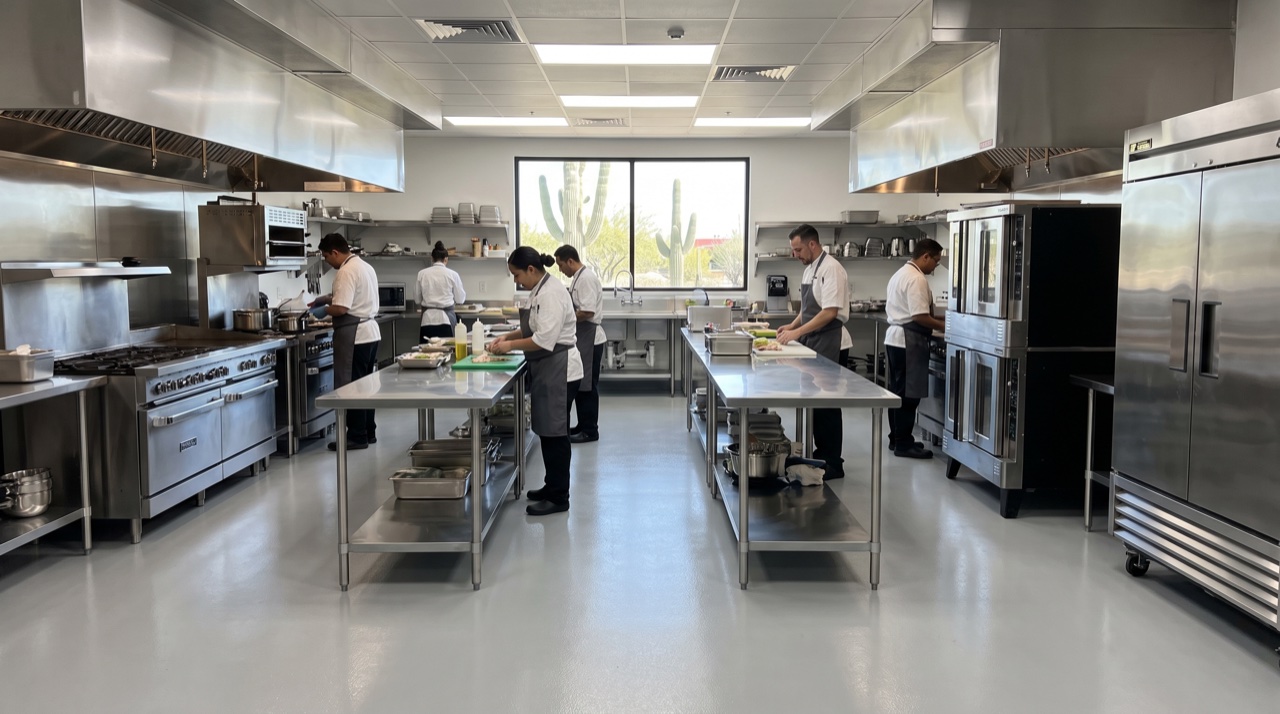
Commercial kitchen floors in Phoenix must satisfy Maricopa County Environmental Services (MCESD) health code: smooth, non-absorbent, easily cleanable, and free of cracks where food debris accumulates. Bare concrete fails. Standard household epoxy fails. NSF-certified epoxy and urethane cement are the two systems that pass - and choosing the right one for your use case matters more than most owners realize.
What Health Inspectors Look For
MCESD inspectors evaluate kitchen floors on four criteria. All four must pass - partial compliance results in a citation:
Smooth & Non-Absorbent
Floor must not absorb grease, water, or food. Sealed concrete is borderline - a coating system with NSF certification is the clear path to passing.
Easily Cleanable
Seamless surface with no grout lines, joints, or gaps. Tile (even sealed tile) fails on grout lines. Coated concrete surfaces pass when integral coving is installed at wall bases.
Integral Coving
Curved transition at wall-floor junction (minimum 4 inch height, 3/8 inch radius). Eliminates 90-degree corners where grease accumulates. Must be part of the coating system - not caulk or metal trim.
Slip Resistant
Wet kitchen floors must meet OSHA friction coefficient minimums. Aggregate broadcast into the topcoat or anti-slip texture built into urethane cement provides compliant traction.
Beyond these four, health inspectors also flag cracked, chipped, or peeling coatings. A coating system that meets code on day one but peels by year three creates ongoing violation risk. System durability matters as much as initial compliance.
NSF Certification Explained
NSF International (formerly National Sanitation Foundation) certifies materials for food-adjacent use. NSF/ANSI 169 covers special purpose food equipment and materials including floor coatings. An NSF-certified floor coating means:
- The formulation has been tested and verified to not leach harmful chemicals into food contact surfaces
- The cured coating resists food acids, animal fats, caustic cleaning chemicals, and sanitizing agents
- Documentation is available for health inspector review upon request
Not all commercial epoxy is NSF-certified. When getting quotes, ask specifically: "Is your epoxy system NSF/ANSI 169 certified?" and request the certification document. An installer who can't produce it is using an unverified product.
Epoxy vs Urethane Cement for Phoenix Kitchens
Both systems can achieve NSF compliance - but they excel in different environments:
| Factor | NSF Epoxy | Urethane Cement |
|---|---|---|
| Thermal Shock Resistance | Limited (steam can delaminate) | Excellent (rated to 250°F+) |
| Chemical Resistance | Good (most kitchen chemicals) | Excellent (lactic acid, caustic cleaners) |
| Bond to Damp Concrete | Needs dry slab (MVT test required) | Bonds to damp or green concrete |
| Installation Odor | Moderate (amines) | Low (water-based formulations) |
| Cure Time to Service | 16–24 hours | 12–16 hours |
| Surface Texture | Smooth to aggregate | Built-in texture (standard) |
| Cost (installed) | $6–$10/sqft | $8–$14/sqft |
| Best For | Prep areas, cooler thresholds, bars, dining | Hot line, dishwash, fryer areas, breweries |
The Thermal Shock Problem
The most common reason commercial kitchen epoxy fails in Phoenix restaurants is thermal shock - not the Arizona heat, but the temperature differential from steam cleaning. When a steam wand hits an epoxy floor, the surface goes from ambient temperature (75–85°F in a running kitchen) to 160–180°F in seconds. Standard epoxy has a coefficient of thermal expansion that can't handle this cycling. Over time: micro-cracks form, moisture infiltrates, and sections begin to delaminate.
Urethane cement's cross-linked polymer structure handles this cycling without cracking. If your kitchen uses steam cleaning - which most MCESD-compliant operations do - urethane cement on the hot line is not optional.
Where Each System Belongs in a Restaurant
Most Phoenix restaurants use a hybrid approach: urethane cement in the highest-stress zones, NSF epoxy elsewhere:
- Urethane cement: Hot line (fryers, ranges, griddles), dishwashing area, walk-in cooler floors, meat prep areas
- NSF epoxy: Dry prep areas, expo line, wait station, bar floor, walk-in cooler thresholds
- Standard commercial epoxy: Dining room, bar service area, storage rooms
- Polished concrete: Front-of-house seating areas for aesthetics (never in kitchen production)
Installation Scheduling for Open Restaurants
Most Phoenix restaurants cannot close for 3 consecutive days. ProEpoxy schedules commercial kitchen work in overnight shifts to minimize disruption:
Night 1 - Surface Preparation (8 PM – 4 AM)
Diamond grinding, crack repair, integral coving installation. Floor is accessible again for prep by 5 AM. No coating on floor yet - kitchen can operate normally during the day.
Night 2 - Primer and Base Coat (9 PM – 5 AM)
Primer applied after last service and kitchen cool-down. Base coat follows 2–4 hours after primer cure. Floor off-limits for use until topcoat night - kitchens that need to run can section off and work around.
Night 3 - Topcoat and Aggregate (10 PM – 5 AM)
Anti-slip aggregate broadcast into topcoat. Ready for foot traffic in 12 hours - kitchen fully operational by next evening service. Equipment returned morning of Day 4.
For Roosevelt Row, Scottsdale Old Town, and Tempe Mill Ave restaurants with late service until 2 AM, we adapt the schedule - work begins at 3 AM with a tighter window. Contact us to discuss your specific service hours.
Grease Trap and Floor Drain Considerations
Phoenix commercial kitchens are required to have accessible floor drains properly sloped for drainage. When applying floor coatings:
- Drain covers must be removed during coating application and reinstalled after cure. Coating over drains is a health code violation and blocks required cleaning access.
- Slope must be maintained - coating application can slightly reduce effective drain slope if not done correctly. ProEpoxy measures pre- and post-installation slope.
- Grease trap access: Coating must terminate cleanly at grease trap access points, not be applied over the cover.
- Integral coving at floor drains: Not required at floor penetrations, but the coating must transition smoothly without lip or edge that catches debris.
Cost for Phoenix Restaurant Kitchen Floors
| Kitchen Size | NSF Epoxy | Urethane Cement |
|---|---|---|
| Small kitchen (200–400 sqft) | $1,200 – $4,000 | $1,600 – $5,600 |
| Medium kitchen (400–800 sqft) | $2,400 – $8,000 | $3,200 – $11,200 |
| Large kitchen (800–1,500 sqft) | $4,800 – $15,000 | $6,400 – $21,000 |
| Per square foot range | $6 – $10/sqft | $8 – $14/sqft |
All pricing includes preparation, integral coving, anti-slip aggregate, NSF documentation, and overnight scheduling. Phoenix restaurants on the Roosevelt Row, Scottsdale Old Town, Tempe Mill Ave, and Chandler Downtown corridors receive priority scheduling given our density of work in those areas.
Frequently Asked Questions
Get a Commercial Kitchen Floor Quote for Your Phoenix Restaurant
Roosevelt Row, Scottsdale Old Town, Tempe Mill Ave, Chandler Downtown, and across Maricopa County. NSF compliance documentation provided. Overnight scheduling available.
Get My Free Quote(888) 275-7078