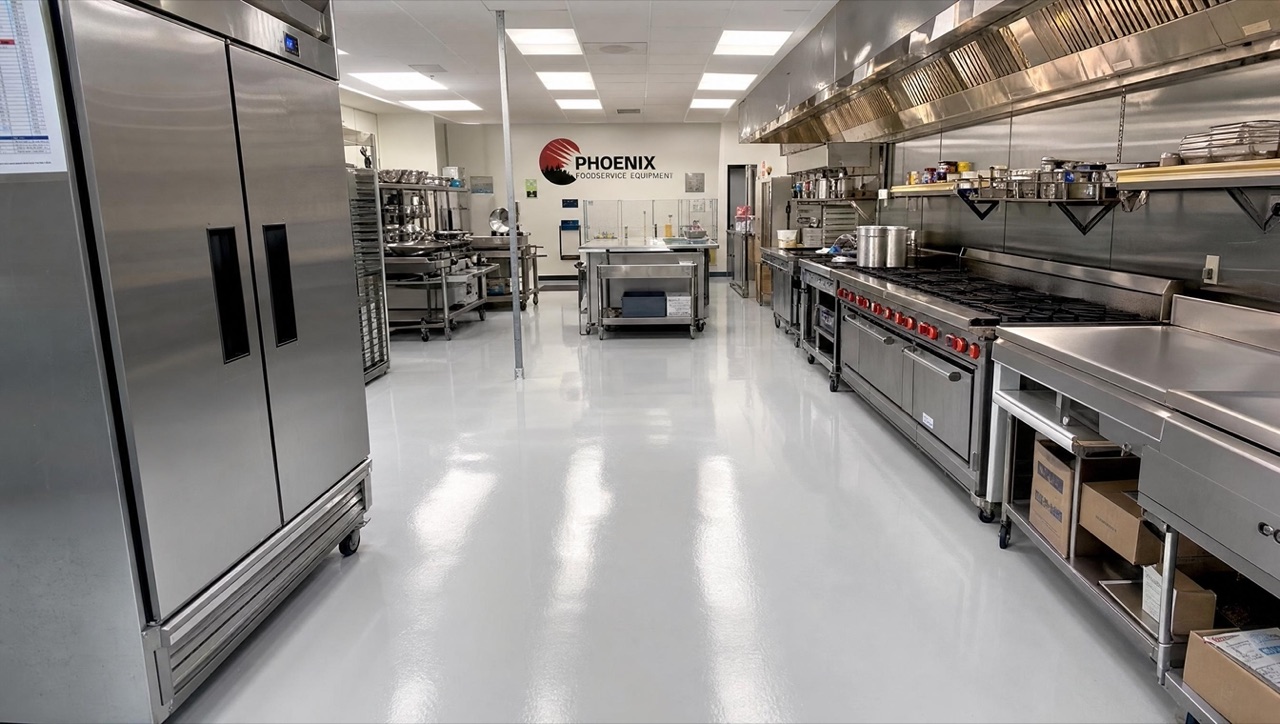
No commercial surface in Phoenix takes more abuse than a working kitchen floor - 400°F fryer splatter, 40°F walk-in transitions, steam table condensation, grease, sanitizer chemicals, and a dinner-rush crew moving hotel pans at a jog. Standard commercial epoxy was never engineered for this. Grease penetrates unsealed grout lines and delaminates weak coatings within months, and thermal shock from a dropped stockpot or hot water flush can crack a mismatched system outright. In Maricopa County, a failing floor is a health department violation waiting to happen.
ProEpoxy installs food-service flooring across metro Phoenix - from independent taquerias to multi-unit restaurant groups, including kitchens along the Roosevelt Row arts and dining corridor downtown, where older tenant-improvement spaces often inherit flooring never rated for full-service cooking loads.
Health Department Requirements in Phoenix / Maricopa County
Maricopa County Environmental Services (MCESD) follows the FDA Food Code standard for food prep area finishes. Inspectors cite four requirements on every walk:
- Smooth, durable, easily cleanable surfaces - no bare, sealed, or painted concrete
- Coved base at all floor-wall junctions
- Non-absorbent, seamless flooring in walk-ins, dish pits, and cook lines
- Proper slope to floor drains
Cracked, pitted, or bare concrete - or failing quarry tile and grout - is one of the most common physical-facility citations MCESD issues. An NSF-recognized, fully coved epoxy or urethane cement system checks every box in one installation. Our commercial epoxy flooring systems are built to this food-service spec.
MCESD tip: Grout lines in old quarry tile are the most common physical-facility citation source we see downtown. A seamless epoxy or urethane cement system eliminates them entirely and is far easier to keep compliant through a re-inspection.
Epoxy vs Urethane Cement for Commercial Kitchens
Both systems are NSF-recognized and code-compliant. The choice comes down to what your kitchen actually does to the floor.
Epoxy Systems
- Strong chemical resistance to sanitizers and degreasers
- Good impact resistance
- Lower installed cost
- Best fit: dry storage, dish rooms with moderate exposure, prep areas without extreme temperature swings
Urethane Cement
- Thermal shock resistance - flexes under rapid swings (200°F steam spill near a cooler door)
- Superior grease and acid resistance under heavy fryer volume
- Moisture vapor tolerant - critical in older downtown Phoenix buildings
- Best fit: cook lines, dish pits, full-service high-volume kitchens
See our urethane cement flooring page for full system specs. Many clients spec urethane cement on the cook line and dish pit, and standard epoxy elsewhere - the hybrid approach balances performance against cost.
Slip Resistance Requirements and Solutions
Slip-and-fall is the most common liability claim in commercial kitchens. The practical industry benchmark is a wet DCOF of 0.42+ in wet-process areas per ANSI A326.3. We calibrate aggregate by zone:
Installation Timing: Overnight, Weekend, Minimal Downtime
Arizona's heat accelerates cure times, making overnight turnarounds more realistic here than in cooler climates. Our standard options:
Overnight Install
Single zone - one cook line, walk-in, or dish pit - especially with fast-cure urethane cement. Kitchen closed after dinner service, floor operational by morning prep.
Weekend Shutdown
Full kitchen re-floors. Friday close to Monday open covers full prep, application, and cure on a standard system.
Phased Sectioning
For kitchens that can't fully close - including higher-volume Roosevelt Row locations - we section the floor and work zone by zone across multiple nights.
Cost for Phoenix Commercial Kitchens
Includes cove base. Best for prep areas, dry storage, dish rooms with moderate exposure.
Full thermal shock and grease resistance. Required for heavy cook lines and high-volume fryer areas.
A typical 1,500 sq ft Phoenix kitchen runs approximately $12,000 (epoxy) to $25,000+ (full urethane cement), with hybrid approaches often in between. We provide fixed quotes based on slab assessment - no surprise overages. Contact ProEpoxy for a free on-site walkthrough.