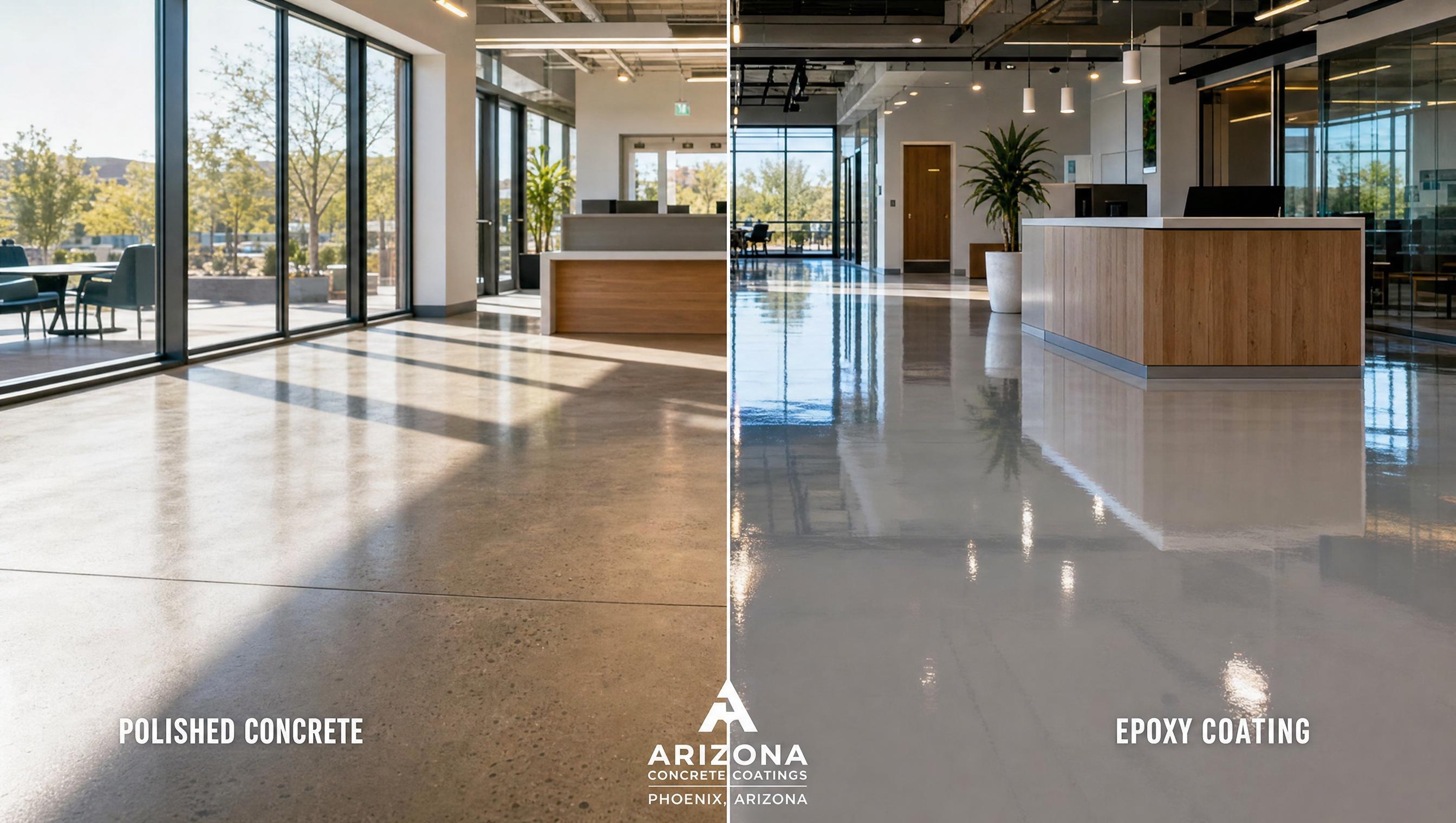
Two of the most searched flooring questions we get from Phoenix homeowners, property managers, and restaurant operators come down to the same fundamental decision: grind and polish the existing slab, or coat it with epoxy? Both result in a durable, good-looking floor. Both are better than bare concrete. But they are not interchangeable - and getting this wrong costs you a full re-floor in five years.
We've installed polished concrete and epoxy coatings across metro Phoenix for years - garages in Scottsdale, warehouses along the I-10 corridor, restaurant kitchens in downtown, retail spaces in Chandler. Here's the honest contractor's comparison.
How Each System Works
Polished concrete is a mechanical process - diamond tooling progressively refines the concrete surface itself. No coating, no film to peel. The slab is densified with a chemical hardener, then ground and polished to the specified sheen (from matte at 400 grit to mirror at 3,000 grit). The floor that results IS the slab - just mechanically refined and hardened.
Epoxy flooring is a coating applied over the slab. A primer bonds to concrete, a body coat is applied (with aggregate, color chips, or broadcast media for texture), and a topcoat seals the surface. Total system thickness typically ranges 20–40 mils for a standard residential/commercial system, and much thicker for heavy-duty mortar systems. The slab stays as-is; the coating provides the working surface.
Arizona factor: Phoenix concrete slabs often have higher moisture vapor emission rates (MVER) than national averages - especially in older builds with no vapor barrier. Polished concrete handles moisture vapor natively; epoxy coatings that aren't vapor-tolerant will delaminate. Always test and specify accordingly.
Head-to-Head Comparison
Cost Comparison - Phoenix 2026
Lower cost per sq ft on large, sound slabs. Cost rises with crack/spall repair, cream vs salt-and-pepper vs aggregate exposure levels.
Wider range - basic garage flake at the low end, heavy-duty mortar or metallic system at the high end. Smaller areas cost more per sq ft.
Polished concrete is often cheaper on large warehouse or retail floors (3,000+ sq ft) where grinding efficiency scales. Epoxy tends to be more cost-effective for smaller residential garages, spaces needing significant cosmetic improvement, or surfaces with concrete that can't be polished to spec without extensive repair.
Arizona-Specific Considerations
Phoenix conditions create a few unique variables not covered in generic national comparisons:
- UV intensity: Standard epoxy yellows rapidly under Phoenix UV - especially in garage interiors with direct sun exposure through the door. Aliphatic polyurethane or polyaspartic topcoats are non-negotiable for UV-exposed areas.
- Thermal cycling: Slab surface temps swing 30–50°F between night and noon in summer. Coatings with CTE close to concrete (polyurea, polyaspartic) handle this better than thick epoxy films.
- Low humidity aids polishing: Arizona's low ambient humidity is actually favorable for concrete polishing - MVE rates are more manageable than in coastal climates, and resin systems cure faster.
- Caliche sub-base: Some older Phoenix metro slabs have caliche intrusion that creates soft spots. A slab assessment before either system is installed identifies problem zones before they become failures.
Which to Choose by Use Case
Warehouse / Distribution
No coating to delaminate under forklift point loads. Densifier + polished surface handles heavy traffic without peeling risk.
Residential Garage
Color options, chip systems, UV-stable polyaspartic topcoat. Handles oil drips and hot tire pickup better than uncoated concrete.
Retail / Showroom
High-end aesthetic at lower lifetime cost. Easy to clean, no topcoat to scuff, refinishable with a light re-polish.
Commercial Kitchen
Chemical resistance, coved base capability, health-code compliance, zone-calibrated slip resistance. Polished concrete can't match kitchen chemical load.
Office / Light Commercial
Modern look, low maintenance, no recoat cycle. Stain guard for porous areas is the only recurring treatment.
Auto Shop / Manufacturing
Chemical resistance to oils, brake fluids, and solvents. Epoxy mortar handles heavy equipment impact. Polished concrete would absorb oil over time.