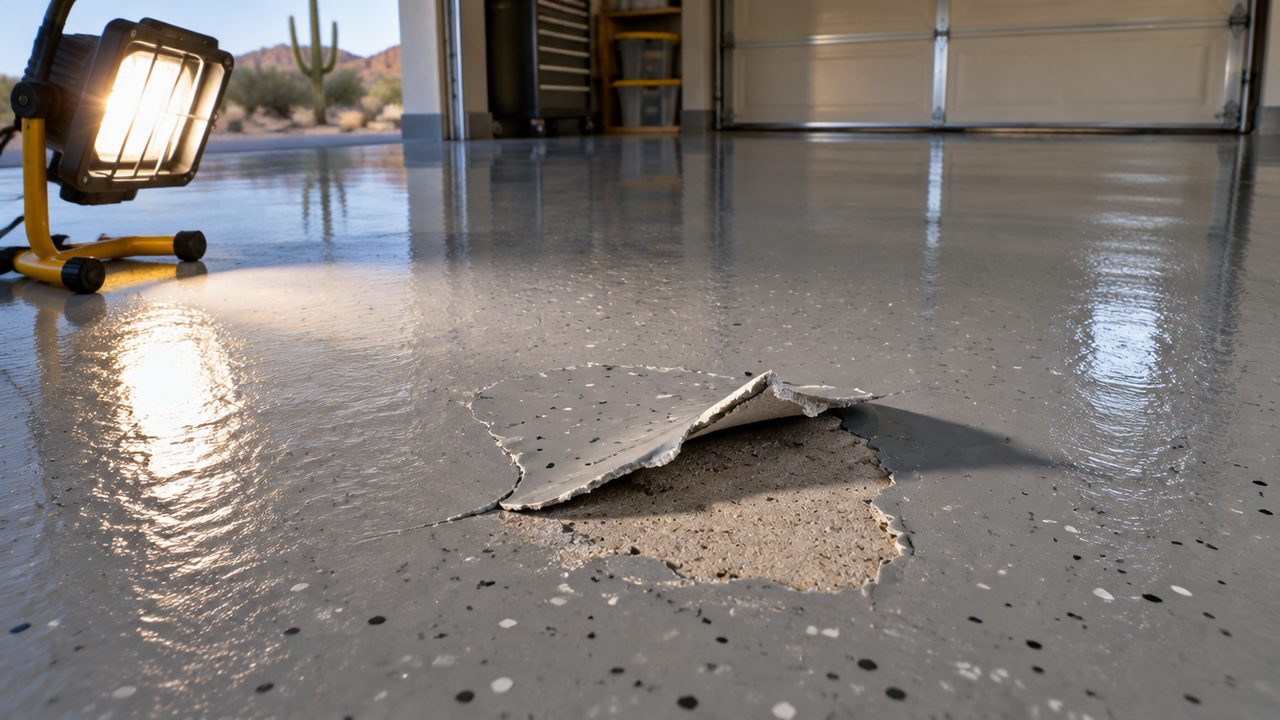
Common epoxy floor problems almost always start with the same few causes: poor surface preparation, moisture in the slab, the wrong topcoat for the use or a floor driven on too early. This guide is a diagnostic index for Phoenix owners who can see something wrong with a floor and are not sure what it is. It matches each symptom to its likely cause, points to the full guide on that problem and says whether the fix belongs at quote stage or after the fact. If your floor has already failed, our epoxy floor repair in Phoenix service explains how damaged coatings are assessed and fixed.
Quick answer: the most common epoxy floor problem is adhesion failure, meaning peeling, lifting or delamination, and it nearly always traces back to a slab that was acid etched or only cleaned instead of mechanically ground. The next most common are bubbling from slab moisture, yellowing from UV, a rough surface from application errors and hot tire pickup. Most of these are preventable if three things happen before the coating goes on: grinding, a documented moisture test and a topcoat chosen for the use.
1. A Symptom to Cause Index for Epoxy Floor Problems
The fastest way to diagnose a floor is to start from what you see, because each defect has a small set of usual causes. Use this table to find your symptom, then follow the link to the full guide for that problem.
| What you see | Likely cause | Full guide | Prevent at quote stage? |
|---|---|---|---|
| Peeling, lifting or sheets coming away | Weak bond from poor prep | Delamination and recoat | Yes: grinding and a profile spec |
| Bubbles, blisters or pinholes | Slab moisture vapor or released air | Bubbling and peeling | Yes: moisture test first |
| Marks or lifting where tires park | Hot tire pickup on a soft or poorly bonded topcoat | Hot tire peeling | Yes: topcoat choice and cure |
| Rough or sandy feel | Too much aggregate, thin topcoat or contamination | Rough, sandy texture | Mostly: specify finish and coats |
| Cracks at lines in the slab | Coating bridging control joints | Control joints | Yes: joint treatment in the scope |
| Yellow cast in sunlit areas | UV on aromatic epoxy | Topcoat guide below | Yes: UV-stable topcoat |
| Dull lanes where people walk or drive | Normal wear on a lighter system | Repair and recoat section below | Partly: system thickness |
These pages each go deeper on one defect, so this article stays at the summary level. The sections below group the problems by type so you can see how the causes connect.
2. Adhesion Failures: Peeling, Lifting and Delamination
Adhesion failure happens when the coating loses its grip on the concrete, and the usual reason is that the surface was never prepared to hold it. This is the single most common cause of failed floors, and it is the most preventable.
Concrete has a weak, dusty surface layer and a sealed top that coatings cannot bond to. Mechanical grinding removes both and opens the pores, leaving a rough profile that the epoxy locks into. The industry describes that profile using the ICRI concrete surface profile scale in ICRI 310.2R. Acid etching and simple cleaning leave a much shallower, less even surface, and a floor coated over them may look fine for a season before sheets begin to lift.
You can confirm bond strength with a pull-off adhesion test under ASTM D4541, which measures the force needed to detach the coating. Our guide to epoxy floor delamination and recoating in Phoenix covers how failed areas are removed and rebuilt.
3. Moisture Failures: Blistering, Bubbling and Osmotic Pressure
Moisture failures happen when water vapor moves up through the slab and builds pressure under the coating, causing blisters, bubbles or white spots. Phoenix is dry, but slabs can still carry moisture from irrigation, plumbing, a high water table in some areas or the concrete itself.
Two standard tests measure it. ASTM F1869 uses calcium chloride to measure moisture vapor emission from the surface, and ASTM F2170 uses probes to measure relative humidity inside the slab. A test result before the quote is finalized tells the installer whether a moisture-mitigating primer is needed. Bubbles can also come from air released by the concrete as it warms during cure, which is why timing matters in Phoenix heat. We cover the diagnosis in why epoxy floors bubble and peel in Phoenix and the testing in concrete slab moisture testing.
4. Appearance Failures: Ambering, Roughness and Lap Marks
Appearance failures are cosmetic rather than structural, but they are the ones owners notice first. They include yellowing, a rough or sandy surface and visible lines where one section of coating overlapped another.
- Ambering: standard epoxy is aromatic, and ultraviolet light slowly turns it yellow, especially near garage doors and windows. Phoenix sun makes this faster than in many cities. A UV-stable aliphatic or polyaspartic topcoat prevents it.
- Roughness: a sandy feel can come from too much aggregate, an overly thin topcoat or dust and debris trapped in the coating. We cover it in why an epoxy floor feels rough or sandy.
- Lap marks: visible lines appear when the coating begins to set before the next pass is applied. In Phoenix summers this is a real risk, so crews work in sections and at cooler times of day.
- Cracks along slab lines: a coating that bridges a control joint can crack as the slab moves. Joints should be honored or filled with a flexible material, as explained in epoxy floor control joints.
5. Traffic Failures: Hot Tire Pickup and Wear Lanes
Traffic failures are caused by use, and in Phoenix the biggest one is hot tire pickup, where a hot tire softens the coating and pulls it up as it cools. Summer slab and tire temperatures make this a common complaint for garages.
It is linked to the topcoat type, the cure and how soon the floor is driven on, so it can be prevented. Hard, heat-resistant topcoats resist it better, and respecting the return-to-service time before parking matters. Our guide to hot tire peeling on a Phoenix epoxy garage floor explains the mechanism and the fixes. For a new floor, an epoxy garage floor in Phoenix installed with a heat-rated topcoat is the best protection.
Wear lanes are a different issue. Paths where people walk or vehicles drive dull first, and a thin system wears faster than a thick one. That is normal aging, not a defect, but a thicker build and a harder topcoat slow it down.
6. Why Phoenix Conditions Change the Risk
Phoenix conditions raise the risk of several of these problems, because heat, sun and fast-drying air affect how a coating cures and how it ages. A floor that is fine in a mild climate can fail here if the installer does not plan for the weather.
Summer temperatures in Phoenix regularly exceed 100 degrees, and concrete surfaces get hotter than the air. Heat speeds the cure of epoxy, which shortens the working time and can cause lap marks, trapped air and bubbles if the crew works too slowly. Warm slabs also release air as they heat during the day, which is a common source of pinholes. Experienced installers schedule coating at cooler times, work in smaller sections and sometimes cool the slab or the work area.
Sun is the second factor. Garages with west-facing doors and commercial spaces with glass see strong ultraviolet exposure, so a standard aromatic epoxy will amber faster than in a shaded space. Specifying a UV-stable topcoat is a small cost compared with replacing a yellowed floor. Finally, the monsoon season brings humidity spikes that can affect curing and surface moisture, which is another reason to test and to avoid coating when conditions are unsuitable.
The takeaway is simple: ask an installer how they plan for Phoenix heat and sun. A clear answer about timing, sectioning and topcoat chemistry usually signals a contractor who has seen these failures and knows how to avoid them.
7. Which Problems Are Preventable at Quote Stage
Most epoxy floor problems are preventable if the quote includes the right preparation, testing and specification, and they are the problems that appear in the table with a yes in the last column. The quote is where you win or lose a floor.
- Grinding to a stated profile. Ask that the quote names mechanical grinding and the target profile, not acid etching.
- A documented moisture test. Ask for an ASTM F1869 or F2170 result before the quote is final, and a plan if readings are high.
- Joint and crack treatment. Ask how control joints and cracks will be handled.
- A topcoat chosen for the use. UV-stable for sun, heat-rated for garages, harder for traffic.
- Return-to-service times in writing. Do not drive on the floor until the stated cure time has passed.
If you are comparing bids, our epoxy flooring quote comparison guide shows how to check these items line by line.
8. When to Repair, When to Recoat and When to Replace
The right fix depends on the type of failure: surface problems are usually repaired or recoated, while adhesion and moisture failures usually need the affected area removed down to the slab and the cause fixed first.
| Problem type | Typical fix | Why |
|---|---|---|
| Roughness, dull gloss, light wear | Abrade and recoat | The bond is sound, only the surface is worn |
| Local damage, chips or small lifted spots | Spot repair | Remove the failed area and patch |
| Widespread peeling or delamination | Remove and recoat to the slab | The bond has failed, so the cause must be fixed |
| Moisture blistering | Remove, mitigate, recoat | The coating will fail again unless moisture is addressed |
In every case, find the cause before choosing the fix. Recoating over an unresolved moisture or prep problem is the most common reason a repair fails a second time. For an assessment of a floor you already have, request a free quote and we will look at the slab and explain what is wrong.
9. Frequently Asked Questions
Get a Free Epoxy Floor Assessment
We look at the slab, test for moisture and tell you whether your floor needs a repair, a recoat or a replacement.