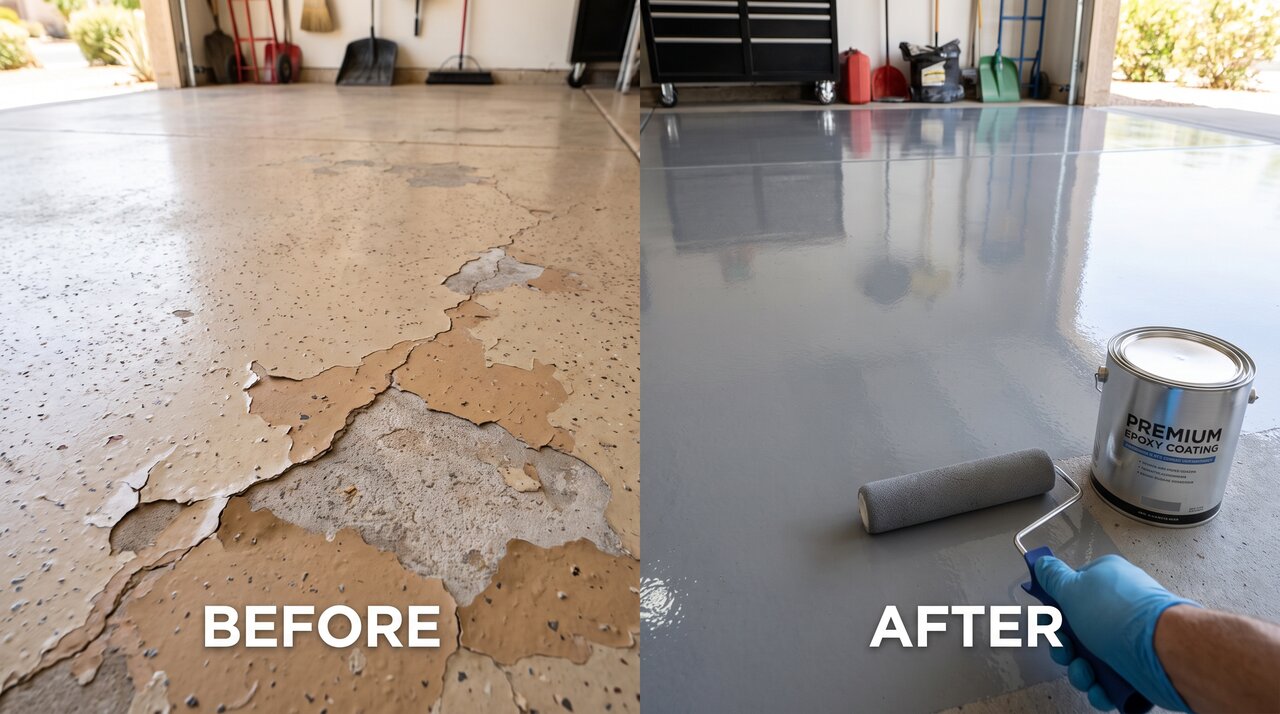
Epoxy floor failures in Phoenix follow predictable patterns - and they're almost always preventable. Whether you're seeing pinhole bubbles in a new installation or large peeling sheets in a garage that looked perfect last year, the cause falls into one of five categories. This guide covers each failure mode, how to diagnose which one you have, and your repair options from spot-fix to full replacement.
1. The 5 Most Common Epoxy Failure Causes in Phoenix
Moisture or air trapped in warm concrete escapes through wet epoxy, creating pinholes and craters. Phoenix slabs heated by summer sun outgas aggressively when epoxy is applied midday.
Standard aromatic epoxy softens above 140°F. Phoenix garage floors hit 130–160°F in summer. Hot tires park on softened epoxy, bond to it, and pull up chunks when moved.
Epoxy applied over oil contamination, laitance (weak surface layer), or dust has no mechanical bond. It peels cleanly in sheets, showing no concrete on the back face.
Concrete slabs emit moisture vapor from below (hydrostatic pressure or ground moisture). Vapor accumulates under epoxy, causing blistering and delamination - especially after monsoon rain saturates soil.
Aromatic epoxy yellows and chalks under Phoenix UV. Degraded topcoat loses flexibility, cracks under thermal cycling, and allows moisture intrusion at edges.
2. Outgassing: Phoenix's #1 Epoxy Problem
Outgassing is the most common cause of bubbling in freshly installed Phoenix epoxy. Concrete is porous - it holds air and moisture that expand when heated. When epoxy is applied to a warm slab, gas escapes upward through the wet coating before it cures, leaving behind craters, pinholes, or a textured "orange peel" surface.
Phoenix-specific risk factors are severe: slab surface temperatures on summer afternoons exceed 110°F. Applying epoxy when the slab is above 85°F and rising dramatically increases outgassing. Professional Phoenix installers apply epoxy in early morning (6–9 AM) when slab temperatures are lowest and stable.
Signs of outgassing failure: uniform pinhole craters across the surface, worst in direct sun zones, best in shaded areas. No delamination - the epoxy is bonded, just cosmetically marred.
3. Hot Tire Pickup: The Garage Killer
Hot tire pickup is Phoenix's most misunderstood failure. Homeowners blame the product or installer when the actual cause is material chemistry mismatched to Arizona temperatures. Standard aromatic epoxy - the most common DIY and budget contractor product - has a glass transition temperature (Tg) of around 120–140°F. Phoenix garage floors hit these temperatures regularly in June through September.
When a hot vehicle parks on softened epoxy, the tire bonds. When the vehicle moves, it rips up pieces of the topcoat or base coat. The repair leaves visible ghost marks in the shape of tire treads.
Prevention is straightforward: specify an aliphatic polyaspartic floor coating as the topcoat. Aliphatic polyaspartics have Tg values above 200°F and are specifically rated for automotive applications in hot climates.
4. Adhesion Failures: Surface Prep Shortcuts
Clean adhesion failure peels in large intact sheets. The epoxy film comes off without concrete attached - meaning the bond never formed. Common causes in Phoenix:
- Oil contamination - Motor oil, hydraulic fluid, or driveway sealer not fully removed before application
- Laitance not removed - The weak surface layer on any concrete slab must be removed by diamond grinding (ICRI CSP 3 minimum) before epoxy
- Acid etching only - Acid etching without mechanical abrasion leaves a chemically clean but mechanically smooth surface insufficient for high-build epoxy
- Dusty surface - Fine concrete dust not vacuumed creates a release layer between epoxy and slab
For epoxy floor repair after adhesion failure: full diamond grind to bare concrete, degrease with pH-neutral cleaner, and apply two-component moisture-tolerant primer before re-coating.
5. Moisture Vapor Delamination
Moisture vapor delamination is the hardest Phoenix epoxy failure to predict. Concrete slabs continuously emit water vapor from below. The emission rate depends on slab thickness, vapor retarder presence (or absence), and soil moisture levels. Phoenix monsoon season - July through September - dramatically increases soil moisture and drives higher vapor emission.
Vapor accumulates under the impermeable epoxy layer until pressure exceeds the coating's bond strength, creating blisters. Whitish or milky discoloration at the epoxy-concrete interface indicates moisture intrusion.
Diagnosis: ASTM F1869 calcium chloride test. Acceptable limit for standard epoxy is 3 lbs/1000 sq ft/24 hrs. Above 8 lbs: standard epoxy will fail regardless of prep quality. Requires moisture-tolerant primer or epoxy injection systems.
6. Quick Diagnosis: Which Failure Do You Have?
| Symptom | Most Likely Cause | Test |
|---|---|---|
| Pinholes/craters, epoxy still bonded | Outgassing | Check installation date vs. ambient temp records |
| Tire-shaped missing patches | Hot tire pickup | Confirm topcoat chemistry - aromatic vs. aliphatic |
| Large sheets peeling clean (no concrete on back) | Adhesion failure | Inspect concrete surface - smooth = laitance not removed |
| Blisters, whitish haze at interface | Moisture vapor | ASTM F1869 calcium chloride test |
| Yellowing + cracking at edges | UV degradation | Confirm topcoat is aromatic epoxy (outdoor exposure) |
| Failure at seams, cracks, or drains only | Edge infiltration | Check perimeter seal and crack fills |
7. Repair Options: Spot Fix to Full Replacement
Best for localized hot tire damage or small adhesion spots. Grind damaged area, feather edges, re-apply base + topcoat. Color match required for solid colors; easier on flake systems.
Best for outgassing craters or UV chalking on otherwise bonded floor. Sand entire surface, apply new aliphatic polyaspartic topcoat. Extends life 5–8 years.
Best for widespread adhesion failure or moisture blistering under 30% of floor. Diamond grind to bare concrete, treat moisture issues, install fresh system.
Required when moisture vapor rate exceeds 8 lbs, when base coat delamination exceeds 40% of floor, or when concrete structural damage is found. Includes vapor mitigation layer.
8. Frequently Asked Questions
Epoxy Failing? Get a Free Diagnosis
On-site assessment to identify your failure mode and quote the right repair - not the most expensive one.