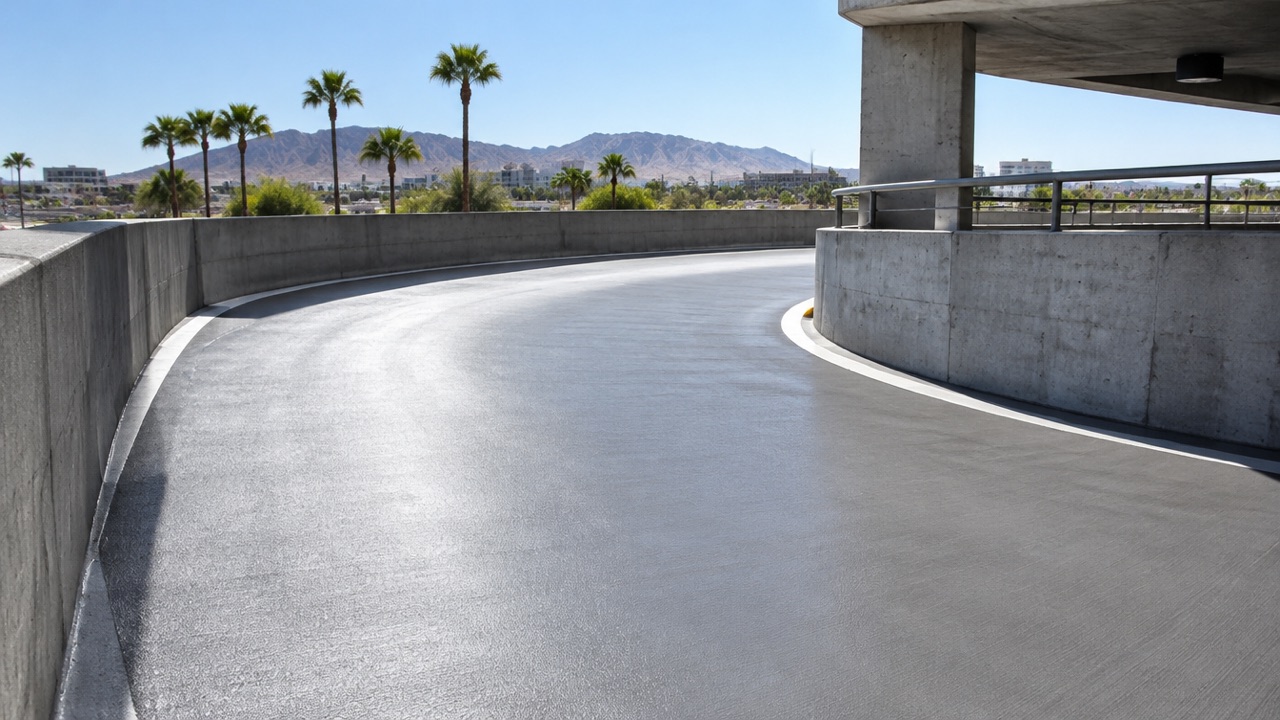
Fast cure coating systems for a concrete parking garage ramp are reinforced urethane or polyurea traffic systems with a heavy aggregate broadcast, chosen because they cure quickly enough for overnight closures and are tough enough to survive turning wheels. Ramps fail before the flat deck around them, so they need a different specification rather than the same system applied thicker. If you are scoping a ramp repair, this guide covers why ramps fail, what resists the damage and how to stage the work, starting from our parking garage epoxy service.
1. Why Ramps Fail Before the Rest of the Deck
Ramps fail first because they combine the loads that wear a coating most: turning, braking and acceleration, all on a slope. A flat drive aisle sees mostly straight rolling traffic, while a ramp sees tires twisting against the surface at every turn.
| Area | Dominant load | Typical wear |
|---|---|---|
| Flat drive aisle | Straight rolling traffic | Even, slow surface wear |
| Parking stalls | Slow turning and parked weight | Tire scuffing, oil staining |
| Ramp straights | Braking and acceleration on a slope | Wear bands, aggregate loss |
| Ramp turns and turn areas | Torsional shear from turning tires | Coating tears and delaminates |
| Bottom of each ramp | Heavy braking | Early failure, ruts in the film |
Water adds to the problem. A ramp sheds water toward its low end, so the bottom of a ramp sees more moisture, more de-icing salt on structures where it is used and more chloride exposure than the rest of the deck. In Phoenix, summer surface heat also softens a coating, which is when tire-driven damage shows up fastest. For how the membrane side works on flat decks, see our guide to parking structure traffic deck membranes.
2. Torsional Shear From Turning Wheels and What Resists It
Torsional shear is the twisting force a turning tire applies to the surface, and it is what peels a coating off a ramp. It resists best in a system with enough elongation to flex with the slab, a strong bond to the concrete and an aggregate layer that carries the load at the surface.
- Strong bond: Surface preparation to the specified profile, commonly described by ICRI 310.2R, gives the membrane something to grip. A weak bond is where shear starts.
- Elongation: A flexible urethane or polyurea membrane stretches over small cracks and movement instead of splitting.
- Build: Enough membrane thickness to survive abrasion between aggregate particles.
- Wear course: A top coat that locks the aggregate in place so it does not roll out under turning wheels.
Phoenix adds thermal movement to the shear problem. An exposed deck can swing by many degrees between a summer afternoon and the early morning, and the slab expands and contracts with it. A rigid coating stores that movement as stress and cracks at joints and turns, while an elastomeric membrane absorbs it. That is one more reason elongation is a specification line and not a nice-to-have.
Thin epoxy alone does not survive ramp duty. Epoxy is hard and relatively inflexible, so a turning tire can crack and lift it, while a reinforced urethane or polyurea system gives and recovers. Where a thinner system is used on flat areas, the ramp and turn zones are normally upgraded to the heavier system.
3. Fast-Cure Chemistry for Overnight Ramp Closures
Fast-cure polyurea, polyaspartic and urethane systems let a ramp section be coated and returned to traffic in a matter of hours rather than days. That is what makes overnight closures possible, which matters because a ramp is often the only way into the structure.
| System type | Cure speed | Best for |
|---|---|---|
| Polyurea | Minutes to hours | Fast turnaround, high abrasion resistance |
| Polyaspartic topcoat | Hours | UV-stable wear course, overnight reopening |
| Reinforced urethane membrane | Longer, often overnight | Elongation and waterproofing over cracks |
| Standard epoxy | Days to full cure | Flat interior areas, not ramps |
Cure speed depends on temperature, and both the product data sheet and the weather set the real schedule. In Phoenix the surface is hot for most of the day, so ramp work is planned for the cooler overnight hours, which also suits closure windows. We cover how cure windows and recoat timing work in our guide to polyaspartic recoat windows.
4. Aggregate Broadcast Rate and Traction on a Slope
On a slope, traction comes from the aggregate, so ramps get a heavier broadcast than flat decks. The broadcast rate sets how much grip the surface provides when it is wet, oily or dusty, and it is the trade-off between safety and cleanability.
- Light broadcast: Aggregate scattered across the wet coat, leaving some membrane exposed. Suitable for flat areas.
- Heavy broadcast: Aggregate applied until the wet surface will take no more, then sealed in. This is the usual choice for ramps.
- Aggregate type: Hard, angular material such as aluminum oxide resists wear and holds traction longest under traffic.
- Seal coat: A top coat locks the aggregate in so it does not shed under turning wheels.
Ramps have a cleaning trade-off like any textured floor: more texture holds more dirt. Our guide to slip resistance, COF and non-slip additives covers how grit size relates to traction, and the same logic applies here, with the slope tipping the choice toward more texture.
5. Detailing at Expansion Joints, Drains and Curbs
Most ramp coating failures start at details rather than in the open field: the expansion joint, the drain and the curb. Each needs a specific treatment, because a membrane that is not terminated and sealed correctly lets water in at its weakest edge.
- Expansion joints: Joint sealants are installed or replaced, and the membrane is detailed to move with the joint rather than bridging it rigidly.
- Drains: Flanges are sealed and the surface is sloped toward the drain so water does not pond around it.
- Curbs and walls: The membrane is turned up the vertical face in a cove, and the top edge is terminated so water cannot run behind it.
- Cracks: Working cracks are routed and sealed with a flexible material before the membrane goes down.
- Spalls and repairs: Damaged concrete is repaired to sound material first, since a coating will not hold over crumbling concrete.
ASTM C957 describes high-solids elastomeric waterproofing with an integral wearing surface, which is the material class used for traffic-bearing membranes on exposed decks. ACI 362.1R is a design guide for durable concrete parking structures and is a useful reference for the drainage and joint questions that sit behind the coating.
6. Staging a Ramp Recoat Without Closing the Structure
A ramp can usually be recoated without closing the whole structure by working in halves and using the cooler overnight hours. Fast-cure systems keep each section offline for hours rather than days, and traffic is routed to the open lane or a different level.
- Plan the sequence: Divide the ramp into sections that can each be finished in one closure window.
- Prepare the surface: Grind or blast to the specified profile, repair cracks and clean with vacuum extraction.
- Work in halves: Coat one lane or half-width at a time so the other stays open where the geometry allows it.
- Apply in coats: Membrane, aggregate and seal coat, each within its recoat window.
- Release on schedule: Reopen on the written cure time for foot and vehicle traffic, with signage and traffic control in place.
The constraint is usually cure temperature and the number of coats, not the crew. A written schedule showing which section is closed when, plus a plan for signage and alternate access, is what keeps the structure functioning during the work.
7. Where to Inspect a Ramp for Early Warning
Four places show trouble first: the turn radii, the braking zone at the bottom of each ramp, the joints and the drains. Inspecting them once or twice a year gives early warning before a small failure becomes a deck repair.
| Location | What to look for |
|---|---|
| Turn radii | Tearing, lifting edges and exposed concrete |
| Bottom of each ramp | Rutting, aggregate loss and shiny worn bands |
| Expansion joints | Cracked or pulled sealant, membrane lifting at the joint |
| Drains and low points | Ponding water, staining and efflorescence |
| Cracks | New or widening cracks, with staining below the slab |
Staining or dripping on the level below is the strongest sign that water is getting through, and it is the failure that matters most. Chloride reaching the reinforcing steel is the expensive problem, not the worn surface, which is why a waterproofing membrane is specified over occupied or parked space below. Ramp areas typically need attention on a shorter cycle than the flat deck, often several years sooner.
8. What to Put in a Ramp Coating Scope
A good ramp scope names the system, the surface preparation, the aggregate, the detailing and the staging plan, so bids can be compared on the same basis. It should read like a specification, not a quote for a square-foot price.
- System: The membrane, wear course and seal coat, by product and build.
- Preparation: The method and profile, with moisture and adhesion testing before coating.
- Aggregate: Type, size and broadcast rate by zone, with a heavier rate at turns and braking areas.
- Details: Joints, drains, curbs and terminations drawn out rather than left to the crew.
- Staging: Sections, closure windows, traffic control and written cure times.
- Striping: Lane and stall marking after cure, covered in our guides to parking garage ADA striping and facility floor markings.
We do not publish a single price for ramp work because the system, the repairs and the staging change it too much. A firm number comes from seeing the structure. For smaller residential garages the approach is simpler, and our epoxy garage floor Phoenix page covers that system.
9. Frequently Asked Questions
Get a Free Quote for Your Ramp
Tell us about your structure and get a written scope with the system, details and staging plan spelled out.