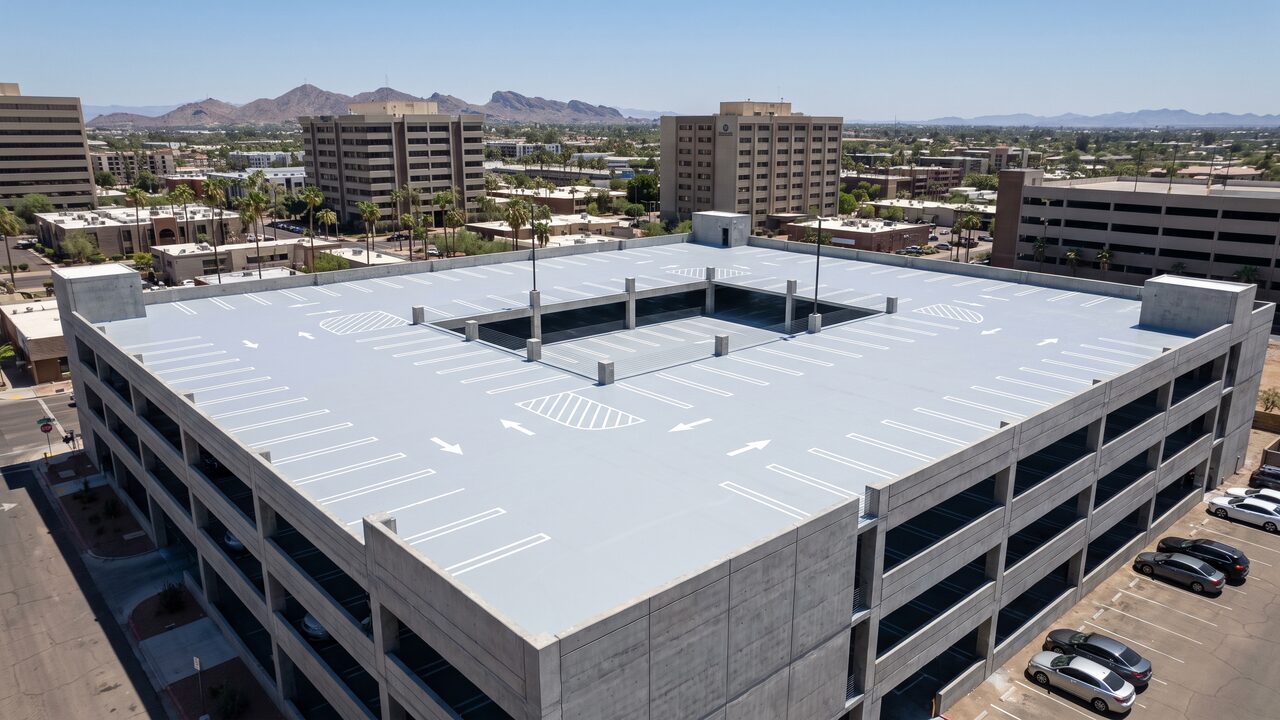
Standard epoxy coatings are not waterproofing systems. This distinction matters enormously for Phoenix parking structure owners who specify parking garage epoxy Phoenix and expect long-term moisture protection. Traffic deck membranes - purpose-engineered, crack-bridging, flexible systems rated to ASTM C 836 or ASTM C 957 - are the correct specification for above-grade parking decks exposed to thermal cycling, vehicle traffic, and Arizona's monsoon season.
1. Why Phoenix Parking Structures Need Waterproof Membranes (Not Just Epoxy)
Standard epoxy coatings are rigid and brittle at the film thicknesses used for decorative applications (8–15 mil DFT). Concrete cracks. When concrete below a rigid epoxy coating cracks due to thermal movement, shrinkage, or structural loading, the epoxy cracks with it - or delaminated along the crack - allowing water direct access to the rebar.
Traffic deck membranes are designed specifically to prevent this failure mode. They are applied at 50–120 mil total thickness and formulated to remain flexible across the temperature range of Phoenix parking decks - from 40°F on winter nights to 180°F on summer afternoons in direct sun. The flexibility allows the membrane to bridge cracks as they open and close through daily thermal cycles without losing waterproof integrity.
For multi-level parking structures, the stakes are especially high. Water that infiltrates an upper deck drains through cracks and joints to levels below, attacking rebar in structural concrete across multiple floors simultaneously. Spalling repair on a 500-car parking structure runs $50–$200 per square foot - far exceeding the cost of proper waterproofing at the time of construction or first renovation.
2. How Water Infiltrates Phoenix Parking Decks (Even in the Desert)
Many Phoenix building owners underestimate moisture exposure because Phoenix averages only 8 inches of annual rainfall. But parking structures face moisture sources beyond rain:
- Monsoon storms: Phoenix receives 50–70% of its annual rainfall in July–September as intense, short-duration events. Drainage systems designed for normal rainfall can be overwhelmed, allowing water to pond on deck surfaces for hours.
- Vehicle condensate: Air conditioned vehicles driven in summer Phoenix generate condensate that drips continuously while parked. A 500-space structure can collect thousands of gallons of condensate daily in peak summer.
- Car wash water: On-site or nearby car wash operations introduce detergent-laden water that penetrates standard coatings faster than clean water due to surfactant action.
- Irrigation overspray: Landscaping around parking structures introduces regular moisture at grade level and on low-level decks.
- Thermal cycling condensation: Phoenix's extreme day/night temperature differential (often 30–40°F) causes condensation on concrete surfaces during temperature transitions.
3. Traffic Deck Membrane Systems: PMMA, Polyurea, and Urethane Options
Fast-cure (30–60 min return to traffic), excellent crack bridging, ASTM C 836 compliant. Preferred for occupied structures with minimal shutdown time. High chemical resistance. $6–$10/sq ft installed in Phoenix.
Elongation at break up to 400%. Best crack-bridging performance for structures with active movement. Spray-applied, seamless. Requires experienced applicator. Polyurea coating suitable for expansion joints. $5–$8/sq ft installed.
Multi-coat urethane system with aggregate broadcast for slip resistance. ASTM C 957 compliant. Lower elongation than polyurea - better for structures with minimal active cracking. $4–$7/sq ft installed in Phoenix.
4. ASTM C 836 and ASTM C 957: Waterproofing Standards for Parking Decks
Two ASTM standards govern traffic deck waterproofing systems for parking structures:
ASTM C 836 covers high-solids content, cold liquid-applied elastomeric waterproofing membranes for use with wearing course. It tests for tensile strength, elongation, water vapor transmission, and low-temperature flexibility. Membranes meeting ASTM C 836 are appropriate for Phoenix above-grade decks where flexibility across the 140°F temperature range is critical.
ASTM C 957 covers high-solids content, cold liquid-applied elastomeric waterproofing membranes with integral wearing surface. It applies to systems where the membrane itself is the traffic surface without a separate wearing course. Both standards require minimum elongation of 100% at -20°F - ensuring Phoenix membranes retain flexibility even in unlikely extreme cold.
When specifying traffic deck membrane systems in Phoenix, always require ASTM compliance documentation from the manufacturer and certified installer application records.
5. Crack-Bridging Capability: Essential for Phoenix's Thermal Cycling
Phoenix parking structures experience among the most severe thermal cycling of any US market. A concrete parking deck surface can swing from 45°F at 5 AM to 185°F at 2 PM in July - a 140°F daily range. Concrete expands and contracts predictably: approximately 0.0000055 inches per inch per degree Fahrenheit. A 100-foot deck section experiences 0.66 inches of movement over this temperature range.
This movement concentrates at existing cracks, construction joints, and areas of structural stress. A membrane's crack-bridging capability is measured by its ability to span a crack opening under dynamic loading without losing watertight integrity. PMMA and polyurea systems achieve 1/16-inch crack bridging at minimum - adequate for most Phoenix parking structure conditions. Structures with active structural cracks or significant joint movement require engineered joint treatment before membrane application.
6. Reflective Coatings: Reducing Phoenix Parking Deck Surface Temperatures
Phoenix's urban heat island effect is among the most severe in the US. Standard grey concrete parking decks absorb solar radiation aggressively, reaching surface temperatures of 160–185°F on summer afternoons. High-SRI (Solar Reflectance Index) topcoats applied over traffic deck membranes reduce surface temperatures by 40–70°F, delivering three benefits:
- Extended membrane life: UV and heat degradation are primary causes of membrane failure. Reducing surface temperature from 175°F to 115°F can double membrane service life.
- Reduced thermal cycling stress: Lower peak temperatures reduce the amplitude of daily thermal cycling, reducing stress at cracks and joints.
- Occupant comfort and safety: Cooler deck surfaces reduce heat stress for pedestrians and lower the temperature of vehicles parked in direct sun - relevant for electric vehicles sensitive to battery temperature.
White and light grey high-SRI topcoats with SRI values of 80–110 are available for all major traffic deck membrane systems. The additional cost of $0.50–$1.50 per square foot for a reflective topcoat pays back within 3–5 years in extended membrane life.
7. Cost of Traffic Deck Membrane Systems in Phoenix
| System | Thickness | $/sq ft Installed | Service Life | ASTM |
|---|---|---|---|---|
| PMMA Traffic Deck | 60–90 mil | $6–$10 | 15–25 yrs | C 836 |
| Polyurea / Hybrid | 50–80 mil | $5–$8 | 15–20 yrs | C 836 |
| Urethane Traffic Topping | 40–60 mil | $4–$7 | 12–18 yrs | C 957 |
| Substrate crack repair | - | $3–$12 (varies) | - | - |
| High-SRI reflective topcoat | +5–10 mil | +$0.50–$1.50 | - | - |
Substrate condition is the largest variable in Phoenix parking deck membrane projects. Decks with existing spalling, rebar corrosion, or active cracks require concrete repair before membrane application. Budget $3–$12 per square foot for substrate remediation depending on severity.
8. Frequently Asked Questions
Parking Structure Waterproofing Quote
Free on-site deck assessment, substrate evaluation, and written membrane specification for your Phoenix parking structure.