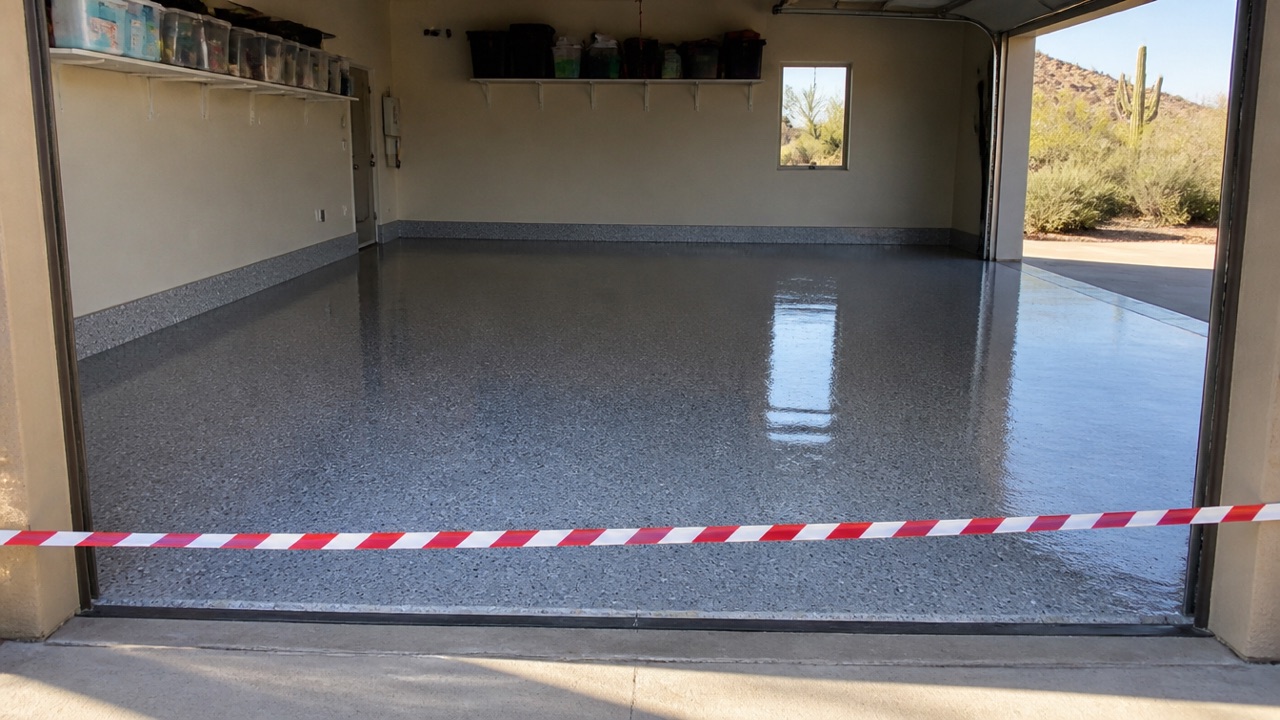
Epoxy garage floor cure time comes down to three milestones: you can usually walk on the floor in 12 to 24 hours, park on it after about 72 hours for traditional epoxy or 24 hours for polyaspartic, and wash or spill on it after five to seven days. Those numbers apply to a properly installed system on a epoxy garage floor Phoenix homeowners book, and they move with the product, the build thickness and the slab temperature. This guide explains each milestone from the owner's side, what Phoenix heat does to them and what goes wrong if you rush.
1. The Three Cure Milestones That Actually Matter
A new floor passes through three stages that matter to you: it can take foot traffic, it can take a vehicle and it reaches full chemical cure. Everything else, such as tack-free time and recoat windows, is a step the crew manages, not a date you need to plan around.
| Milestone | Traditional Epoxy | Polyaspartic |
|---|---|---|
| Light foot traffic | 12 to 24 hours | A few hours |
| Vehicle traffic | About 72 hours | About 24 hours |
| Furniture and heavy items | 3 to 4 days | 48 to 72 hours |
| Wash and chemical exposure | 5 to 7 days | 5 to 7 days |
The numbers above are typical, not a promise. The product's technical data sheet sets the real values, and ASTM D1640 is the standard method used to measure drying and curing times of organic coatings. Ask your installer for the data sheet and a written return-to-service schedule for your specific floor.
This page covers the owner's side of the schedule. The crew's day-by-day sequence is in our epoxy garage floor installation timeline, and how a one-day system is built is in our guide to same-day epoxy floor installation.
2. Foot Traffic: When You Can Walk on a New Epoxy Floor
You can usually walk on a new epoxy floor in socks or soft-soled shoes after 12 to 24 hours, and a fast-cure polyaspartic can be ready within a few hours. Walking early is the lowest-risk way to use a new floor, as long as you stay light and clean.
- Wear clean, soft-soled shoes or socks. Grit stuck in a sole can scratch a floor that is still soft.
- Keep pets off. Claws leave marks in a coating that has not hardened.
- Do not drag anything. Carry items rather than sliding them, since a drag mark can be permanent.
- Avoid turning on your heel. A twisting motion puts concentrated pressure on the film.
The floor will feel hard to the touch well before it is ready for heavier use, which is why the foot traffic window is the most frequently misjudged. A floor that is dry on the surface is not the same as a floor that is cured through its thickness.
3. Vehicle Traffic and the Hot Tire Pickup Risk Window
Plan on about 72 hours before parking on a traditional epoxy floor and about 24 hours for polyaspartic, because the coating needs enough hardness to resist warm tires. Parking early is the single most common cause of hot tire pickup.
Hot tire pickup happens when a warm tire softens an undercured film and lifts it from the slab as the car moves. A tire that has just driven on hot Phoenix pavement carries a lot of heat into the garage. If the coating has not reached the hardness it needs, the rubber can bond to it and tear it off, leaving patches shaped like the tire contact patch.
We cover the failure and its repair in our guide to hot tire peeling on epoxy garage floors. The simple prevention is to keep vehicles out for the full period on your written schedule, then ease back in by parking cool cars first and avoiding hard turns on the floor for the first week.
If you share the garage with more than one vehicle, bring them back one at a time rather than all at once. Park the car you drive least first, so you find out how the floor handles real weight before the daily driver goes in.
4. Full Chemical Cure and When You Can Wash or Spill on It
Full chemical cure, when the floor reaches its rated chemical and abrasion resistance, is typically five to seven days. Until then the film can stain or soften from exposures it will shrug off later.
- Days 1 to 3: Dry sweep only. Wipe spills immediately with a clean dry cloth.
- Days 3 to 7: Light damp mopping with water is fine. Avoid cleaners, degreasers and anything acidic.
- After day 7: Normal cleaning with a neutral cleaner. Chemical resistance is now at its rated level.
- Always: Do not tape, tack or stick anything to the surface in the first week, since adhesives can pull at the film.
The first wash is the milestone people ask about most, and the safe answer is to wait the full week for anything beyond water. Oil, brake fluid and fertilizer are the usual early spills, and wiping them off fast matters more than any special product.
5. How Phoenix Slab Temperature Moves Every One of These Numbers
Phoenix heat speeds the chemical reaction, but it does not reliably shorten the safe return-to-service window. A hot slab can skin over on top while the film underneath is still soft, so the surface feels ready before the coating is.
Temperature works in both directions. A warm slab cures faster, a cool slab slower, and a floor installed on a cold winter morning in a shaded garage can take noticeably longer than the same floor in a warm one. Humidity matters too, since high moisture slows some systems. For the summer chemistry and why crews start early, see our guide to polyaspartic same-day cure in Phoenix summer.
| Condition | Effect on Cure | What to Do |
|---|---|---|
| Hot slab, summer | Fast surface cure, soft below | Do not shorten the written schedule |
| Cool slab, winter | Slower cure | Add time before parking |
| High humidity | Can slow some systems | Follow the data sheet |
| Thick build or multiple coats | Longer through-cure | Ask for system-specific times |
6. What Happens If You Use the Floor Too Early
Using a floor too early can leave marks, soften the coating or lift it from the slab, and most of the damage is repairable only by grinding and recoating the affected area. The cost of waiting a day is nearly always smaller than the cost of repair.
- Tire marks and pickup: Visible patches where warm tires pulled the film away.
- Scratches and scuffs: Permanent marks from dragging, grit or pet claws.
- Stains: Oil, chemicals or cleaners that soaked into an undercured surface.
- Imprints: Furniture or heavy items that leave dents in a soft film.
If something does go wrong, tell your installer promptly. A small area can often be ground and recoated without redoing the whole floor, and most installers prefer to fix a problem early rather than after it has spread.
7. Why Epoxy and Polyaspartic Cure Times Differ
Epoxy and polyaspartic differ in cure time because they harden through different chemical reactions, and the faster reaction in polyaspartic is what shortens the wait for foot and vehicle traffic. The final hardness is comparable once both are fully cured.
Traditional epoxy cures through a slower crosslinking reaction, which is why it needs overnight between coats and about 72 hours before a car. Polyaspartic reacts faster, so a topcoat can be walked on in hours and driven on in about a day. For a side-by-side look at the two systems, including cost and lifespan, see our guide on epoxy versus polyaspartic in Phoenix.
Many garage floors combine both: an epoxy base for build and bond, and a polyaspartic topcoat for UV stability and a quicker return to service. In that case the milestones follow the topcoat for traffic and the full system for chemical cure, so ask your installer which product governs each date.
8. How to Tell Whether Your Floor Is Actually Ready
Your installer's written schedule is the answer, and a few simple checks can confirm it. None of these replace the data sheet, but they catch a floor that is behind schedule because of weather or a thick build.
- Thumbnail test: Press a fingernail into an inconspicuous spot such as under a shelf. A mark that stays means the film is still soft.
- Surface feel: A tacky or slightly rubbery feel means it has not finished curing, even if the surface looks dry.
- Smell: A strong lingering odor is a sign the system is still releasing solvents and needs more ventilation and time.
- Weather check: A cool or humid stretch since installation means the schedule may need extra time. Ask before you park.
If you are unsure, wait another day. The cost of extra patience is a day of parking on the street, and the cost of guessing wrong can be a repair.
9. A Simple Return-to-Service Checklist
The easiest way to avoid mistakes is to ask for the schedule in writing before the crew leaves and tape it up in the garage. A good schedule has four lines and no ambiguity.
- Walk on it: Date and time for soft-soled foot traffic.
- Park on it: Date and time for the first vehicle.
- Move furniture back: Date for shelving, workbenches and heavy items.
- First wash and full use: Date for cleaners, chemicals and normal use.
10. Frequently Asked Questions
Free Garage Floor Quote
Get a written return-to-service schedule with your quote, so you know exactly when you get your garage back.