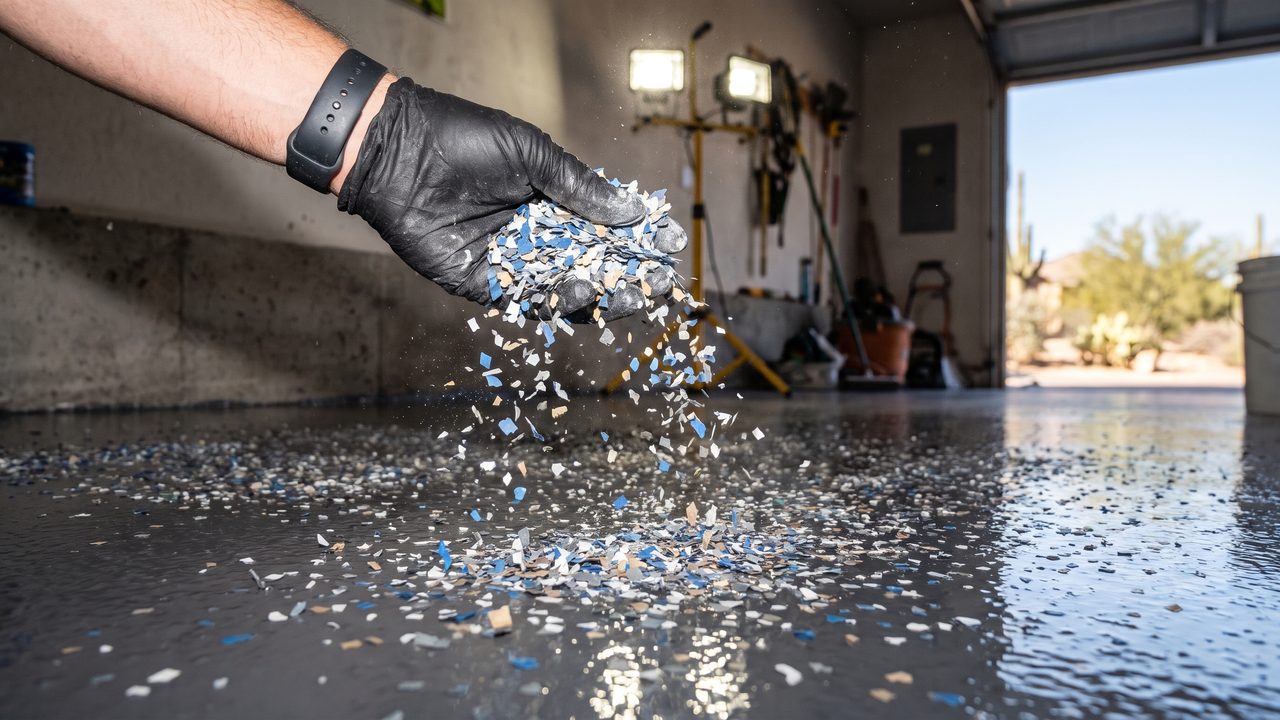
Epoxy flake flooring in Phoenix is sold by look, but it is built by specification: a flake size, a broadcast density and a coverage rate in pounds per square foot. Those three numbers decide how the floor looks, how it feels underfoot and how much material and clear coat the job really needs. If you are comparing quotes, this guide turns those numbers into something you can ask for. For the overall system, see our page on epoxy flake flooring in Phoenix.
Quick answer: Quarter inch flake gives a bold, visible pattern and is the usual garage choice. Eighth inch gives a finer, more uniform look. Full broadcast covers the base coat completely and uses far more flake than a partial broadcast, which leaves base color showing. Ask every installer for the flake size, the broadcast type and the coverage rate in pounds per square foot, plus how many clear coats go over it.
This post is about measurable choices. It does not repeat the system overview, color selection or pricing, which live in our epoxy flake flooring guide and in the garage floor color and flake pattern guide. Here we treat flake as a specification you can read, compare and question.
| Specification item | Typical options | What it changes |
|---|---|---|
| Flake size | 1/16 in., 1/8 in., 1/4 in. | Pattern scale and texture |
| Broadcast type | Partial or full (to rejection) | Base color visibility, flake volume |
| Coverage rate | Pounds per square foot | Material cost and system build |
| Clear coats | One to two, by mils | Final smoothness and wear |
1. What a Flake Floor Is Built From, Layer by Layer
A flake floor is a stack of four layers on a ground concrete slab: a primer or base coat, the flake, an optional second flake pass and one or more clear topcoats. Each layer has a job, and the flake is only one of them.
The slab is diamond ground first so the coating can key into the concrete. The base coat is rolled out as a wet, tinted layer. While it is still wet, the installer throws flake into it by hand, so the flake sinks in partway and locks in as the base coat cures. Loose flake is then scraped and swept off, and clear coats go over the top to bury the flake edges and seal the surface.
The flake itself is thin colored vinyl chip. It carries almost no structural load. What it does is give color, hide minor slab flaws and create texture before the clear coats. Strength and wear resistance come from the base coat thickness and the clear topcoat, which is why a quote that only describes the flake tells you very little about durability. If the slab has moisture issues, flake will not fix them, so read about concrete slab moisture testing before you commit to any coating.
Phoenix heat shapes this process. On a summer day a garage slab can be hot enough to shorten the working time of the base coat, which means the installer has to broadcast flake quickly and evenly before the surface skins. Crews often work early in the morning for that reason. A floor with patchy flake is usually a timing problem, not a material problem.
2. Flake Size: Quarter Inch, Eighth Inch and the Look Each Gives
Quarter inch flake reads as a bold, visible chip pattern from standing height, while eighth inch reads as a finer, more even speckle. The choice is mainly about appearance and texture, not performance.
Flake is sold by its chip dimensions, and the size is the first thing to pin down on a quote. A quarter inch chip is a visible piece of color you can see individually from several feet away. It is the common garage choice because it gives a clear pattern that hides tire marks, dust and small slab marks well. An eighth inch chip is half that size. From standing height it blends into a fine, uniform texture, which suits interior rooms, utility spaces and laundry areas where a calmer look is wanted.
Micro flake, often called 1/16 inch, goes smaller still and reads almost like a terrazzo or granite finish. It tends to be used where a clean, contemporary look matters more than visual hiding power.
| Flake size | Visual scale | Typical use | Texture before clear coat |
|---|---|---|---|
| 1/4 in. | Bold, individual chips visible | Residential garages, workshops | Most pronounced |
| 1/8 in. | Fine, even speckle | Interior rooms, laundry, utility | Moderate |
| 1/16 in. | Near-uniform granite look | Baths, offices, clean interiors | Light |
Size also interacts with the clear coat. Larger chips stand taller above the base coat, so they need more clear coat to bury the edges. An installer who proposes quarter inch flake with a single thin clear coat is setting up the gritty finish that homeowners complain about most. Which colors and blends suit a space is a separate question, covered in our guide to epoxy flooring colors in Phoenix.
3. Full Broadcast Versus Partial Broadcast
Full broadcast means flake is thrown until the base coat will take no more and no base color shows through, while partial broadcast leaves base color visible between flakes. Full broadcast is the heavier, more uniform option, and partial broadcast is the lighter, more open one.
In a full broadcast, also called broadcast to rejection, the installer keeps throwing flake until the wet base coat is saturated. Flake lands on top of flake and simply sits there, which is why the excess is scraped and swept away after cure. The result is a solid blanket of color with no visible base coat. It forms a more uniform surface, and it hides more slab flaws because there is more material over them.
In a partial broadcast, the installer throws a lighter pass, so some of the base coat color shows between the flakes. It uses less flake, and some owners like the layered look it gives, especially with a contrasting base color. The tradeoff is that coverage depends on the installer's hand. A lighter pass is harder to keep even over a large floor, and thin areas can read as mistakes instead of design.
Neither choice is wrong. They are different specifications with different material use, and that is exactly why quotes can differ so much for the same garage. A quote that does not say which one it prices cannot be compared with one that does.
4. Coverage Rate in Pounds per Square Foot and What It Buys
Coverage rate is how many pounds of flake go onto each square foot, and a full broadcast uses roughly two to three times what a light partial broadcast does. It is the number that makes two quotes comparable.
Published planning figures vary by supplier, flake size and installer technique, so treat the numbers below as ranges for comparison and confirm the real figure against the manufacturer's coverage rate data sheet for the product being installed. As a rough guide, a light partial broadcast often lands around 0.1 to 0.2 pounds per square foot, while a full broadcast to rejection commonly lands around 0.3 to 0.5 pounds per square foot of flake thrown, with some of it recovered as excess.
| Broadcast type | Planning range (lb per sq ft) | Flake for a 500 sq ft garage | Base color visible |
|---|---|---|---|
| Light partial | About 0.1 to 0.2 | About 50 to 100 lb | Yes |
| Full to rejection | About 0.3 to 0.5 | About 150 to 250 lb | No |
The garage column is simple arithmetic on those planning ranges, not a published figure for any one product, so use it only to see the scale of the difference. On a typical two car garage, the gap between the two methods is well over a hundred pounds of flake. That difference is a real line item, and it explains part of the spread between a low quote and a high one.
Coverage rate also affects the rest of the build. More flake on the floor means more material standing above the base coat, and that needs more clear coat to cover it. Ask the installer how many clear coats are included and what film thickness they target. Thickness on a coating is measured in mils, one thousandth of an inch. ASTM D7091 is the standard method for measuring dry film thickness, but it applies to coatings on metal, so on concrete installers rely on wet film gauges under ASTM D4414 and on measured spread rates. A contractor who can quote the spread rate of each coat is working to a spec and not guessing.
5. How Flake Density Changes Texture, Cleanability and Build
Higher flake density gives a rougher, thicker surface before the clear coats, and the clear coats then decide how smooth and cleanable the finished floor feels. The flake sets the starting texture and the topcoat sets the final one.
A full broadcast of quarter inch flake produces the roughest starting surface, with chip edges and gaps that would collect dirt if left exposed. Each clear coat fills the low points and buries the edges. One thin clear over that surface leaves a gritty finish that grabs mop heads, holds dirt and feels coarse under bare feet. Two properly built clear coats leave a floor you can sweep and mop easily.
Partial broadcast starts smoother because there are fewer edges standing up, so it can reach a clean finish with less clear coat. It also shows more of the base coat, which can show wear and scuffs at a spot like a tire path or a workbench. Phoenix sun adds another factor. A garage with a door facing the afternoon sun exposes the floor to strong UV near the opening, and the clear coat there is the layer taking the exposure. Our sealer and topcoat guide explains how topcoat chemistry handles that heat and light.
Cleanability is where the numbers pay off. A floor with the right build wipes clean with a damp mop. A floor with too little clear over dense flake holds fine dust in the texture, which is a common complaint in desert homes where dust is constant. If a floor already feels gritty or shows rough patches, our list of the warning signs of a bad epoxy floor job covers how to document it.
| Setup | Starting texture | Clear coat demand | Cleanability when built right |
|---|---|---|---|
| Full broadcast, 1/4 in. | Roughest | Highest | Good with two clear coats |
| Full broadcast, 1/8 in. | Moderate | Moderate | Good |
| Partial broadcast, 1/8 in. | Lightest | Lowest | Good, shows more base coat |
6. Reading the Flake Specification on an Epoxy Flake Flooring Phoenix Quote
A usable epoxy flake flooring Phoenix quote names the flake size, the broadcast type, the coverage rate, the number of clear coats and the products by name. If any of those is missing, you are comparing prices for different floors.
Start with the flake size and ask for it in inches. Then ask whether the broadcast is partial or full to rejection, because the two use very different amounts of material. Ask for the coverage rate in pounds per square foot and for the manufacturer data sheet that supports it. A written number lets you compare two bids on the same basis.
Next, count the clear coats and ask what each one is. Two coats is common over a full broadcast, and the quote should name the topcoat chemistry. Ask what thickness the system targets and how the installer confirms it, such as wet film readings during application. Finally, ask what is included in the price: grinding, crack repair, the base coat and the flake. A quote that bundles all of that into one number is harder to compare than one that lists each part.
- Flake size: stated in inches, such as 1/4 in. or 1/8 in.
- Broadcast type: partial, or full to rejection.
- Coverage rate: pounds per square foot, with the data sheet behind it.
- Clear coats: how many, which product, target thickness.
- Scope: grinding, crack repair and base coat listed separately.
The point is not to haggle. It is to be sure that when two quotes differ, you know why. A lower price that quietly uses a partial broadcast and one clear coat is a different floor from a higher price with a full broadcast and two coats. For the full scope of how a garage system is specified, see our page on an epoxy garage floor Phoenix, which lists the preparation, base coat and topcoat steps this flake choice sits inside.
7. Frequently Asked Questions
Get a Free Flake Floor Quote With the Spec Written Out
We will quote your garage with the flake size, broadcast type, coverage rate and clear coats listed, so you can compare it line by line.