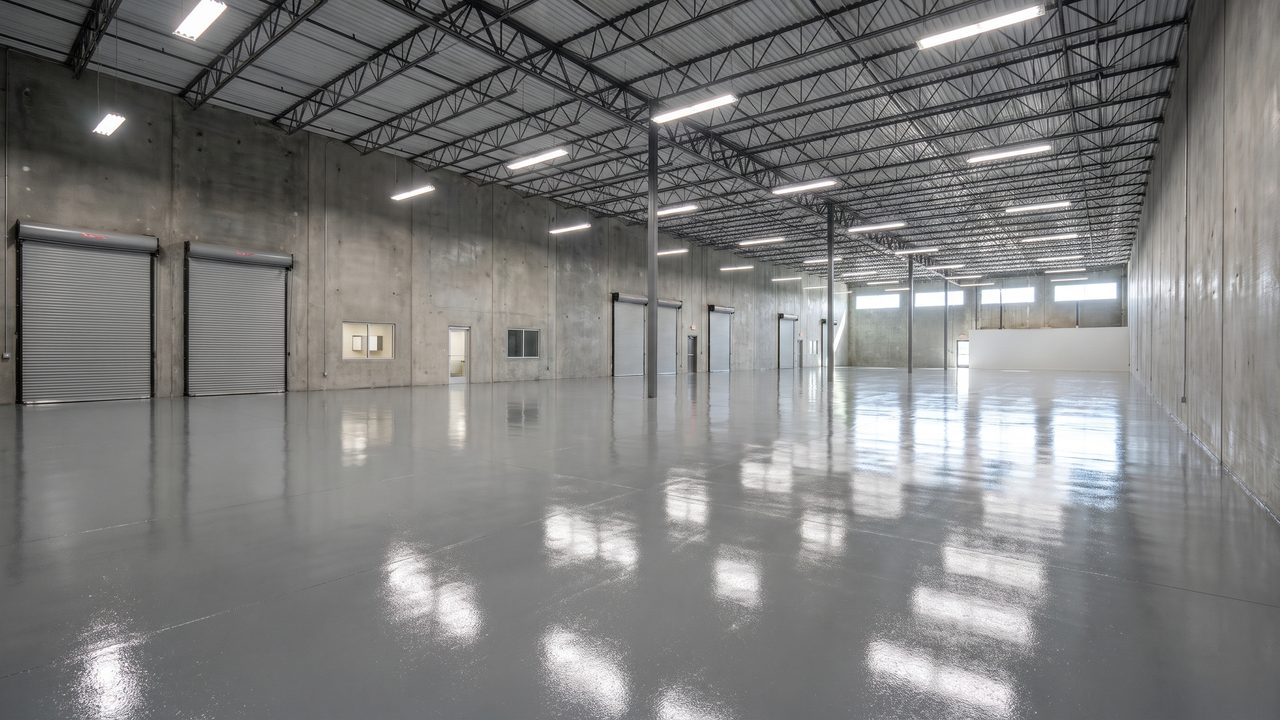
Commercial epoxy flooring cost per square foot is not a single number, because the same system costs less per unit on a 20,000 square foot warehouse than on a 1,500 square foot shop. This guide is written for a facility manager building a capital request, and it shows how area, slab condition and system choice move the price, using the ranges ProEpoxy already publishes. If you are scoping an install, the full service is described on our commercial epoxy flooring in Phoenix page, where you can request a slab assessment.
Quick answer: Commercial epoxy flooring in Phoenix is published at $5 to $12 per square foot installed, and the per-square-foot figure falls as the floor gets larger because mobilization, setup and containment are largely fixed costs. Published volume reductions run 8 to 12 percent above 25,000 square feet and 12 to 18 percent above 50,000 square feet. Surface prep moves a quote more than the coating does, so budget a range and hold a contingency for the slab.
| Factor | Effect on the quote | Published reference | Unit |
|---|---|---|---|
| Project area | Price per unit falls as area rises | 8 to 12% off above 25,000 sq ft; 12 to 18% off above 50,000 sq ft | sq ft |
| Small project minimum | Quote reflects the minimum, not the area | $800 to $1,200 on jobs under 300 sq ft | flat fee |
| Coating removal | Adds grinding or shot blasting labor | $0.50 to $1.50 | per sq ft |
| Moisture mitigation | Adds a vapor-control primer | $0.50 to $1.25 | per sq ft |
| System tier | Sets the base rate | $3.50 to $14.00 | per sq ft |
The figures above come from the pricing already published on our site, not from a new price list. Residential and garage numbers are covered in our Phoenix epoxy flooring cost guide, and this post stays on the commercial side. The sections below explain why the numbers move and where the largest swings come from.
1. Why Commercial Pricing Works Differently From Residential
Commercial pricing works differently because a commercial quote is built from fixed project costs plus a variable per-square-foot cost, while a residential quote is mostly the variable part. On a garage, the square footage is small enough that the crew, equipment and cleanup fit into one or two days. On a 30,000 square foot building, the logistics of moving that same crew and equipment across the floor become a line item of their own.
Three things separate the two. First, the scope is larger and more varied, with dock aprons, drive lanes, racking bays, offices and restrooms that may each need a different system. Second, the building is usually occupied or on a lease clock, so the schedule has a cost. Third, the buyer is spending someone else's money and needs a number that survives approval, which is why a range with a stated contingency is more useful than a single figure.
Commercial floors are also held to performance requirements that a garage is not. Forklift traffic, pallet jack abrasion, chemical exposure and cleaning regimes decide how thick the system has to be, and thickness drives material cost. In Phoenix, slab surface temperatures in July and August can run far above air temperature, and that narrows the install window and pushes much of the work to early morning or overnight. Those scheduling constraints are part of why a commercial rate is higher than a residential one even before size is considered.
Because of this, the published commercial range of $5 to $12 per square foot is wide on purpose. The low end describes a large, straightforward floor with a sound slab. The high end describes a smaller or more specialized floor, or one with demanding prep. Where your project lands is mostly a question of area and slab condition, which the next sections take in turn.
2. Mobilization Cost and the Small Project Minimum
Mobilization is the cost of getting a crew, grinders, dust extraction, mixing equipment and materials to the site and set up, and it is the same whether the floor is small or large. Because it does not scale with area, it dominates the price of a small job and nearly disappears on a large one.
The effect is easy to see with simple arithmetic. The table below spreads a single $1,000 fixed charge, which is the midpoint of the $800 to $1,200 small-job minimum we publish, across four floor sizes. The figure is an illustration of how fixed cost behaves, not a quote, and real commercial mobilization is usually larger than the small-job minimum.
| Floor area | Fixed charge | Fixed cost per sq ft | Share of a $6.00 per sq ft job |
|---|---|---|---|
| 300 sq ft | $1,000 | $3.33 | 56% |
| 1,000 sq ft | $1,000 | $1.00 | 17% |
| 5,000 sq ft | $1,000 | $0.20 | 3% |
| 10,000 sq ft | $1,000 | $0.10 | 2% |
That is the reason most installers have an effective minimum. Mobilizing a crew and grinding equipment costs the same whether the area is small or large, so below a certain size the quote reflects the minimum, not the square footage. On jobs under 300 square feet we publish a minimum fee of $800 to $1,200. A small commercial space such as a single-bay shop, a break room or a tenant suite can sit close to that threshold, and the per-square-foot price of a floor that size will look high next to a warehouse figure.
Containment and protection are the other fixed costs. Diamond grinding generates fine silica-bearing dust, and a commercial site usually needs dust extraction, sealed doorways and protection for adjacent finishes or stock. Those measures are set up once per work area. Spreading them across 10,000 square feet costs a small fraction of what they cost across 500. Crew travel and daily setup behave the same way, which is why a larger floor is cheaper per unit even when the system and the labor rate are identical.
3. How Price Per Square Foot Falls as Area Increases
Price per square foot falls as area increases because fixed costs are spread across more floor and because material and labor are purchased and scheduled at a better scale. The published volume reductions give a usable curve for a budget.
For warehouse and light industrial floors, our published guidance is $5 to $8 per square foot at 5,000 square feet and above for a standard epoxy system. Beyond that, the volume reductions published for large floors apply after an on-site assessment and a materials confirmation. The table applies them to a working base of $5.00 to $7.00 per square foot, the published range for a high-build epoxy system on a heavy-traffic warehouse floor.
| Project area | Published volume reduction | Resulting price per sq ft | Notes |
|---|---|---|---|
| Under 5,000 sq ft | None published | Upper part of the $5 to $12 range | Fixed costs weigh heavily |
| 5,000 to 25,000 sq ft | Standard rates | $5.00 to $7.00 | Base pricing applies |
| 25,000 to 50,000 sq ft | 8 to 12% | $4.40 to $6.44 | Applied per sq ft in qualifying zones |
| 50,000+ sq ft | 12 to 18% | $4.10 to $6.16 | Negotiated after assessment |
The curve flattens quickly. Most of the saving appears between a few hundred square feet and about 5,000, where fixed costs stop dominating. After that, each doubling of area saves a smaller percentage, and the published reductions of 8 to 18 percent reflect that. A buyer who expects the price to keep falling at the same pace past 50,000 square feet will be disappointed, because the remaining cost is mostly material and grinding labor, which scale with area.
Two cautions apply. The reductions assume reasonable slab condition, so a large floor with a failed prior coating or widespread moisture can quote higher per unit than a smaller clean slab. And a reduction applies to the zones that qualify, not necessarily to every line of the quote. Ask for the volume adjustment to be shown as its own line so you can see what size is worth. Our Phoenix warehouse epoxy flooring guide lists the same bulk breaks alongside system pricing for forklift floors.
4. Prep Condition: The Variable That Moves the Number Most
Surface preparation is the variable that moves a commercial quote the most, because removing an old coating, repairing damaged concrete or mitigating slab moisture can cost more than the coating itself. Two identical buildings can quote very differently based only on slab condition.
Prep begins with mechanical grinding to a defined profile. ICRI Technical Guideline 310.2R describes concrete surface profiles on the CSP scale, and the coating manufacturer sets the profile a given system needs, with thicker systems generally calling for a coarser profile. Grinding a clean, sound slab to profile is the baseline cost already inside the system rate. The items below are what pushes a quote above that baseline.
| Prep item | Added cost | Unit | What triggers it |
|---|---|---|---|
| Previous coating removal | $0.50 to $1.50 | per sq ft | Old paint or failed coating that blocks adhesion |
| Moisture mitigation primer | $0.50 to $1.25 | per sq ft | High vapor emission or relative humidity readings |
| Crack routing and injection | $150 to $400 | per linear foot | Structural cracks wider than 1/8 inch |
| Spall and crack repair | $200 to $800 | project add-on | Damaged joints and chipped areas |
Moisture is the item that surprises capital requests most often. Two standard tests exist: ASTM F1869 uses calcium chloride to measure moisture vapor emission, and ASTM F2170 measures relative humidity inside the slab. The acceptable limits are set by the coating manufacturer, and a slab that reads above them needs a mitigation primer before anything is applied. Phoenix slabs are often assumed to be dry, but irrigation near building edges, plumbing leaks and monsoon-season water can all leave moisture in a slab that looks fine on a dry day. Our slab moisture testing guide explains what the readings mean.
The arithmetic matters at commercial scale. A mitigation primer at $0.50 to $1.25 per square foot adds $5,000 to $12,500 to a 10,000 square foot floor, and coating removal at $0.50 to $1.50 adds $5,000 to $15,000. Both can apply to the same floor. That is a swing larger than most of the difference between two coating systems, which is why prep belongs at the center of the budget conversation.
This is also why a quote given without a slab test is an assumption. An installer pricing a floor sight unseen is pricing an average slab, and the adjustment arrives after the assessment. Asking each bidder to state what they assumed about prep, and what happens to the price if the assumption is wrong, makes quotes comparable. Our concrete grinding and surface prep guide covers why this line separates floors that last from floors that lift.
5. System Selection and What Each Tier Costs to Install
System selection sets the base rate: standard epoxy sits at the low end, high-build epoxy in the middle, and urethane cement or specialty compliance systems at the top. Choosing the right tier for the actual traffic and exposure is worth more than choosing the cheapest one.
| System | Installed price | Unit | Typical use |
|---|---|---|---|
| Standard epoxy, broadcast or flake | $3.50 to $5.50 | per sq ft | Storage, pick-and-pack, staging |
| High-build epoxy | $5.00 to $7.00 | per sq ft | Forklift lanes, impact zones, racking aprons |
| Decorative or polished system | $6.00 to $10.00 | per sq ft | Retail showrooms and offices |
| ESD static-dissipative | $6.50 to $9.50 | per sq ft | Electronics and sensitive equipment areas |
| Urethane cement | $8.00 to $14.00 | per sq ft | Dock aprons, wash-down areas, kitchens |
Tier choice follows the load. A floor that sees pallet jacks and occasional forklifts rarely needs more than a standard or high-build epoxy. A dock apron that sees thermal shock from hot wash-down water or freezer transitions needs urethane cement, which costs more per square foot and is justified by the failure it prevents. A mixed building often uses two or three tiers, so a single per-square-foot figure for the whole floor is an average, not a rate.
In Phoenix, UV exposure is a separate line. Where a floor sees sunlight through dock doors or glazing, a UV-stable polyaspartic topcoat is the right finish, and it adds $0.75 to $1.50 per square foot compared with bare epoxy. An interior floor that never sees sun may not need it. Compare quotes on whether the topcoat is named and whether the exposure justifies it.
Thickness is the other hidden variable. Two quotes that both say high-build epoxy can differ in film build, and the difference shows up in wear years later. Ask for the system as a list of layers with thickness in mils, and confirm the coating manufacturer's technical data sheet matches. A lower price per square foot that comes from a thinner build is not a saving on a floor that carries forklifts.
6. Building a Budget Number Before You Have a Quote
To build a budget number before you have a quote, multiply the floor area by the published range for your system tier, apply the volume reduction if the area qualifies, and then add a separate contingency line for prep items that are unknown until the slab is tested.
Here is a worked example for a 20,000 square foot warehouse with high-build epoxy. The area falls in the standard-rate band, so the base is $5.00 to $7.00 per square foot, or $100,000 to $140,000. The slab has not been tested, so the contingency covers the two prep items most likely to apply. Moisture mitigation across the whole floor adds $10,000 to $25,000, and coating removal adds $10,000 to $30,000. The capital request becomes a base of $100,000 to $140,000 plus a contingency of up to $55,000. The figures are an illustration built from published ranges, not a quote for any specific building.
Request the contingency as a separate line rather than blending it into the base. If testing shows the slab is dry and sound, the contingency is not spent. If it shows moisture, the money is already approved and the project does not stall waiting for a second request. This is the same logic behind asking each bidder to price prep items separately, so that the quotes line up. Our guide to tenant improvement allowances for commercial epoxy flooring covers how to fit a floor into a lease budget when the landlord is paying part of it.
Phasing is the last variable. Each phase is a separate mobilization, and each termination edge between phases is extra detail work, so a phased install costs more than a single pour of the same area. The tradeoff is keeping the facility running, and in an operating building that is usually worth more than the premium. Decide early whether the building can shut down, since it changes the number as much as any system choice.
Finally, keep garage and shop-floor comparisons in their lane. Homeowners searching for an epoxy garage floor Phoenix project will see lower per-square-foot figures and much smaller totals, because the fixed costs and the performance requirements are different. Commercial budgets should be built from commercial ranges only.
7. Frequently Asked Questions
Get a Free Commercial Floor Quote
We test the slab, measure the area and price prep as its own line, so your capital request has a range you can defend.