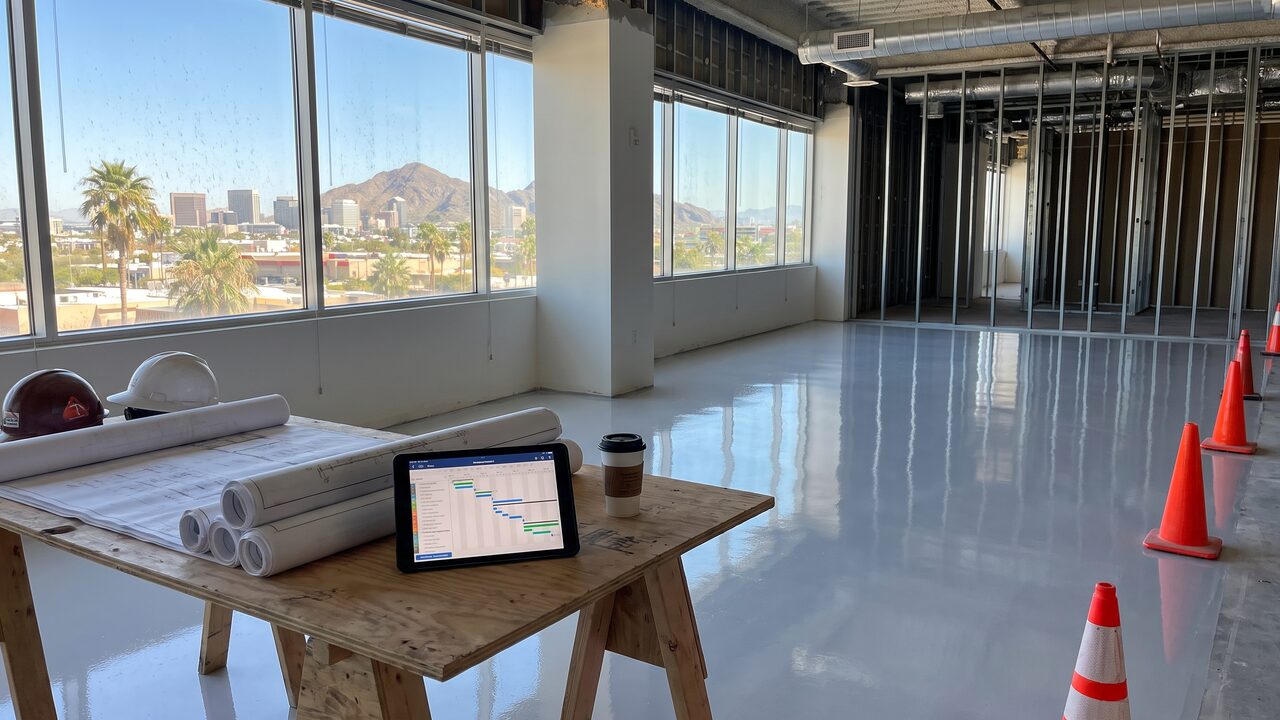
Wondering whether your landlord will pay for a commercial epoxy flooring Phoenix upgrade? The answer almost always comes down to your lease's tenant improvement (TI) allowance - a budget most commercial tenants have and rarely fully understand until they're mid-negotiation with a property manager over what actually qualifies. This guide walks through how TI allowances work, what's typically covered, and how to position an epoxy flooring request so it gets approved instead of pushed back on you.
We work with Phoenix tenants across retail, restaurant, office, and light industrial spaces, and the single biggest source of frustration we see is a tenant assuming flooring is automatically included in their TI package, only to find out mid-project that decorative upgrades fall outside the standard allowance.
This guide is written for tenants who are somewhere in the leasing or renewal process and want to walk into that conversation informed - not for landlords or property managers, though the same information is useful for understanding what a reasonable tenant request actually looks like from the other side of the table.
1. What Is a Tenant Improvement Allowance
A tenant improvement allowance is a dollar amount - usually expressed as a per-square-foot figure - that a commercial landlord agrees to contribute toward build-out costs when a tenant signs or renews a lease, meant to help the space fit the tenant's specific business needs.
TI allowances in the Phoenix market commonly range from a modest per-square-foot figure for a simple retail fit-out up to a much higher figure for a full restaurant or medical build-out, depending on lease term length, the tenant's negotiating leverage, and whether the space is a raw "vanilla shell" or a second-generation space with existing improvements. Longer lease terms generally command larger allowances, since the landlord is amortizing the cost over more years of guaranteed rent.
Why Landlords Offer a TI Allowance at All
It's worth understanding the landlord's incentive here: a TI allowance isn't charity, it's a competitive tool. Phoenix's commercial market has enough available inventory that landlords use TI packages to win tenants over comparable spaces, and the allowance amount is effectively baked into the lease's overall economics - either recovered through slightly higher base rent over the term, or absorbed because a signed, occupied space is worth more to the landlord than a vacant one. Understanding this framing helps when negotiating: you're not asking for a favor, you're negotiating one term within a larger economic package.
2. Is Flooring Typically Covered Under Phoenix Commercial Leases
Flooring is usually covered under a Phoenix commercial TI allowance at a baseline level, but decorative or premium upgrades - including most epoxy systems beyond a basic sealed concrete finish - often exceed what the standard allowance is intended to fund.
| Flooring Scope | Typically TI-Covered | Notes |
|---|---|---|
| Basic sealed/polished concrete | Usually yes | Often the landlord's baseline standard finish |
| Standard solid-color epoxy | Sometimes | Depends on allowance size and lease negotiation |
| Epoxy flake or decorative broadcast | Rarely fully covered | Usually requires tenant overage funding |
| Metallic epoxy or custom finish | Rarely covered | Almost always a tenant-funded upgrade |
The gap between what the allowance covers and what a premium finish costs is called the "TI overage," and it's the tenant's responsibility to fund unless specifically negotiated otherwise. Restaurants and healthcare tenants often see somewhat more flexibility here since flooring performance (slip resistance, chemical resistance) is closely tied to code compliance the landlord has an interest in meeting.
Second-generation spaces - units that previously housed another tenant's build-out - add another wrinkle. If the prior tenant already installed epoxy or polished concrete that's in reasonable condition, a landlord may push back hard on funding a full replacement rather than a refresh, even if you'd prefer a different finish. Getting a firsthand assessment of the existing floor's condition before you request funding helps set realistic expectations for what a landlord will actually agree to.
3. Negotiating Epoxy Flooring Into Your TI Package
Negotiating epoxy flooring into your TI package works best when you frame it as a durability and maintenance investment rather than a purely cosmetic upgrade - landlords respond better to arguments about reduced long-term maintenance costs and code compliance than to aesthetic preferences alone.
- Get your flooring quote before lease negotiations close - a specific number from a contractor like ProEpoxy gives your broker something concrete to negotiate with, rather than a vague request.
- Tie the request to your business type - a restaurant citing slip-resistance code requirements or a healthcare tenant citing infection-control flooring standards has a stronger negotiating position than a generic aesthetic request.
- Ask about allowance timing - some landlords will increase the TI allowance in exchange for a longer lease term, which can offset an epoxy upgrade's cost without coming out of your pocket directly.
- Consider a landlord/tenant cost split - even when a full upgrade isn't covered, negotiating a partial contribution toward the overage is common and worth asking for directly.
- Loop in your broker early - a commercial broker who regularly works Phoenix leases will already know which landlords in a given submarket are flexible on flooring upgrades and which aren't, saving you from a negotiation that was never going to succeed.
One negotiating angle that works surprisingly well: proposing that any flooring upgrade beyond standard code-required finish becomes part of the landlord's own asset value if you eventually vacate, since flooring improvements typically stay with the space rather than leaving with the tenant. Framing the request as an investment in the property, not just your business, occasionally shifts a landlord who was otherwise unwilling to budge.
If your business is in retail, our commercial epoxy flooring guide and polished concrete options both make strong TI-negotiation cases since both are widely recognized, code-friendly commercial finishes landlords are generally comfortable approving.
Timing your ask also matters more than most tenants realize. Requesting a flooring upgrade during the initial lease negotiation, before you've signed, gives you real leverage - the landlord wants to close the deal and is more likely to accommodate a reasonable request. Asking for the same upgrade six months into occupancy, after the lease is signed and the allowance has already been allocated to other build-out costs, is a much harder conversation with far less leverage on your side.
4. Documentation Landlords Require Before Approving Work
Most Phoenix commercial landlords require a defined documentation package before releasing TI funds or approving a flooring contractor's access to the space, and having this ready in advance speeds approval significantly.
Your contractor's proof of general liability and workers' comp coverage, typically naming the landlord as additional insured.
A written description of the flooring system, prep process, and any downtime the space will experience during installation.
Some flooring scopes trigger a permit depending on jurisdiction and whether other trades are involved concurrently.
Sign-off confirming work matches the approved scope, often required before final TI reimbursement is released.
ProEpoxy provides all standard documentation Phoenix landlords request as part of every commercial project, which is worth confirming with any contractor you're considering before committing to a TI-funded build-out.
Property managers overseeing multi-tenant Phoenix commercial buildings also frequently require coordination around building access, freight elevator scheduling, and after-hours work windows if your unit shares common walls or infrastructure with active neighboring tenants - details that rarely show up in the lease itself but that your contractor needs to know well before the install date to avoid delays.
5. When Tenants Pay Out of Pocket Instead
Tenants end up paying out of pocket for epoxy flooring most often when the requested finish exceeds the remaining TI allowance, when the request comes mid-lease outside the original build-out window, or when the landlord simply declines to fund a purely cosmetic change.
In these cases, it's still worth getting a clear quote and comparing the investment against your business's specific needs - a restaurant epoxy flooring upgrade that reduces slip-and-fall liability, or a healthcare epoxy flooring system that meets infection-control standards, can pay for itself in reduced liability exposure even when funded entirely by the tenant. A metallic epoxy finish in a retail showroom is a similar story - the improvement drives customer perception and sales in a way that can justify a self-funded upgrade even without landlord contribution.
Tenants who pay out of pocket should also consider whether the flooring cost can be amortized as a leasehold improvement on their own books, which is a tax and accounting question worth raising with your accountant rather than assuming - the answer affects the real cost of a self-funded upgrade more than the sticker price alone suggests. It's also worth confirming with your landlord in writing that any self-funded improvement won't be treated as grounds to raise your base rent at renewal, since a nicer floor can otherwise become an argument the landlord uses against you at the negotiating table down the line.
6. Frequently Asked Questions
Get a TI-Ready Flooring Quote
A documented estimate and scope of work your landlord and broker can act on, free.