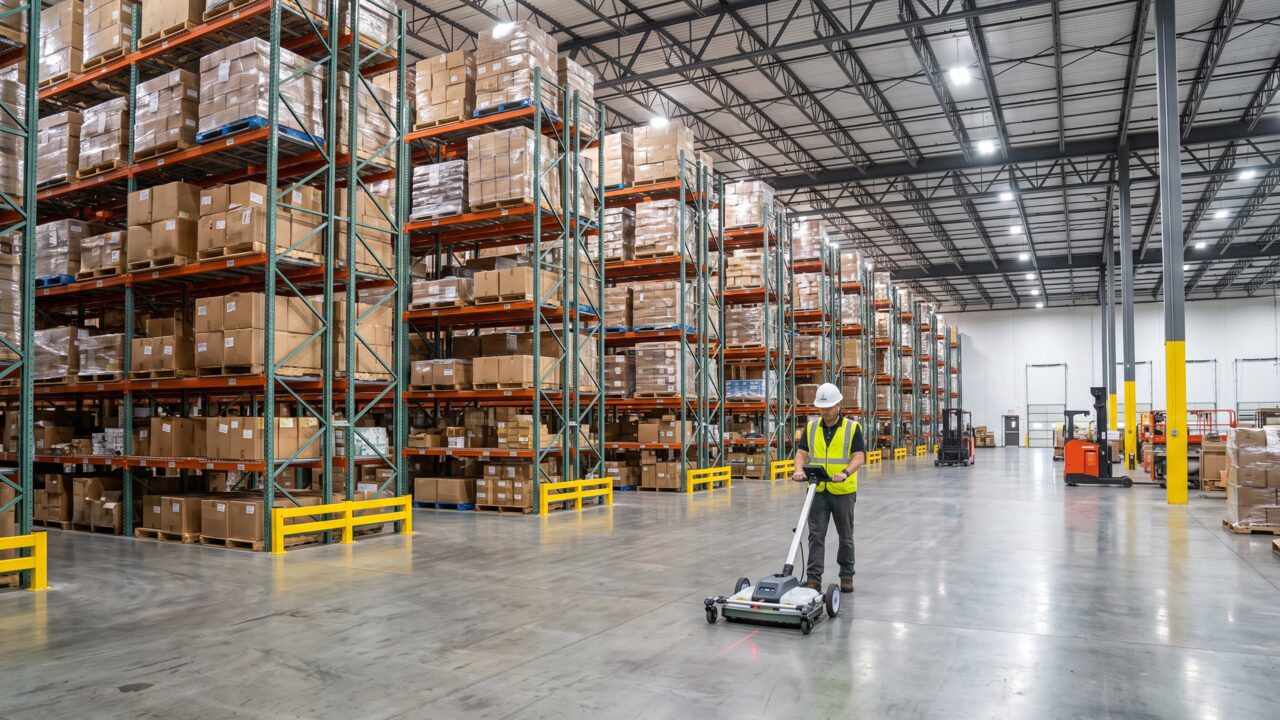
Every warehouse epoxy flooring Phoenix project involving pallet racking should start with one question most facility managers never ask until it's too late: what are the slab's FF and FL numbers, and will your racking manufacturer actually approve the floor once it's coated? Skipping this step is the single most common reason a brand-new coated warehouse floor ends up failing a post-installation racking inspection.
FF and FL numbers sound like an obscure engineering detail, but for any Phoenix warehouse installing or expanding a racking system, they determine whether uprights sit plumb, whether pallets load safely, and whether your racking supplier will sign off on the installation at all. This guide breaks down what these numbers measure, how they're tested, and what to do if your existing slab doesn't meet spec before coating work begins.
Phoenix's industrial corridor along the I-10 and Loop 202 has seen a wave of new distribution and fulfillment construction over the past several years, and a growing share of that square footage is being retrofitted for narrow-aisle and very narrow-aisle racking as e-commerce operators pack more pallet positions into the same footprint. That retrofit trend is exactly where FF/FL testing becomes non-negotiable - a building originally designed for wide-aisle selective racking was never tested or built to the tighter tolerance a VNA system demands, and finding that out after ordering racking is an expensive mistake.
1. What FF and FL Numbers Actually Measure
FF (Floor Flatness) and FL (Floor Levelness) are two separate numeric ratings, defined by ASTM E1155, that together describe how flat and how level a concrete slab is - and racking manufacturers use both to determine whether a floor can safely support a given rack configuration.
Floor Flatness (FF)
FF measures small-scale bumps and dips over a short 24-inch span. A higher FF number means fewer local high and low spots - critical for narrow-aisle forklifts whose wheels need consistent contact with the slab to avoid destabilizing a raised load.
Floor Levelness (FL)
FL measures the slab's broader tilt or waviness over a longer 10-foot span. A floor can have excellent FF (very few small bumps) but poor FL (a gradual slope across the bay) - which is why racking specs almost always require minimums for both numbers, not just one.
Phoenix presents a specific challenge here that many out-of-state racking suppliers don't fully account for: expansive clay and caliche soils under a slab can shift slightly over years of thermal cycling, which sometimes causes a warehouse floor that met spec at construction to drift out of FL tolerance over time, even without any visible cracking. That's one reason we recommend re-testing an existing slab rather than relying on a builder's original flatness certification, especially in a building more than five or six years old.
2. ASTM E1155 Testing for Phoenix Warehouse Floors
ASTM E1155 is the industry-standard test method for measuring FF and FL, and any Phoenix warehouse considering new or expanded racking should have this testing done on the existing slab before finalizing a floor coating scope.
Testing is performed with either a Dipstick Floor Profiler or an F-Meter, both of which record thousands of elevation data points across the slab in a defined grid pattern. The results are processed into statistical FF and FL scores for the tested area - not a single floor-wide average, since ASTM E1155 recognizes that flatness can vary significantly from bay to bay within the same building.
| Racking Type | Typical FF Minimum | Typical FL Minimum | Notes |
|---|---|---|---|
| Standard selective racking | 25 | 20 | Wide-aisle, forgiving of minor variation |
| Narrow-aisle (NA) racking | 35 | 25 | Common in Phoenix mid-size distribution centers |
| Very narrow-aisle (VNA) | 50 | 50 | Wire-guided or rail-guided trucks, tight tolerances |
| Automated storage/retrieval | 75+ | 75+ | Superflat spec, project-specific engineering |
These figures are general industry benchmarks - every racking manufacturer publishes its own minimums, and the final number for your Phoenix facility should always come from the racking engineer of record, not a generic table.
Random-Traffic vs. Defined-Traffic Testing
ASTM E1155 also distinguishes between random-traffic floors (forklifts can travel any direction, as in a standard selective-rack aisle) and defined-traffic floors (wire-guided or rail-guided VNA trucks that always travel the exact same path). Defined-traffic testing uses tighter measurement profiles because the truck's wheels track the identical line every single pass, so even a small deviation becomes a repeated stress point. If your Phoenix facility is planning VNA racking, make sure whoever tests your slab is measuring to the defined-traffic method - a random-traffic test on a VNA floor can produce a misleadingly favorable number.
3. Racking Manufacturer Flatness Requirements
Racking manufacturers set their own FF/FL minimums because upright stability, seismic bracing calculations, and load-beam deflection tolerances all assume a floor within a certain flatness range - a Phoenix facility installing VNA racking on a floor that only meets selective-racking spec risks a failed inspection and a costly re-engineering delay.
Most reputable racking suppliers will not finalize a layout or issue a stamped engineering approval without seeing current FF/FL test data for the specific bays where racking will be installed. If your Phoenix warehouse is planning a racking expansion alongside a floor coating project, sequencing matters: testing and any corrective leveling work needs to happen before the topcoat goes down, not after.
OSHA general industry standards (29 CFR 1910) also come into play indirectly - while OSHA doesn't set FF/FL numbers itself, out-of-tolerance floors are a documented contributing factor in forklift tip-over incidents, which OSHA does regulate and cite under powered industrial truck rules. Getting the flatness right isn't just about racking approval; it's a genuine safety factor for anyone operating a forklift or order picker in your Phoenix facility.
4. How Epoxy Topping Affects Existing Slab Flatness
A standard epoxy topcoat does not meaningfully change a warehouse floor's FF/FL numbers, because at 10-20 mils thick, the coating simply follows the contour of whatever concrete is underneath it.
This is a common point of confusion for facility managers: coating a floor makes it look uniformly flat and glossy, but it does not correct an underlying out-of-spec slab. If your existing floor already meets racking spec, a standard commercial epoxy flooring system is a great way to add chemical resistance, dust control, and a cleanable surface without touching flatness. If it doesn't meet spec, flatness correction has to happen as a separate step before coating.
A polished concrete topping is a slight exception worth understanding. A dense-shield polished system involves grinding several passes into the surface, which can shave down isolated high points by a small margin - but it's not a substitute for engineered leveling and shouldn't be relied on to bring an out-of-spec floor into compliance on its own. Think of grinding as a fine-tuning step after the real correction work, not the correction itself.
5. Correcting Out-of-Spec Floors Before Coating
Out-of-spec Phoenix warehouse floors are typically corrected with a self-leveling cementitious underlayment poured to a measurable thickness - often 1/4 inch to several inches depending on how far off the existing slab is - which is then tested again to confirm it meets the racking manufacturer's FF/FL requirement before the epoxy or polished topcoat is applied.
Timeline matters for operating warehouses trying to minimize downtime: a targeted grinding correction on a few isolated bays can often be completed in a matter of days, while a full self-leveling pour across a larger footprint needs proper cure time before it can be tested again and coated, typically stretching a project into a multi-week phased schedule so sections of the warehouse can stay operational while others are under construction.
In some cases, targeted concrete polishing or diamond grinding can address isolated high spots without a full leveling pour, which is a faster and less expensive fix when the flatness problem is localized rather than floor-wide. Determining which approach fits your situation requires the ASTM E1155 data first - guessing at a correction method without test data is how projects end up paying for leveling work in the wrong areas.
Budget for leveling work varies widely depending on how far out of spec the slab is and how much square footage needs correction - a few isolated high spots near proposed VNA aisles cost far less to fix than a floor-wide re-level. This is exactly why we push for testing before quoting: a coating-only estimate on a floor that turns out to need leveling work is a number nobody can actually use for budgeting, and it's a frustrating surprise to discover mid-project. Getting the ASTM E1155 data up front lets us give Phoenix facility managers one accurate number that covers testing, any needed correction, and the final warehouse epoxy flooring or polished topping system together.
ASTM E1155 dipstick or F-Meter survey of every bay where racking will sit - never assume flatness from a visual walk-through.
Match results against your racking manufacturer's published FF/FL minimums for the specific rack type being installed.
Self-leveling underlayment or targeted grinding brings out-of-spec bays up to requirement before any topcoat goes down.
Confirm corrected flatness meets spec, then apply your epoxy, polyaspartic, or ESD anti-static epoxy topcoat as planned.
6. Frequently Asked Questions
Free Warehouse Floor Assessment
ASTM E1155 flatness testing and a coating recommendation for your Phoenix racking project.