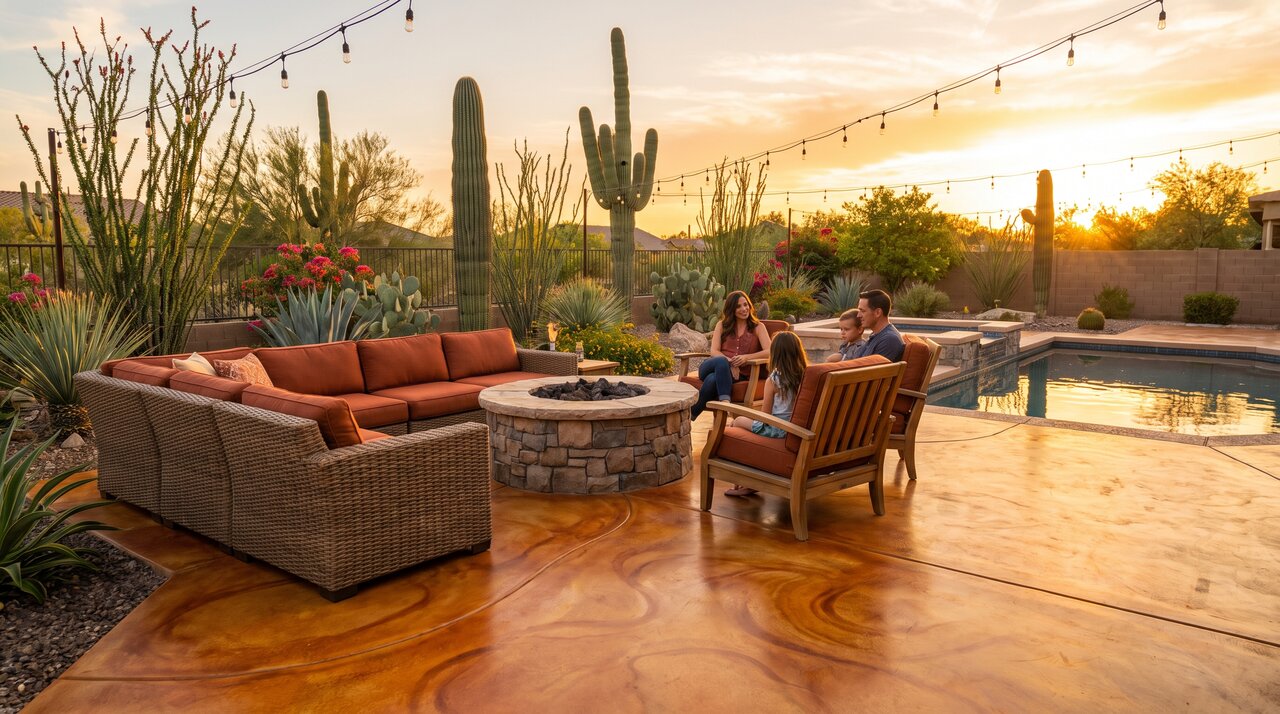
Phoenix outdoor patios endure conditions that destroy most decorative concrete finishes: UV radiation at 300+ sunny days per year, surface temperatures exceeding 160°F in summer, monsoon rain events dropping inches of water in hours, and thermal cycling that stresses every material on the slab. Acid-stained concrete, when properly executed with a UV-stable sealer, is one of the most durable and beautiful outdoor patio surfaces available in Arizona. This guide covers everything Phoenix homeowners need to know about stained concrete floors for outdoor patios in 2026.
1. Why Phoenix Homeowners Choose Stained Concrete for Outdoor Patios
Stained concrete has grown steadily as a patio surface choice in Phoenix for three reasons: it works with existing concrete, it produces colors that suit the desert landscape naturally, and properly sealed it outperforms nearly every competing surface in long-term durability and maintenance cost.
The economics are compelling. A new concrete pour plus acid staining and sealing runs $6–$12 per square foot total. Travertine pavers cost $15–$30 installed. Tile on a bed runs $12–$25. Flagstone runs $20–$40. For a 600 sq ft patio, stained concrete saves $5,000–$20,000 versus pavers or tile while producing a surface that's seamless, doesn't shift in Arizona's expansive clay soils, and can be re-stained or resealed decades later.
Aesthetically, acid stain produces variegated color - no two areas of the slab look identical. The natural variation complements desert landscaping, exposed aggregate surrounds, and stucco architecture in a way that uniform tile cannot. Arizona's terracotta, sand, and earth-tone stain palette is particularly suited to desert outdoor spaces.
2. Acid Stain Chemistry on Phoenix's Alkaline Outdoor Concrete
Acid staining is a reactive chemical process, not a paint or coating. Metallic salts in a dilute hydrochloric acid carrier react with calcium hydroxide in the concrete, forming permanent metalite compounds that cannot peel, chip, or be scrubbed off the surface.
Phoenix outdoor concrete has characteristics that affect stain behavior differently than interior slabs:
- High alkalinity from irrigation mineral deposits. Hard water irrigation deposits calcium carbonate on outdoor slabs over years. These deposits react vigorously with acid stain, creating high-contrast spots. Surface prep (diamond grinding or light acid washing to remove deposits) is critical for even results.
- Sun bleaching and UV oxidation. Outdoor slabs exposed to Arizona UV develop an oxidized surface layer that resists stain penetration. A light diamond grind opens the surface and produces more consistent, deeper stain color.
- Curing compound residue. New concrete slabs are typically sprayed with curing compound at pour. This compound must be completely removed before staining - it creates a vapor barrier that prevents chemical penetration. Diamond grinding is the only reliable removal method.
- Greater color variation. Outdoor concrete exposed to weather, irrigation, and temperature cycling shows more inherent variation than interior slabs. This is generally an advantage - acid stain on outdoor concrete typically produces richer, more natural-looking results than on interior flatwork.
3. Color Palette for Arizona Outdoors: Desert Earth Tones vs Bold Statements
Acid stain color selection for Phoenix patios involves both aesthetic preference and practical considerations around surface temperature and UV stability.
4. UV-Stable Sealer Selection for Phoenix Outdoor Concrete
Sealer selection is the most critical decision in any Phoenix outdoor stained concrete project. The wrong sealer fails in Arizona conditions within 1–2 seasons; the right sealer protects for 5–8 years.
5. Non-Slip Requirements for Wet Patio Areas Around Phoenix Pools
Pool deck and wet patio areas require careful slip resistance specification. The ANSI A137.1 standard and most Arizona municipality pool codes require a Dynamic Coefficient of Friction (DCOF) of 0.42 or higher for wet surfaces - and 0.60+ is strongly recommended for Phoenix pool decks where bare feet on hot, wet surfaces are the norm.
For stained concrete around Phoenix pools, slip resistance is achieved through sealer texture rather than aggregate broadcast (which would obscure the stain). Options:
- Anti-slip sealer additive: Shark Grip or equivalent polymer bead additive mixed into the final sealer coat. Provides adequate grip (DCOF 0.55–0.70 wet) while maintaining the translucent, color-enhancing appearance of the sealer. Barely visible at normal viewing distance.
- Textured sealer application: Polyaspartic applied by roller with a textured nap produces light orange-peel texture (DCOF 0.60–0.75 wet). Slight texture reduction in color depth - acceptable for most clients, notable for metallics.
- Broom finish preservation: If the original concrete has a broom finish, light diamond polishing (rather than full grinding) can preserve texture while still opening the surface enough for acid stain penetration.
ProEpoxy provides DCOF test results per ANSI A326.3 for all pool deck and exterior wet area installations.
6. Stained Concrete Patio Maintenance in Arizona's Monsoon Season
Arizona's monsoon season (July–September) delivers intense, short-duration rainfall - sometimes 2–3 inches in an hour. Stained concrete patios with a properly maintained sealer handle monsoon conditions without damage. Here's what to monitor:
- Water beading test: Pour a small amount of water on the sealed surface. If it beads into droplets, the sealer is intact. If water soaks in (darkens the surface within 30 seconds), resealing is overdue.
- Post-storm debris: Dust and caliche that blow in during haboobs (dust storms) deposit on the patio surface. Sweep or blow clean within 24 hours - caliche dust is highly alkaline and can etch degraded sealer films if left to dissolve with rain.
- Standing water: Sealed stained concrete is impermeable - pooled water will evaporate but won't penetrate. If standing water is a recurring problem, it indicates a drainage issue in the concrete slope, not a sealer problem.
- Sealer recoat timing: Plan exterior polyaspartic recoats for October–May in Phoenix - cooler temperatures improve pot life and extend working time. Summer application requires early morning starts before slab temperature exceeds 90°F.
7. Stained Concrete Patio vs Pavers: Phoenix Cost Comparison
| Factor | Acid-Stained Concrete | Travertine Pavers | Flagstone |
|---|---|---|---|
| Installed Cost (600 sq ft) | $3,600–$7,200 | $9,000–$18,000 | $12,000–$24,000 |
| Seam / Grout Lines | None (seamless) | Grout every 2–3 years | Irregular gaps |
| AZ Clay Soil Stability | Monolithic slab - no shift | Settles, lifts unevenly | Settles, lifts unevenly |
| Weed Intrusion | None | Grout joints - frequent | Gaps - frequent |
| Resealing Frequency | Every 5–7 years | Every 2–3 years | Every 2–3 years |
| Repair (cracked unit) | Epoxy crack fill + restain | Replace individual paver | Replace individual stone |
| Long-Term Maintenance Cost | Low | High | High |
The seamless, monolithic nature of stained concrete is a significant advantage in Phoenix's expansive clay soils, which swell and contract seasonally. Pavers and flagstone set in these soils develop uneven surfaces within 5–10 years regardless of installation quality. Stained concrete, poured on a properly subgraded and compacted base, moves as a unit.
8. Frequently Asked Questions
Get a Free Phoenix Patio Staining Quote
On-site assessment, color samples, and written estimate. Existing or new concrete welcome.