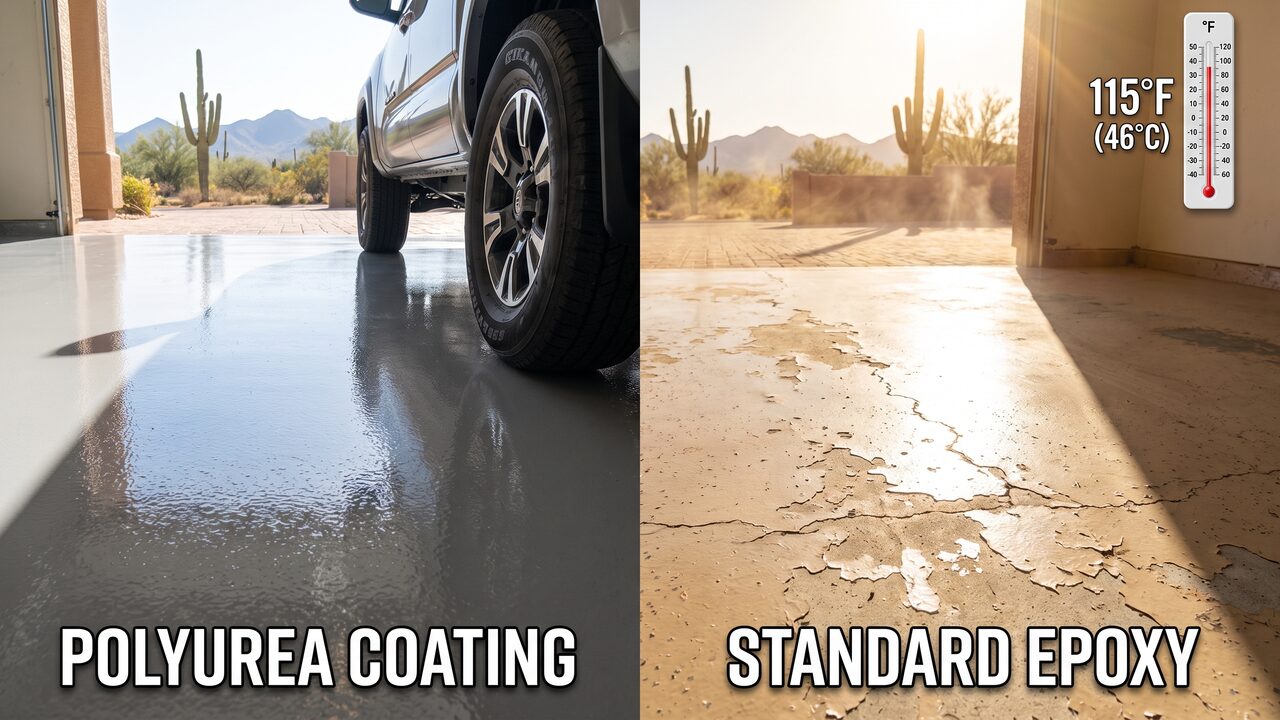
Phoenix garage and commercial floors face a punishing combination: 150–170°F surface temperatures in direct summer sun, 80°F+ daily thermal swings, and intense UV exposure over 300+ sunny days a year. Standard epoxy and polyurea floor coating Phoenix systems respond very differently to these conditions - and choosing wrong means premature failure.
1. The Phoenix Floor Coating Challenge: Why Standard Products Fail
Most floor coating products sold nationally are engineered and tested for moderate climates - 60–90°F ambient temperatures with limited direct sun exposure. Phoenix routinely exceeds these design parameters. A concrete slab in direct summer sun can reach surface temperatures of 150–170°F, well above the 130–140°F softening point of standard bisphenol-A epoxy.
This mismatch explains why so many Phoenix homeowners experience epoxy floor problems within 3–6 years that manufacturers rarely see in cooler markets: hot tire pickup, yellowing, and thermal cracking. The solution isn't a different color or a thicker coat - it's a fundamentally different chemistry suited to extreme heat.
2. Temperature Resistance: Polyurea vs Epoxy at Phoenix's 150°F Surface Temps
| Property | Standard Epoxy | Polyurea |
|---|---|---|
| Softening point | 130–140°F | 300°F+ |
| Hot tire pickup resistance | Poor above 140°F | Excellent |
| Thermal cycling tolerance | Moderate - cracks over time | High - flexible |
| Cold-morning brittleness | Moderate | Low |
Polyurea's polymer structure remains stable across a far wider temperature range than standard epoxy. Where epoxy begins to soften and become tacky in Phoenix summer heat - allowing vehicle tires to literally bond with the coating and peel it up when the car moves - polyurea retains its hardness and surface integrity even at 170°F+.
3. Cure Time and Usability: How Fast Each System Returns to Service
Cure speed is one of polyurea's biggest practical advantages for Phoenix homeowners and businesses:
- Standard epoxy: 24–72 hours to walk on, 5–7 days to full cure and vehicle traffic. Extended downtime for garages and commercial spaces.
- Pure polyurea: Tack-free in 5–20 seconds, walkable within hours, full vehicle traffic same day or next day. Ideal for commercial floors and busy Phoenix households that can't afford a week without their garage.
This speed comes from polyurea's moisture-insensitive, fast-reacting chemistry - a major advantage during Phoenix installations where crews want to minimize open-air cure time during peak heat.
4. Flexibility and Crack Resistance in Phoenix's Thermal Cycling
Phoenix concrete slabs expand and contract daily as surface temperatures swing 80–100°F between early morning and mid-afternoon. Standard epoxy, being relatively rigid, transmits this movement directly into the coating film, leading to hairline cracking at expansion joints and existing concrete cracks over 2–4 years of Phoenix exposure.
Polyurea's elastomeric properties - elongation rates of 300–500% compared to epoxy's typical 3–6% - allow the coating to flex with the substrate rather than crack. For garages and driveways with any history of concrete movement, this flexibility difference alone often justifies the switch to polyurea.
5. UV Resistance: Which Stays Looking Good in Arizona's Intense Sun
Arizona's UV index frequently exceeds 10 (very high) for 6+ months of the year. Standard epoxy topcoats, even when marketed as UV-resistant, typically yellow or chalk within 2–4 years of unshaded Phoenix sun exposure. Aliphatic polyurea and polyurea-polyaspartic hybrid topcoats are formulated specifically to resist UV degradation, maintaining color stability for 10+ years.
For any Phoenix installation with direct sun exposure - driveways, uncovered patios, west-facing garage doors left open - a UV-stable polyurea or polyaspartic coating topcoat is essential regardless of the base system chosen.
6. Cost Comparison: Polyurea vs Epoxy for Phoenix Garages and Commercial Floors
| System | $/sq ft Installed | Typical Phoenix Lifespan | Best For |
|---|---|---|---|
| Standard Epoxy (no polyurea topcoat) | $3–$5 | 3–6 years | Budget, low-sun-exposure areas |
| Epoxy Base + Polyurea Topcoat | $5–$8 | 12–18 years | Most Phoenix garages (recommended) |
| Pure Polyurea (direct to concrete) | $6–$10 | 15–20 years | Commercial, industrial, fast turnaround |
The 20–30% premium for polyurea over standard epoxy pays back within 3–5 years through avoided repair and recoat costs. For most Phoenix homeowners, the math clearly favors polyurea - either as a topcoat over decorative epoxy, or as a pure system for utilitarian spaces.
7. The ProEpoxy Recommendation: When to Use Each System
Best of both: epoxy's decorative flexibility (color, flake, metallic) with polyurea's heat and UV performance on top. This is what we install on nearly every Phoenix garage floor.
Best for commercial floors, warehouses, and any project needing same-day return to service. Higher upfront cost offset by minimal downtime and longest service life.
Only recommended for shaded garages, indoor spaces with minimal sun exposure, or short-term budget constraints. Expect shorter service life in direct Phoenix sun.
For commercial epoxy applications and any floor needing repair, our team evaluates existing conditions before recommending a system - see our epoxy floor repair guide for diagnosing whether recoating or full removal is needed, and our garage epoxy floor guide for residential specifics.
8. Frequently Asked Questions
Not Sure Which System Fits Your Floor?
Free on-site assessment and system recommendation based on your Phoenix floor's sun exposure and use.