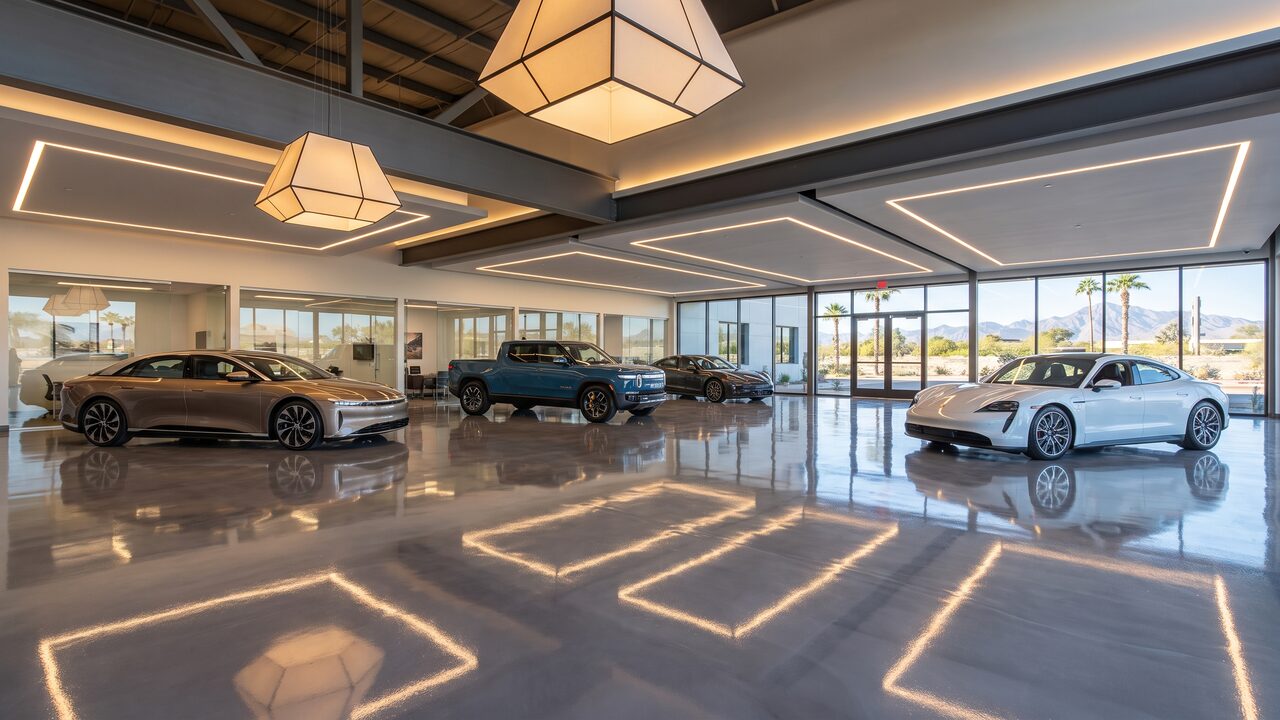
Over the past several years, we've watched a steady shift among our dealership clients toward polyaspartic floor coating Phoenix systems for both showroom and service bay floors, replacing standard epoxy as the default choice. The reasons come down to two things dealership operators care about most: minimizing downtime and keeping a showroom floor looking new under nonstop vehicle and foot traffic.
This guide walks through why that shift is happening, what specifically epoxy struggles with in a dealership environment, and how to weigh the cost difference against the operational benefits.
Phoenix's auto retail corridor along the I-17, the 101, and the Camelback area has seen a wave of dealership remodels over the past few years as franchises update showrooms to match new brand standards, and flooring has quietly become one of the more consequential decisions in those remodels - not because it's the most expensive line item, but because getting it wrong means either a compromised look within a couple of years or a service department that loses revenue every day the floor is under construction.
1. The Dealership Flooring Problem: Downtime and Durability
Dealership flooring faces a combination of constant vehicle weight, frequent tire contact, foot traffic, and - in service areas - chemical exposure that most commercial flooring never has to handle simultaneously, which is why generic commercial epoxy specs often underperform in this specific environment.
A showroom floor isn't just decorative; it's a sales tool that needs to look immaculate every single day the dealership is open. A service bay floor takes far more physical abuse - rolling jacks, dropped tools, chemical spills - while also needing to look presentable enough for customers who walk through on their way to the service desk. Any flooring project at a dealership also has to work around an operational reality most other commercial spaces don't face: a dealership can rarely afford to close for days at a time during a floor renovation.
The Franchise Standards Angle
Many manufacturer franchise agreements now specify facility image standards that touch on flooring appearance directly, particularly for showroom areas. A dulled, scuffed, or yellowing floor can become a facility-standards compliance issue at a brand audit, not just an aesthetic complaint - which is pushing more Phoenix dealerships to treat flooring durability as a brand-compliance investment rather than a discretionary upgrade.
2. Why Standard Epoxy Falls Short for Showroom Traffic
Standard epoxy falls short in dealership environments primarily on two fronts: cure time, which extends project downtime beyond what a busy dealership can tolerate, and long-term scratch/scuff resistance under constant vehicle and cart traffic.
| Factor | Standard Epoxy | Polyaspartic |
|---|---|---|
| Cure time to foot traffic | 12-24 hours | 1-4 hours |
| Cure time to vehicle traffic | 3-7 days | 24 hours |
| UV stability (showroom glass exposure) | Fair - can yellow over years | Excellent - UV-stable aliphatic chemistry |
| Scratch/scuff resistance | Good | Excellent |
The UV stability point matters more than dealerships often expect going in - a showroom's floor-to-ceiling glass frontage, designed to show off vehicles in natural light, also means the floor itself takes years of direct and reflected sun exposure that a standard epoxy topcoat can slowly yellow under, undermining exactly the polished appearance the showroom is designed to project.
Phoenix showrooms face this UV exposure more intensely than dealerships in most other markets - the Valley sees well over 300 sunny days a year, and showroom glass is typically oriented to maximize natural light on the vehicles rather than to minimize solar exposure on the floor. A coating choice that performs fine in a market with more cloud cover or shorter sun hours can visibly underperform once installed under Phoenix's near-constant direct and reflected light.
3. Polyaspartic's Fast Cure Advantage for Dealership Schedules
Polyaspartic's fast cure - often ready for vehicle traffic within 24 hours versus 3-7 days for standard epoxy - is the single biggest reason Phoenix dealerships are switching, since it directly translates to less lost service revenue and showroom downtime during a flooring project.
For a service department, this cure speed enables an install approach dealerships increasingly ask for by name: coating one or two bays overnight, bringing them back into service the next morning, then moving to the next section. A standard epoxy project timeline simply can't support this bay-by-bay approach without an unacceptably long total project duration, since each section needs several days of cure before it can handle a vehicle again.
A typical phased approach for a mid-size Phoenix dealership service department might sequence four to six bays per night across a week to ten days, versus a standard epoxy timeline that could easily stretch a comparable job to three or four weeks once cure windows are factored in bay by bay. For a franchise dealership where every service bay represents real daily revenue, that difference in total project duration is often the deciding factor on its own, independent of any durability argument.
Scheduling around a dealership's slowest days also helps minimize disruption further. Many Phoenix dealerships see their lightest service traffic early in the week, and coordinating a phased polyaspartic install around that natural lull - rather than a rigid calendar sequence - lets a facility absorb the project with even less visible impact on customers than the cure-speed advantage alone would provide.
4. Scratch and Chemical Resistance in High-Traffic Showrooms
Polyaspartic's denser, more scratch-resistant topcoat holds up better under the specific combination of stresses a dealership floor experiences: rolling display stands, foot traffic in dress shoes and boots, and - in service areas - regular exposure to motor oil, brake fluid, and cleaning chemicals.
High-heel and hard-sole shoe traffic scuffs standard epoxy visibly over time; polyaspartic's harder surface resists this scuffing significantly better.
Repeated tire contact during showroom repositioning and service bay pull-ins is a leading cause of standard epoxy wear patterns near entry points.
Motor oil, brake fluid, and coolant resistance is meaningfully better on polyaspartic - see our dedicated polyaspartic floor coating resistance data for specifics.
Jacks, dollies, and parts carts create point-load stress that a denser polyaspartic topcoat distributes and resists better than standard epoxy.
Automotive service areas considering a coating upgrade should also review our automotive epoxy flooring guide for a fuller picture of system options, and if your facility handles heavier commercial vehicle service, polyurea coating is worth discussing as an even faster-curing alternative for the most demanding bays.
Slip resistance deserves its own mention here, since it sits at the intersection of safety and liability for any dealership. Polyaspartic topcoats can be formulated with a texture additive to achieve appropriate slip resistance in service bays without sacrificing the smooth, easy-to-clean surface a showroom needs - a customization standard epoxy also offers, but one where polyaspartic's better long-term wear characteristics mean that texture profile holds up longer before needing to be refreshed.
5. Case for Switching: Cost vs Long-Term Value
Polyaspartic typically costs 15-25% more per square foot than standard epoxy, but for a busy Phoenix dealership, the reduced downtime and longer service life usually make it the lower total-cost option once lost service revenue and more frequent recoat cycles are factored in.
A dealership calculating the real cost of a flooring project needs to account for more than material and labor price per square foot - every day a service bay is out of commission during a standard epoxy cure is lost service revenue, and every year a showroom floor looks visibly worn is a subtle drag on the sales environment a dealership works hard to maintain. When we walk dealership clients through both numbers side by side, polyaspartic's total-cost picture wins more often than the upfront price difference alone would suggest. For dealerships also considering a polished concrete alternative for select areas like a customer lounge, our polished concrete guide covers how that option compares on cost and maintenance. And for the broader commercial context behind any dealership flooring decision, our commercial epoxy flooring guide is a useful companion resource.
Recoat frequency is the other half of the total-cost equation that's easy to overlook at the time of the original purchase decision. A standard epoxy showroom floor under Phoenix's UV exposure and daily traffic often needs a full recoat or refresh within 5-7 years to maintain a showroom-quality appearance, while a properly installed polyaspartic system commonly extends that interval to 8-10 years or more. Multiplied across a dealership's expected facility lifespan, that difference in recoat cycles alone can offset most or all of the initial price premium, which is the calculation that ultimately convinces most of the dealership operators we work with in Phoenix.
6. Frequently Asked Questions
Plan a Phased Dealership Install
Free consultation on a bay-by-bay polyaspartic install that keeps your dealership open.