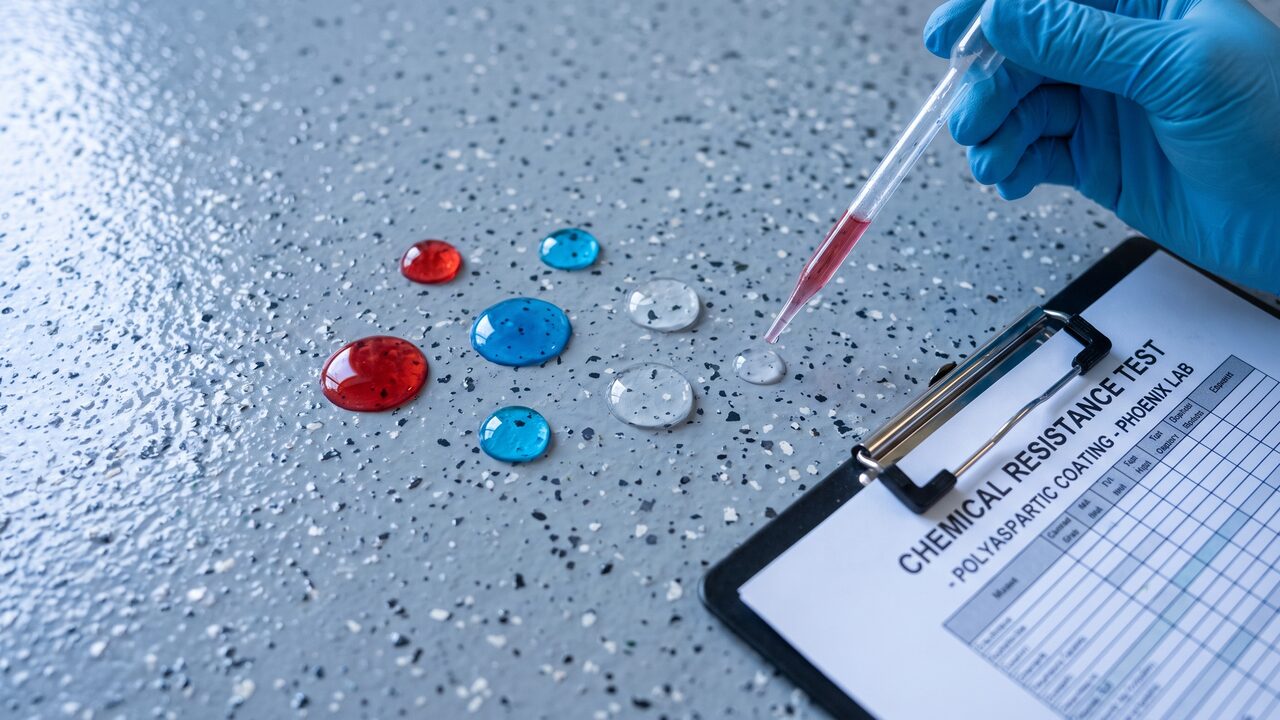
Choosing a polyaspartic floor coating Phoenix installers actually recommend for a garage, shop, or lab comes down to one practical question: what's going to spill on this floor, and how well will the coating hold up against it? This guide breaks down real chemical resistance data across the substances Phoenix homeowners and business owners deal with most - motor oil, brake fluid, battery acid, industrial solvents - so you can pick a topcoat that matches what actually happens on your floor.
Polyaspartic and epoxy are often talked about interchangeably, but their chemical resistance profiles aren't identical. Understanding where they differ matters most in spaces where a wrong choice means recoating within a year or two instead of getting a decade of service out of the floor.
The charts below reflect what we see consistently across hundreds of Phoenix installs - residential garages, independent auto shops, warehouses, and a handful of light industrial and lab spaces. They're a starting point for the conversation, not a substitute for a site-specific consultation, since exact resistance depends on coating thickness, cure time, and how quickly a spill gets cleaned up.
1. Why Chemical Resistance Matters for Phoenix Floors
Chemical resistance matters for Phoenix floors because the desert climate concentrates spills rather than diluting them - high heat accelerates evaporation, which can leave a more concentrated residue sitting on the coating surface longer than the same spill would in a cooler, more humid region.
A garage floor exposed to dripping motor oil, antifreeze, and brake fluid needs a different resistance profile than a lab floor exposed to reagent-grade acids, and both are different again from a restaurant kitchen dealing with grease and sanitizing chemicals. Specifying the wrong topcoat for the exposure you actually have is one of the most common - and most expensive - mistakes we see when a floor fails prematurely.
Cure Time Affects Resistance
An often-overlooked factor is cure time. Both epoxy and polyaspartic reach full chemical resistance only after the resin has completely cross-linked, which can take several days to a couple of weeks depending on the product and ambient temperature - a floor that looks and feels hard to the touch may still be days away from its rated chemical resistance. We always tell Phoenix customers to hold off on parking a freshly serviced vehicle with a known fluid leak on a brand-new floor until the full cure window has passed, even if the surface already seems dry and walkable.
2. Chart: Motor Oil, Brake Fluid, and Coolant Resistance
Polyaspartic and 100%-solids epoxy both resist common automotive fluids well when cleaned up within a reasonable window, but polyaspartic's denser crosslink structure gives it a meaningful edge against staining from prolonged exposure.
| Chemical | Standard Epoxy | Polyaspartic | Cleanup Window |
|---|---|---|---|
| Motor Oil | Good - may stain if left overnight | Excellent - minimal staining | Wipe within 24 hrs |
| Brake Fluid | Fair - can etch surface | Good - resists etching | Wipe promptly, within hours |
| Antifreeze/Coolant | Good | Excellent | Wipe within 24 hrs |
| Transmission Fluid | Good | Excellent | Wipe within 24 hrs |
Brake fluid deserves special attention - it's one of the few common automotive chemicals that can visibly etch standard epoxy if left to sit, which is a common reason DIY garage floors develop dull spots near where a car is regularly serviced. Glycol-based brake fluid is hygroscopic, meaning it absorbs moisture from the air, and that moisture uptake can compound its softening effect on a lower-grade coating the longer it sits.
Hot Phoenix summer pavement outside the garage also plays a role indirectly: a hot tire pulling into a garage carries residual heat into the coating for the first few minutes after parking, and combined with a fresh fluid drip, that heat can accelerate how quickly a chemical penetrates an under-cured or lower-quality coating. It's one more reason we recommend polyaspartic for any Phoenix garage with regular DIY maintenance work happening on the same spot of floor.
3. Chart: Battery Acid and Cleaning Chemical Resistance
Battery acid and common cleaning chemicals are both well-tolerated by polyaspartic and quality epoxy systems, but concentration and dwell time still matter - a fully cured topcoat handles a brief spill far better than a chronic slow leak that sits in the same spot for weeks.
Both systems resist brief exposure well. A slow battery leak sitting in one spot for an extended period can eventually etch even polyaspartic - clean up promptly.
Excellent resistance on both systems. Safe for regular use in normal cleaning routines.
Good resistance at typical household dilution. Full-strength bleach left standing for extended periods can dull gloss over time.
Most citrus and alkaline degreasers are well-tolerated; always rinse thoroughly after use to avoid residue buildup.
Car batteries in Phoenix have a shorter average lifespan than in milder climates - extreme summer heat accelerates the internal chemical reactions that eventually wear a battery out - which means Phoenix garage floors statistically see more battery-related spills and corrosion over a vehicle's life than floors in cooler regions. That's a strong argument for polyaspartic in any garage where a vehicle is regularly parked over the same spot, since the added margin against acid exposure pays off over the life of the floor.
4. Chart: Lab and Industrial Solvent Resistance
Standard polyaspartic and epoxy systems are not automatically rated for aggressive lab and industrial solvents - strong solvents like MEK, acetone, and lacquer thinner can soften even a quality polyaspartic topcoat if left standing, which is why specialty chemistry exists for these environments.
| Solvent/Chemical | Standard Polyaspartic | Specialty Novolac Epoxy |
|---|---|---|
| MEK / Acetone | Fair - can soften if not wiped promptly | Excellent |
| Lacquer Thinner | Fair | Excellent |
| Concentrated Acids (lab grade) | Fair - not rated for extended exposure | Excellent - purpose-formulated |
| Xylene/Toluene | Fair | Good to excellent |
Any Phoenix lab, manufacturing facility, or shop regularly handling these chemicals should specify a purpose-built chemical-resistant topcoat rather than assuming a standard commercial epoxy flooring or polyaspartic system will hold up - this is a case where the general-purpose product genuinely isn't the right tool for the job.
Novolac epoxy resins get their enhanced resistance from a more rigid, tightly cross-linked molecular structure than standard bisphenol-A epoxy, which makes them significantly better at resisting swelling and softening from aggressive solvents - but that same rigidity makes them less flexible and more prone to cracking under thermal movement, so they're typically specified only where the chemical exposure genuinely requires it rather than as a default choice.
5. Choosing the Right Topcoat for Your Chemical Exposure
Choosing the right topcoat starts with an honest inventory of what actually touches your floor regularly, not what might happen occasionally - a residential garage with occasional oil drips has very different needs than a shop performing daily brake jobs or a lab running solvent-based processes.
- Residential garage, occasional automotive fluids: Standard polyaspartic or 100%-solids epoxy handles this well and is the most cost-effective choice.
- Auto shop, daily brake and fluid work: Polyaspartic is the stronger baseline choice given its better resistance to brake fluid etching; our automotive epoxy flooring guide covers shop-specific system options in more depth.
- Warehouse or industrial floor with general chemical exposure: A warehouse epoxy system rated for the specific chemicals in your process is the right starting point for a consultation.
- Lab or facility with concentrated solvents/acids: Specialty novolac epoxy, not standard polyaspartic, is required - flag this during your estimate so we can scope the correct system.
- ESD-sensitive environment with chemical exposure: ESD anti-static epoxy systems can be formulated with enhanced chemical resistance for electronics manufacturing floors.
- Restaurant or commercial kitchen: Grease and sanitizer exposure calls for a slip-resistant textured topcoat rated for food-service environments, in addition to chemical resistance.
It's also worth noting that most manufacturers offer several tiers within both the epoxy and polyaspartic product families, so "polyaspartic" alone doesn't guarantee a specific resistance level - a budget-tier polyaspartic product can actually underperform a premium epoxy system on certain chemicals. This is exactly why we specify by exposure and manufacturer data sheet rather than by generic product category when scoping a Phoenix project with known chemical exposure.
When in doubt, describe your actual use case in detail during your free estimate rather than assuming a standard system will cover an edge case - this is the single easiest way to avoid a premature recoat.
Maintenance habits matter as much as the coating spec itself. Keeping a designated absorbent mat under a vehicle with a known slow leak, wiping spills within the recommended window, and avoiding harsh abrasive scrubbing on a fresh coating all extend the practical life of any system - even the most chemical-resistant polyaspartic floor will underperform its rating if spills are routinely left to sit for days at a time. A quick rinse-and-wipe routine after any known spill is the cheapest insurance a Phoenix garage or shop floor can get.
6. Frequently Asked Questions
Get the Right Coating for Your Chemical Exposure
Free on-site consultation to match your floor system to what actually touches it.