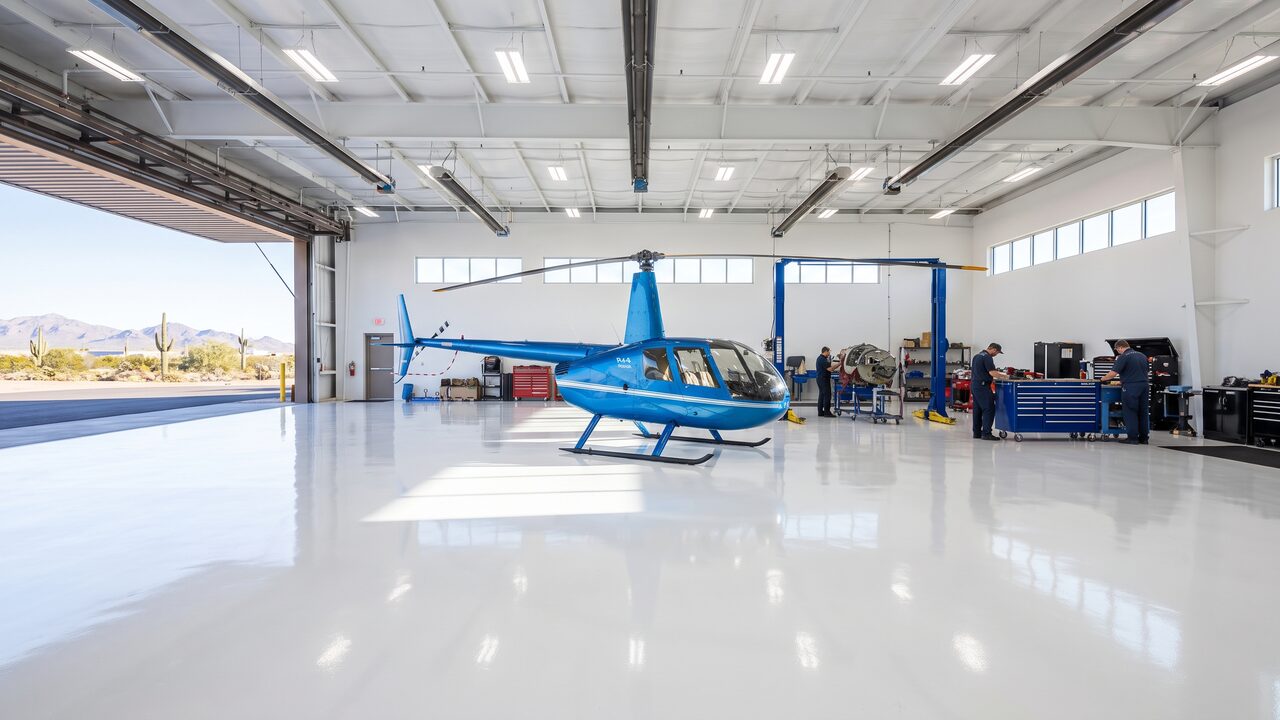
Not all hangars have the same flooring needs. While our main aircraft hangar epoxy flooring Phoenix guide covers general fixed-wing requirements, helicopter operations and light sport aircraft (LSA) facilities have distinct floor demands driven by rotor wash, maintenance intensity, and different budget realities for private owners.
1. Helicopter Hangars vs Fixed-Wing: Different Flooring Requirements
Fixed-wing aircraft taxi in predictable straight paths, concentrating fluid drips and wear along consistent wheel tracks. Helicopters operate very differently - ground handling wheels or dollies move in multiple directions, and the aircraft itself generates significant downward and outward airflow during engine run-up and shutdown that spreads any surface contaminants across a much wider floor area than fixed-wing operations produce.
2. Rotor Wash and Fuel Mist: Chemical Challenges Unique to Helicopter Hangars
During engine start and shutdown procedures, minor fuel and hydraulic fluid residue can become aerosolized by rotor wash and settle across a wider floor footprint than a fixed-wing aircraft would produce from the same minor leak. This makes uniform chemical resistance across the entire hangar floor - not just directly beneath the aircraft - a genuine requirement rather than a nice-to-have for helicopter facilities.
3. Anti-Fatigue Properties: Phoenix Maintenance Technicians Working Long Hours
Helicopter maintenance often involves extended periods of technicians standing on the hangar floor during inspections, avionics work, and component servicing - more standing time than typical fixed-wing turnaround maintenance. While epoxy itself is a hard surface, proper film thickness (50+ mil) and aggregate broadcast texture provide meaningfully better underfoot comfort than bare or thin-coated concrete, reducing technician fatigue over long Phoenix workdays.
4. Non-Slip Requirements for Spinning Rotor Environments
Fine aluminum oxide or silica aggregate broadcast provides slip resistance without compromising the smooth appearance needed for equipment rolling.
Coating must maintain slip resistance even when contaminated with hydraulic fluid or fuel - critical near active rotor systems.
Clear floor marking of safe approach zones and rotor arc boundaries improves ground crew safety awareness.
5. Light Sport Aircraft (LSA) Hangars: Simplified Requirements and Budget Options
Light sport aircraft - significantly lighter than commercial or corporate aircraft - impose far less structural and chemical demand on hangar floors. LSA owners in Phoenix can often specify simpler, more economical systems: standard commercial-grade epoxy with basic anti-slip broadcast, without the full NFPA 409 flammable-liquid-storage specifications required for larger maintenance hangars handling significant fuel volumes.
6. T-Hangar Epoxy for Phoenix Private Owners: Cost-Effective Aviation Flooring
T-hangars - individual aircraft storage bays typically 900–1,200 square feet - represent the most budget-conscious segment of Phoenix's aviation flooring market. Private owners renting or owning a single T-hangar bay can choose between full epoxy systems for maximum durability and appearance, or basic concrete grind-and-seal for owners prioritizing budget over aesthetics while still achieving dust control and easier cleaning than bare concrete.
7. Hangar Lighting Optimization Through High-Reflectivity Floor Coatings
Hangar interiors often rely on a limited number of high-bay fixtures to illuminate large volumes of space. White or light grey high-gloss epoxy floors significantly increase ambient light reflectivity, improving visibility for maintenance work and inspections while reducing the lighting fixture count or wattage needed to achieve target illumination - a direct electricity cost saving relevant to Phoenix's high commercial power rates. See our ESD anti-static epoxy guide for avionics bay-specific static control requirements, and commercial epoxy or warehouse epoxy for related large-facility systems.
8. Frequently Asked Questions
Free Hangar Floor Consultation
On-site assessment and NFPA 409 compliance guidance for your Phoenix hangar project.