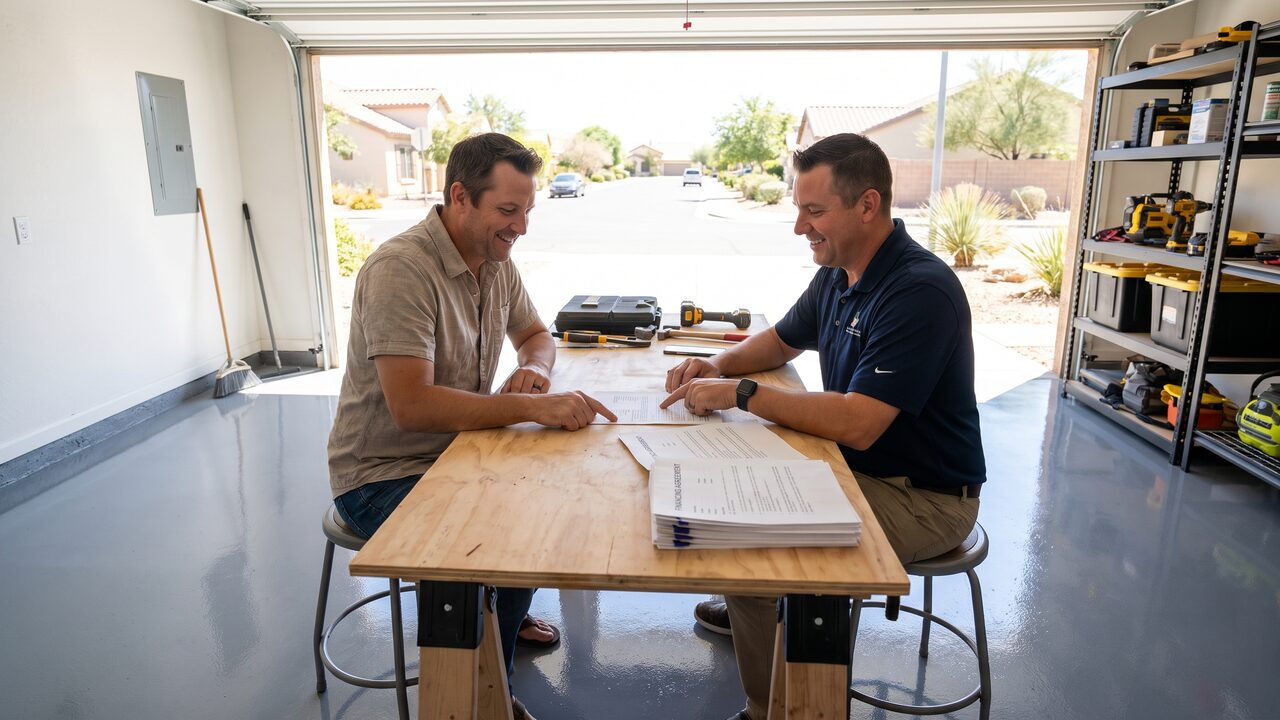
Most homeowners considering an epoxy garage floor Phoenix upgrade have more financing options than they realize - this isn't a project most people need to pay entirely out of pocket in one lump sum. This guide compares the three paths Phoenix homeowners use most often: promotional 0% APR financing, home equity lines of credit, and in-house contractor payment plans, so you can weigh what fits your specific financial situation.
This is general information about how these financing types typically work, not personalized financial advice - your own credit profile, existing debt, and financial goals should guide the final decision, ideally with input from a financial advisor for larger amounts or if you're unsure which option makes sense for you.
We field financing questions from Phoenix homeowners across a wide range of situations - some paying cash without a second thought, others carefully weighing whether a garage floor upgrade is worth taking on new debt for. There's no universally right answer, but understanding how each option actually works in practice makes it much easier to have that conversation with your own lender, HELOC provider, or contractor with confidence.
1. Why Homeowners Finance Garage Flooring Projects
Homeowners finance garage flooring projects for the same reason they finance other home improvements: spreading a several-thousand-dollar cost over months or years rather than depleting savings or a large chunk of available credit all at once, especially when a metallic or flake system pushes the total investment higher than a basic solid-color floor.
Financing also lets some homeowners choose a premium finish they'd otherwise defer - moving from a budget solid-color epoxy to a full flake system or metallic finish becomes more approachable when the cost is spread across a promotional financing period rather than paid upfront in full.
When Financing Makes Less Sense
Not every situation calls for financing. If you have the cash available and no competing near-term expense, paying upfront avoids any interest risk entirely and simplifies the transaction to a single payment. Financing earns its value specifically when it lets you preserve liquidity for other needs, take advantage of a genuinely favorable promotional rate, or spread a larger project cost across a period that better matches your cash flow - not simply because financing is available.
2. 0% APR Promotional Financing: How It Works
0% APR promotional financing works through a third-party lending partner that pays the contractor directly while the homeowner repays the loan over a promotional period - typically 6-18 months - during which no interest accrues as long as the balance is paid off before the promotion ends.
| Feature | Typical Terms | Key Consideration |
|---|---|---|
| Promotional period | 6-18 months | Balance must be paid in full before it ends |
| Interest structure | Often "deferred interest" | Missing the deadline can trigger retroactive interest from day one |
| Approval basis | Credit check through lender | Terms vary meaningfully by credit profile |
| Application process | Usually quick, often same-day | Typically handled at the time of your estimate |
The deferred-interest structure is the single most important detail to understand before signing - it's different from true no-interest financing, and misunderstanding this distinction is the most common regret homeowners report after promotional financing.
Reading the actual loan agreement, not just the marketing material at the point of sale, is the only reliable way to know which structure you're getting. Look specifically for the words "deferred interest" versus "no interest" - the two phrases sound similar but describe very different financial outcomes if the balance isn't paid off in time. If the terms aren't clear from the paperwork, asking the lender directly to confirm in writing is a reasonable and normal request before signing.
3. Home Equity Line of Credit (HELOC) Considerations
A HELOC can offer a lower ongoing interest rate than promotional credit financing once the promotional period ends, since it's secured against your home's equity - but that security comes with real risk, since your home serves as collateral for the debt.
- Best suited for: Homeowners with substantial existing equity who are also considering other renovation projects a HELOC could fund alongside the garage floor.
- Cost structure: Typically variable-rate, tied to broader interest rate movements rather than a fixed promotional rate.
- Approval timeline: Generally slower than promotional financing - expect weeks, not same-day approval, if you don't already have a HELOC in place.
- Risk factor: Since your home secures the line of credit, this option carries more consequence than an unsecured promotional plan if repayment becomes difficult.
A HELOC makes more sense as a financing vehicle for a larger combined project - garage epoxy alongside a kitchen remodel or other renovation - than as the sole funding source for a garage floor alone, given the setup effort involved relative to the project size.
4. In-House Contractor Payment Plans
In-house contractor payment plans let you pay a garage epoxy project off in installments directly to the contractor rather than through a third-party lender, which can mean simpler paperwork but typically less favorable terms than a competitive promotional financing offer.
Not every Phoenix contractor offers this option, and terms vary significantly where it is available - some structure it as a simple deposit-plus-installments arrangement with no interest, while others build financing costs into the total price. Always ask for the total cost breakdown in writing before agreeing to an in-house plan, so you can compare it apples-to-apples against third-party financing options.
One advantage worth noting: an in-house plan keeps the entire relationship with a single point of contact rather than adding a third-party lender into the picture. If a warranty issue or scheduling question comes up mid-payment, you're dealing directly with the company that did the work rather than navigating between a contractor and a separate financing company - a simplicity some homeowners value even if the raw terms aren't quite as favorable as a competitive promotional offer.
5. Choosing the Right Option for Your Budget
Choosing the right financing option comes down to your specific credit profile, how quickly you can realistically pay off the balance, and whether you're comfortable using home equity as collateral - there's no single best answer that fits every homeowner's situation.
For a straightforward garage project you're confident you can pay off within a promotional window, 0% APR financing is often the most cost-effective choice as long as you're disciplined about the payoff deadline. For homeowners already planning a larger renovation, a HELOC may make more financial sense as a single financing vehicle covering multiple projects. And if your credit doesn't qualify for favorable promotional terms, an in-house contractor plan may be the most accessible path, even if the total cost runs slightly higher.
Whichever option you're considering, get a detailed quote first - comparing financing terms is only useful once you know the actual project cost. Our estimates cover system options from a basic solid-color floor up through epoxy flake system and metallic epoxy finishes, and if you're weighing polyaspartic against standard epoxy, our polyaspartic coating guide covers the cost difference in more detail. For homeowners considering financing a broader interior project alongside the garage, our residential epoxy guide is a useful next stop.
A practical starting sequence: get your quote, run the numbers on two or three financing paths against your own situation, and only then commit to a specific plan. Rushing straight into whatever financing option is offered first at the point of sale - without comparing it against a HELOC rate you might already qualify for, or simply against paying cash - is how homeowners end up with financing terms that weren't actually their best available option.
6. Frequently Asked Questions
Get a Quote and Explore Financing
Free estimate with financing options to discuss for your Phoenix garage project.