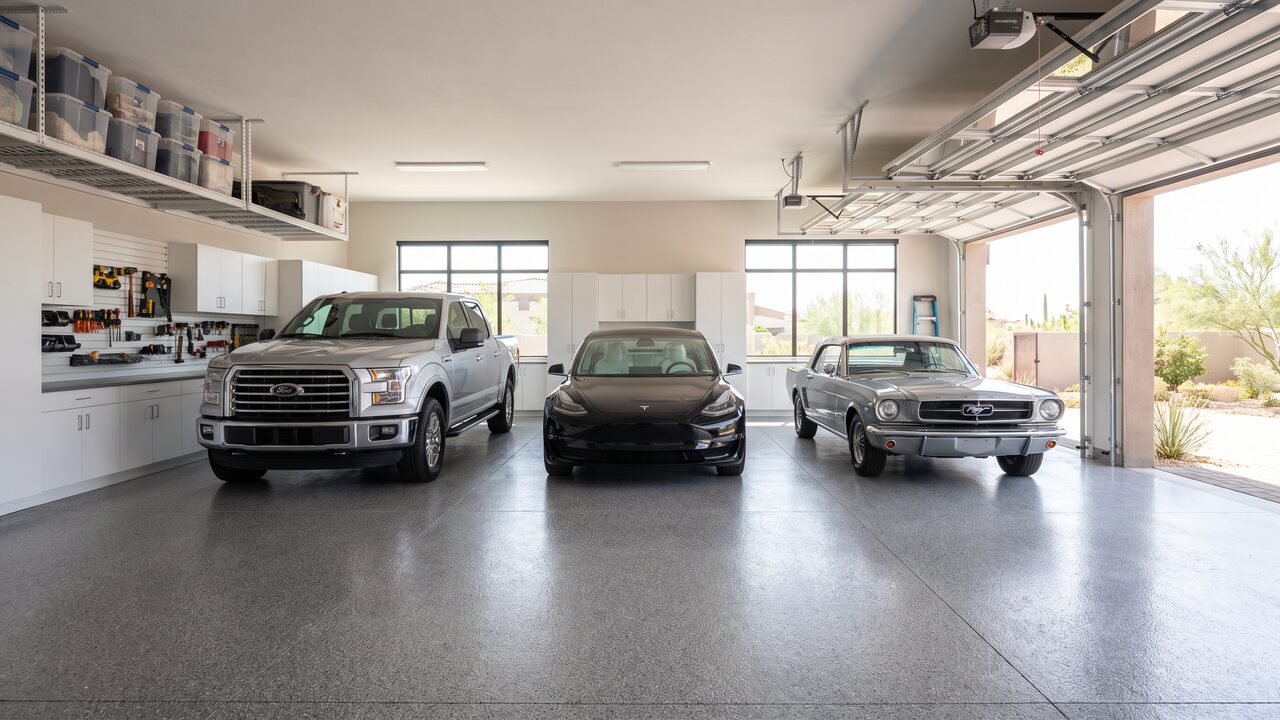
The most common question we field before any epoxy garage floor Phoenix estimate is a simple one: how much more does a 3-car garage cost than a 2-car? The honest answer isn't a clean doubling - it's usually 40-50% more, not 100% more, because a meaningful chunk of every project's cost is fixed setup and mobilization that doesn't scale directly with square footage.
This breakdown walks through real Phoenix pricing patterns across the three most common garage epoxy systems, so you can budget accurately whether you're planning a 2-car or 3-car install.
These figures come from actual Phoenix jobs across a range of neighborhoods and slab conditions - they're meant to give you a realistic planning range, not a binding quote. Every garage is a little different, and the only way to get an exact number is a free on-site assessment where we measure your specific space and inspect the slab condition firsthand.
1. Average Square Footage: 2-Car vs 3-Car Phoenix Garages
A standard Phoenix 2-car garage runs roughly 400-450 square feet, while a 3-car garage typically measures 650-700 square feet - about 55-60% more area, not double, which is the first reason 3-car pricing doesn't simply double either.
Phoenix new-build garages have trended larger over the past decade as builders add deeper bays for full-size trucks and SUVs common in the Valley, so a newer 3-car garage may run closer to 750 square feet, while an older 1990s or 2000s-era home might have a tighter 3-car footprint closer to 600 square feet. Getting an exact measurement - not a guess - is the first step to an accurate quote.
Why Square Footage Alone Doesn't Tell the Whole Story
Two garages with identical square footage can still price differently based on shape. A long, narrow tandem 3-car bay has more perimeter relative to its area than a squarer layout, which means more cutting-in work along walls and around support columns - a detail that a flat price-per-square-foot estimate from a competitor might not account for. This is one of several reasons two quotes for a "3-car garage" can differ meaningfully even before finish selection enters the conversation.
2. Cost Breakdown by System (Solid, Flake, Metallic)
Cost scales differently across the three most common garage epoxy systems, since material cost per square foot and application complexity both increase from solid color up through metallic finishes.
| System | 2-Car (400-450 sq ft) | 3-Car (650-700 sq ft) | % Increase |
|---|---|---|---|
| Solid-color 100% solids epoxy | $1,800-$2,600 | $2,700-$3,800 | ~45% |
| Epoxy flake system | $2,400-$3,200 | $3,600-$4,600 | ~44% |
| Metallic epoxy | $2,800-$3,500 | $4,100-$5,200 | ~46% |
These ranges reflect a typical, straightforward install on a slab in reasonable condition - an existing coating requiring removal, significant crack repair, or unusual layout features will move any of these numbers higher regardless of garage size.
The jump from solid color to flake reflects the added material cost of the broadcast chips themselves plus a slightly longer application process, since flake systems require a full broadcast-to-refusal step and typically a clear topcoat pass beyond what a solid-color floor needs. Metallic epoxy adds another layer of cost on top of that: the multi-color pigment techniques used to create metallic's signature marbled effect require a more experienced applicator and additional material passes, which is reflected in both the higher price and the longer install timeline compared to the other two systems.
3. Why Larger Garages Cost Less Per Square Foot
Larger garages cost less per square foot because equipment mobilization, floor prep setup, and crew travel time are largely fixed costs that get spread across more finished square footage - the marginal cost of coating an additional 250 square feet is lower than the average cost of the first 400.
In practice, this means a 3-car garage typically runs 10-15% less per square foot than a 2-car garage for the same system. It's a real, consistent pattern across Phoenix installs, and it's worth knowing when you see a quote that seems disproportionately high on a smaller project - the fixed-cost floor is simply a larger share of a smaller job's total price.
This same logic applies below the 2-car threshold too - a single-car garage or a small workshop bay under 300 square feet often carries a minimum project charge, since equipment setup, material mixing, and crew time don't shrink proportionally with a very small floor. If you're budgeting for a smaller space, it's worth asking about minimum project pricing directly rather than assuming the per-square-foot numbers above will scale down cleanly.
4. Add-On Costs: Baseboards, Steps, and Storage Areas
Coved baseboards, garage steps, and storage nook areas are common add-ons that aren't always included in a base garage epoxy quote, and confirming what's covered before comparing bids is essential to an apples-to-apples comparison.
- Coved baseboards: A 4-6 inch epoxy cove up the wall base gives a seamless, easy-to-clean finish and prevents moisture from wicking behind drywall - often quoted per linear foot as an add-on.
- Garage steps: Steps up into the house or down from a raised slab need to be coated separately and typically add a modest flat fee per step.
- Storage nooks and irregular layouts: An L-shaped garage, a workshop extension, or a golf cart bay adds square footage and cutting complexity that a standard rectangular quote won't capture.
- Existing coating removal: If your garage already has a failing coating, grinding it off adds labor cost regardless of the final system chosen - our epoxy floor repair team can assess this during your estimate.
- Crack repair: Structural or settlement cracks need to be routed and filled before coating, and the number and severity of cracks found during prep can meaningfully shift the final price on an older Phoenix slab.
Something worth flagging up front rather than discovering mid-project: many of these add-ons scale with linear footage or count rather than square footage, which means they don't follow the same "bigger garage costs proportionally less" pattern as the base floor coating. A 3-car garage with three steps and a full baseboard run around the perimeter will see a larger absolute add-on cost than a 2-car garage with the same features - even though the base floor itself benefits from the larger-footprint discount described above.
A same-day polyaspartic coating option is also worth asking about for either garage size if minimizing downtime matters more to you than the small cost premium over standard epoxy.
Add-ons tend to matter more, proportionally, on a 2-car garage than a 3-car one - a set of coved baseboards or a couple of steps represents a larger share of a smaller project's total cost. When comparing bids across contractors, ask each one to itemize add-ons separately from the base floor price rather than accepting a single bundled number, since that's the only way to fairly compare two quotes that may have made different assumptions about what's included.
5. Getting an Accurate Quote for Your Garage Size
Getting an accurate quote starts with an exact measurement of your specific garage, not a generic price-per-square-foot number pulled from a table - slab condition, layout, and any add-ons all shift the final price meaningfully from the ranges above.
If you're deciding between finishes, a epoxy flake system is our most popular mid-range choice for both 2-car and 3-car Phoenix garages, balancing durability and price well. A metallic epoxy finish is worth the premium if you're treating the garage as a showcase space rather than pure utility. And if your garage is part of a larger interior renovation, our residential epoxy guide covers how garage flooring pricing compares to interior living-space epoxy installs.
The only way to get a number you can actually budget around is a free on-site estimate - square footage, slab condition, and your finish preference all factor into the final price, and every quote we provide breaks these out clearly so you know exactly what you're paying for.
Comparing Multiple Bids
If you're collecting quotes from more than one Phoenix contractor, insist that each one measures your garage in person rather than pricing off a listing square footage or a rough guess - assessor records and MLS listings routinely misstate garage size, and a quote based on the wrong number isn't useful for comparison no matter how detailed it looks. Ask each contractor to itemize base floor cost, add-ons, and any prep or removal work as separate line items, since that's the only way to identify whether a lower total price reflects a genuinely better deal or simply a narrower scope of work than a competing bid.
It's also reasonable to ask what happens if the slab reveals additional issues once prep work begins - cracks, prior coating that turns out thicker than expected, or moisture problems that weren't visible during the initial walkthrough. A contractor who can explain their change-order process clearly before you sign is generally a better sign than one who simply promises the initial number is final regardless of what's found underneath.
6. Frequently Asked Questions
Get Your Exact Garage Price
Free on-site measurement and a detailed quote broken out by system and add-ons.