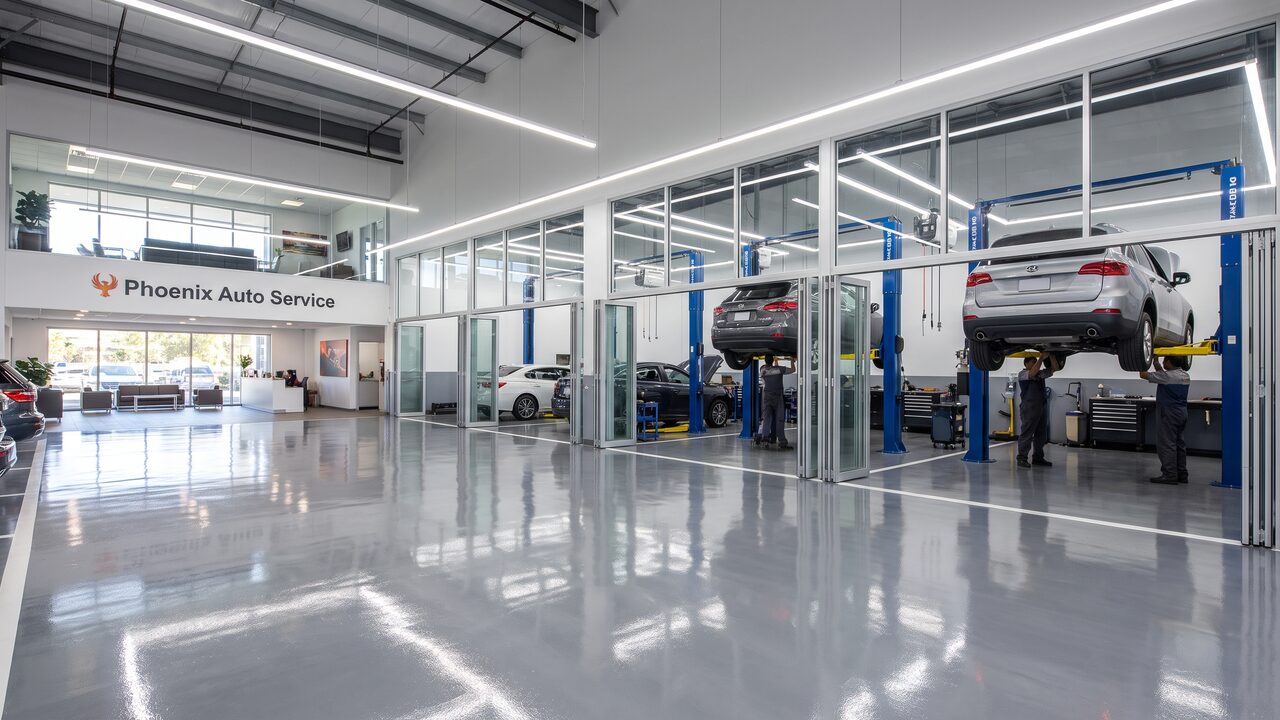
Automotive businesses place unique demands on automotive epoxy flooring Phoenix systems that differ meaningfully from general warehouse or retail applications - paint booth flammability codes, oil pit drainage, and the operational challenge of coating a working service department without a full shutdown.
1. Automotive Business Floor Needs: What's Different from Standard Commercial
Auto body shops, service departments, and dealerships face chemical exposure (solvents, oils, brake fluid, coolant), fire and static hazards in paint booths, and heavy rolling loads from lifts and vehicles - a combination of demands that requires more careful system specification than a typical retail or office commercial floor.
2. Body Shop Overspray Zones: Non-Porous Epoxy for Easy Cleanup
Paint overspray settles on every surface in a body shop, including the floor. Seamless, non-porous epoxy prevents overspray from bonding permanently the way it does on bare or painted concrete, allowing routine cleanup with solvent wipe-down rather than requiring re-painting or resurfacing the floor periodically.
3. Service Department Floors: Oil, Coolant, and Transmission Fluid Resistance
Service bay floors are exposed daily to motor oil, coolant, transmission fluid, and brake fluid - each with different chemical properties that can degrade an improperly specified coating. ProEpoxy specifies chemical-resistant epoxy or urethane topcoats rated for the full range of automotive fluids, with integrated trench drain covers and sloped sections directing spills toward drainage rather than allowing pooling.
4. Dealership Service Drive and Lane Markings
Service drives - the customer-facing intake and pickup lanes at Phoenix dealerships - need durable, clearly marked lane striping to organize vehicle flow, direct customers to the correct check-in point, and maintain a professional appearance under constant vehicle traffic. Epoxy-based striping paint holds up significantly better under Phoenix sun exposure than standard traffic paint used on unpainted asphalt drives.
5. OSHA Floor Compliance for Phoenix Auto Service Facilities
Physical hazard areas - aisles, pits, equipment zones
Fire protection equipment locations
Housekeeping areas and general aisles
Energized equipment warning zones
OSHA 1910.144 governs these color requirements, and Phoenix dealerships commonly add blue markings for ADA-designated parking on service drives, layering local accessibility compliance onto the federal safety color code.
6. Quick-Cure Polyurea for Phoenix Dealerships That Cannot Close
Full-service dealerships operating 20+ bays cannot absorb a multi-week shutdown for floor renovation. ProEpoxy uses fast-cure polyurea systems and phases installation by service bay group - typically 4–6 bays sealed overnight and returned to full service by morning. A large 20-bay department can complete an entire floor renovation in 5–7 nights without losing a single day of customer-facing operation.
7. Cost of Epoxy Flooring for Phoenix Automotive Businesses
| Space | System | $/sq ft Installed |
|---|---|---|
| Service Department (Standard) | Broadcast epoxy, urethane topcoat | $2–$4 |
| Full Chemical-Resistant System | Heavy broadcast + urethane | $4–$7 |
| Paint Booth (NFPA 33 compliant) | Static-dissipative epoxy | $6–$10 |
| Multi-Area Bundle | Service + wash bay + showroom | 15–25% discount |
Bundling service department, wash bay, and indoor showroom flooring into a single project reduces per-square-foot cost meaningfully compared to phased, separate projects. See our commercial epoxy flooring, polyurea floor coating, warehouse epoxy, and epoxy floor repair guides for related automotive and industrial flooring topics.
8. Frequently Asked Questions
Free Automotive Facility Quote
Phased installation planning and NFPA/OSHA compliance guidance for your Phoenix automotive business.