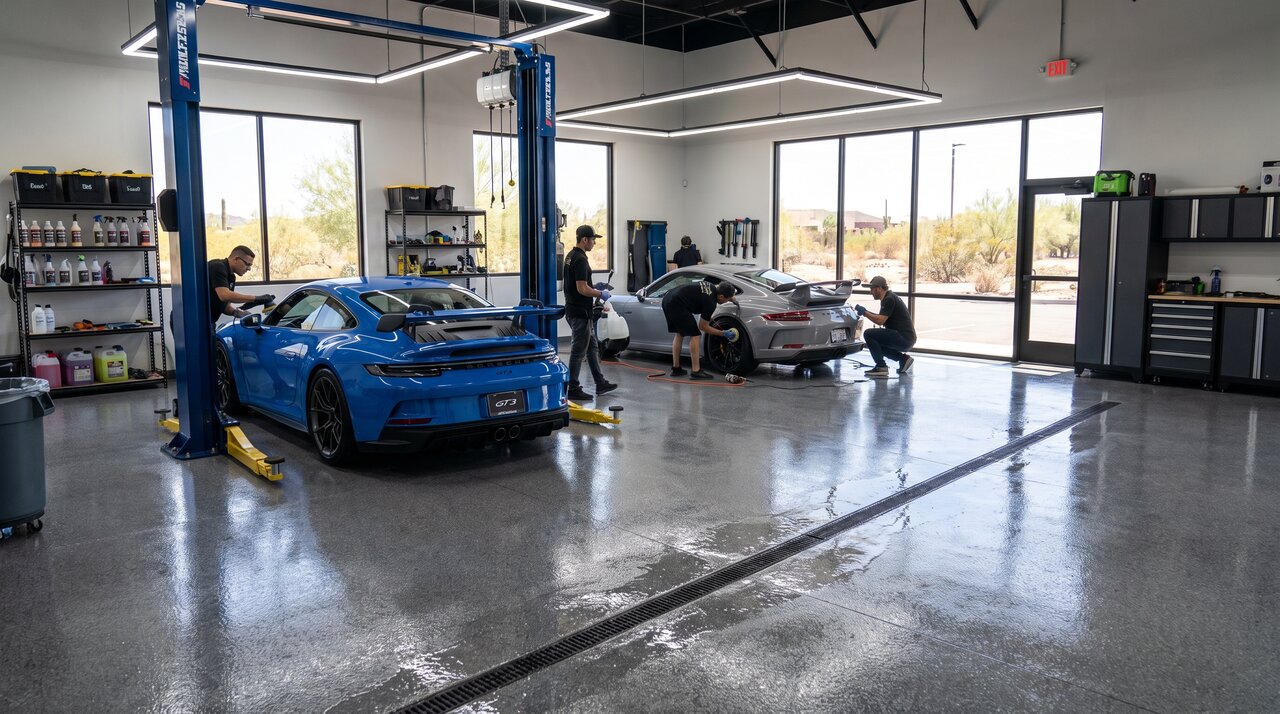
Phoenix auto detailing shops, body shops, and dealerships share a common flooring problem: the chemicals, water, and vehicle traffic in automotive environments destroy standard floor coatings within months. The solution is not simply "epoxy" - it's specifying the right epoxy system for the specific chemicals, drainage requirements, and traffic loads in your facility. This guide covers everything Phoenix automotive business owners need to know about automotive epoxy flooring in 2026.
1. Why Painted Concrete Fails in Phoenix Auto Detailing Environments
One-part latex or oil-based floor paint is the most common flooring "solution" in new detailing shops - and the most common flooring failure. In Phoenix automotive environments, these paints typically last 6–18 months before peeling, chipping, or staining through.
The failure mechanisms are straightforward. Detailing chemicals - degreasers, bug removers, iron fallout removers, clay lubricants, and wheel cleaners - contain acids, alkalines, and solvents that attack paint binders. Hot tire pickup occurs when vehicle tires (heat-softened after street driving) bond to warm paint surfaces and peel them away when the vehicle moves. Phoenix's summer slab temperatures (115–140°F) accelerate this dramatically. And water from washing and detailing penetrates paint films at microscopic defects, then freezes (rarely in Phoenix) or vapor-drives upward, delaminating the paint from below.
A properly formulated commercial epoxy system eliminates all three failure modes. The key is matching the system to your specific shop chemistry and traffic.
2. Chemical Exposure in Auto Shops: What Your Floor Coating Must Handle
Different automotive facilities use different chemical profiles. Understanding yours determines the correct coating specification:
| Facility Type | Key Chemicals | Recommended System | Why |
|---|---|---|---|
| Auto Detailing | pH 1–13 cleaners, iron removers, degreasers | 100%-solids epoxy + polyaspartic | Broad chemical resistance, easy to clean |
| Auto Body Shop | Lacquer thinner, acetone, MEK, primers | Novolac epoxy or polyurea | Ketone/solvent resistance required |
| Car Wash | High pH soaps, acids, surfactants, constant water | Quartz broadcast + polyaspartic | Slip resistance, waterproof, easy clean |
| Dealership Showroom | Light cleaners, occasional tire marks | Metallic or solid-color epoxy + poly | Aesthetics + durability balanced |
| Lube Shop / Quick-Change | Motor oil, ATF, coolant | 100%-solids epoxy, cove base | Petroleum resistance, spill containment |
Critical: Body Shop Solvent Resistance
Standard epoxy is NOT resistant to ketone solvents (acetone, MEK, lacquer thinner). If your shop uses these chemicals, standard epoxy will soften and fail within weeks of exposure. Novolac epoxy or polyurea floor coating systems are required for body shop environments. Always disclose your chemical inventory to your coating contractor before specification.
3. Anti-Slip Systems for Wet Detailing Bays and Car Wash Areas
Slip-and-fall incidents are the leading source of worker's compensation claims in automotive facilities. OSHA 1910.22(b) requires walking-working surfaces to be free from slipping hazards - and a wet, smooth epoxy floor is a direct violation.
Phoenix auto shop epoxy systems address slip resistance through aggregate broadcast into the topcoat. The correct aggregate type and broadcast rate depend on the zone:
- Vehicle movement areas: Fine aluminum oxide (60–80 grit) at 6 oz/sq ft. Provides grip without catching debris or causing trip hazards.
- Active wash bays / car wash: Coarse quartz aggregate (20–40 grit) at 10–12 oz/sq ft. Provides wet COF above 0.8 - well above the OSHA 0.5 minimum for wet surfaces.
- Pedestrian lanes and service counters: Fine polymer grit at 4 oz/sq ft. Comfort underfoot, easy to clean, adequate grip.
- Showroom floors: Micro-aggregate broadcast (finer than 100 grit) at 2–3 oz/sq ft. Barely visible but measurably improves wet COF without affecting appearance.
ProEpoxy provides coefficient of friction test results per ASTM C1028 for all automotive installations - documentation your insurance carrier and OSHA inspector can verify.
4. Drain-Friendly Epoxy: Slope-to-Drain and Seamless Cove Base
Phoenix detailing shops and car washes must comply with local stormwater regulations - water containing detailing chemicals, petroleum products, and tire residue cannot enter the storm drain system untreated. The floor coating system plays a direct role in containment.
The two critical design elements are slope-to-drain and cove base:
Slope-to-drain ensures all liquid reaches collection points rather than pooling or flowing to uncontrolled outlets. A minimum 1/8" per foot slope toward trench drains is standard for detailing bays. The epoxy system must accommodate this gradient - applied by squeegee at uniform thickness regardless of slope angle.
Cove base is the curved epoxy transition between floor and wall. Standard right-angle floor-wall corners trap water, chemicals, and debris and are virtually impossible to clean completely. Epoxy cove base (typically 4–6 inches high with a 3/4" radius) creates a seamless, scrubbable transition that eliminates the corner entirely. It also prevents the most common edge-failure mode, where water infiltrates behind the coating at the wall junction.
Both elements require additional labor and skill - contractors who skip them on automotive projects are cutting corners that will cause premature failure. Every ProEpoxy automotive installation includes slope verification and cove base as standard scope.
5. Body Shop Epoxy: Solvent and Overspray Resistance
Auto body shop environments present the most chemically demanding floor coating requirements in the automotive sector. Beyond the ketone solvents mentioned above, body shops deal with isocyanate-based primers, catalyzed urethane clearcoats, and abrasive media from sanding operations.
The correct floor system for a Phoenix body shop is a novolac epoxy primer and body coat, with a polyurea topcoat for impact resistance and additional chemical protection. Key performance requirements:
- Ketone resistance per ASTM D1308 (acetone, MEK, lacquer thinner): no blistering or softening at 24-hour spot test
- Impact resistance per ASTM D2794: minimum 80 in-lb direct and reverse
- Abrasion resistance per ASTM D4060 (CS17 wheel, 1000 cycles): <100 mg weight loss
- Overspray release: smooth topcoat surface allows dried paint overspray to be scraped cleanly without damaging the coating
Body shop floors also benefit from light-colored coatings (light grey or off-white) - they make dropped fasteners and components visible on the floor surface, reduce eye fatigue under work lighting, and show contamination quickly for cleaning compliance.
6. Dealership Showroom Floors: Durability Meets Aesthetics
Phoenix automotive dealerships face a unique challenge: the showroom floor must look premium enough to complement six-figure vehicles while withstanding constant foot traffic, vehicle movement, and periodic cleaning with commercial floor equipment.
7. Cost of Auto Shop Epoxy Floors in Phoenix
| System Type | Price/Sq Ft (Installed) | Best Application | Expected Lifespan |
|---|---|---|---|
| 100%-Solids Epoxy + Polyaspartic | $4–$7 | Detailing bays, lube shops | 10–15 years |
| Novolac Epoxy + Polyurea | $6–$10 | Body shops, solvent exposure | 12–18 years |
| Quartz Broadcast + Polyaspartic | $5–$8 | Car wash, wet bays | 10–12 years |
| Metallic Epoxy + Polyaspartic | $8–$14 | Dealership showrooms | 8–12 years |
| Polished Concrete | $5–$12 | Luxury showrooms | 20+ years |
All prices include diamond grinding, crack repair, and cove base. Night and weekend installation available for operating facilities. Call (888) 275-7078 for a written commercial quote with product specifications included.
8. Frequently Asked Questions
Get a Commercial Auto Shop Epoxy Quote
Written specifications, product data sheets, and on-site assessment included. Night and weekend installation available.