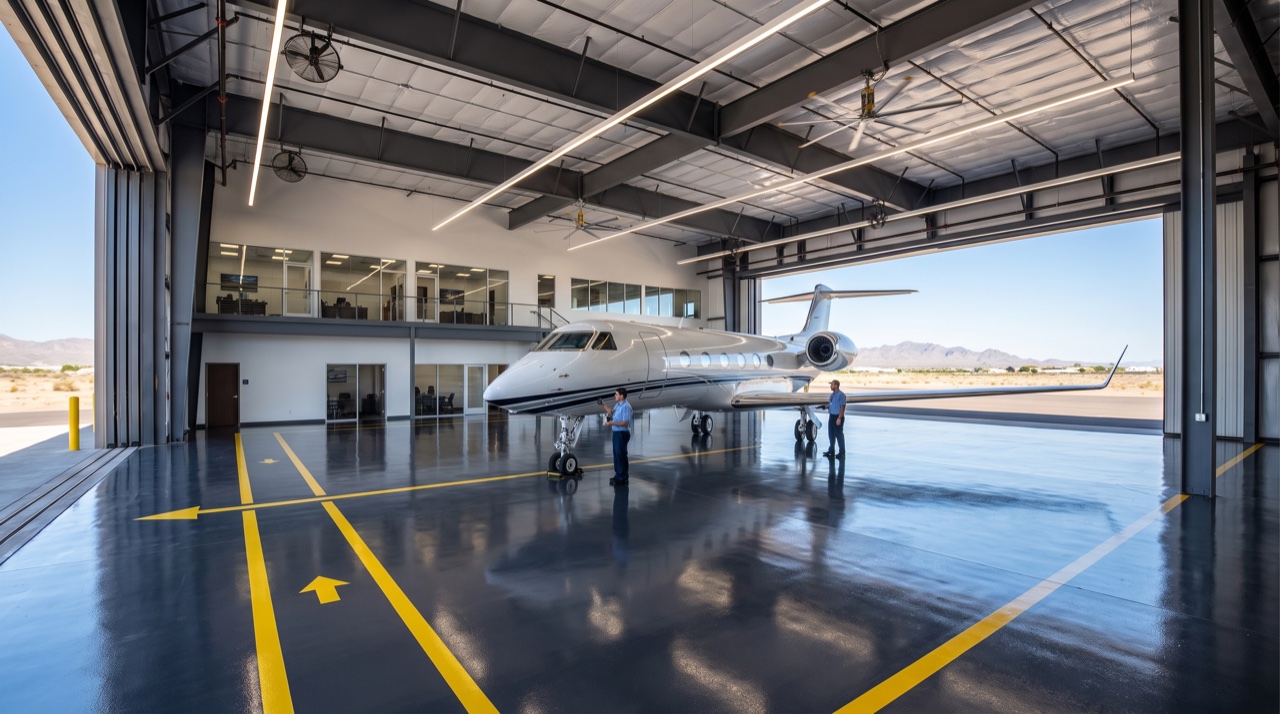
Phoenix is one of the most active general aviation markets in the United States. With Sky Harbor, Scottsdale, Deer Valley, Phoenix Goodyear, and Chandler Airpark serving a dense mix of corporate FBOs, flight schools, charter operators, and private hangars, the demand for aviation-grade floor coatings is consistent and technically demanding. This guide covers MIL-SPEC floor coating requirements, ESD protection, FAA safety marking standards, and what to expect from a professional aircraft hangar epoxy installation in the Phoenix metro in 2026.
1. Why Aircraft Hangar Floors Require Aviation-Specific Coatings
Aircraft hangar floors face a combination of stressors that standard commercial epoxy systems are not rated for. The difference is not cosmetic - it is structural and regulatory.
The primary challenges in Phoenix aviation hangars: concentrated point loads from aircraft jack pads and ground equipment (up to 40,000+ lbs on small contact areas), aviation fuel (Avgas 100LL and Jet-A) and hydraulic fluid exposure, ESD requirements near fuel systems and avionics, extreme thermal cycling from Phoenix's desert climate, and FAA/NFPA marking requirements for safety lanes, fire equipment access, and apron boundaries.
Standard garage or commercial epoxy systems fail in this environment - not due to low quality, but due to wrong specification. Jet fuel and hydraulic fluid are aggressive solvents that dissolve most standard epoxy topcoats within months of regular exposure. Aircraft tire compounds differ from automotive tires and transfer differently onto coated surfaces. Phoenix's concrete slab temperatures (130–150°F in summer) demand topcoat systems rated for sustained high heat - which eliminates most standard-grade epoxies.
Aviation-grade coating systems must be specified by performance standard, not by product line. MIL-SPEC designations exist precisely because the tolerance for failure in aviation facilities is zero.
2. Relevant MIL-SPEC Standards for Phoenix Aircraft Hangars
Military performance specifications for coatings are publicly available and frequently adopted by civilian aviation facilities as the baseline for contract specifications. The following standards are most relevant to Phoenix aircraft hangar projects:
3. ESD (Electrostatic Discharge) Requirements for Phoenix Aviation Facilities
Static electricity is a serious hazard in aircraft hangars near fuel systems, avionics workbenches, and during aircraft fueling operations. NFPA 77 (Static Electricity) and API RP 2003 (Protection Against Ignitions Arising from Static Electricity) govern the requirements.
Resistance values for ESD-compliant epoxy systems are specified in ohms and measured per ASTM F150:
| Zone Type | Resistance Range | NFPA Classification | Phoenix Hangar Application |
|---|---|---|---|
| Fuel Operations Zone | 10⁵ – 10⁸ ohm | Conductive | Fueling pits, fuel truck parking, Avgas/Jet-A storage |
| Avionics Work Area | 10⁶ – 10⁹ ohm | Dissipative | Instrument repair, panel work, component handling |
| General Hangar Floor | 10⁸ – 10¹¹ ohm | Standard | Aircraft parking, ground equipment movement |
| Static-Sensitive Zones | < 10⁶ ohm | Conductive | Military-grade electronic assembly, classified systems |
ESD coatings require a continuous conductive grid embedded in the epoxy system - typically copper tape at 10-foot intervals connected to a verified earth ground. The coating system must maintain its resistance values through Phoenix's thermal cycling and humidity variation. ProEpoxy tests each ESD installation with a calibrated megohmmeter and provides certified resistance documentation for insurance and regulatory records.
4. Phoenix Climate Considerations for Hangar Floor Coatings
Phoenix's climate creates specific challenges for aviation hangar coatings that are not present in moderate-climate markets. Understanding these is critical to specifying a system that will perform for 10+ years.
Summer slab temperatures. Phoenix concrete slabs in open or partially-shaded hangars can reach 130–150°F in July and August. Standard epoxy body coats begin to soften above 140°F, reducing their resistance to concentrated aircraft tire loads. Aviation-grade systems must use 100%-solids epoxy body coats with a polyaspartic or aliphatic polyurethane topcoat - both rated to 200°F+ continuous service temperature.
Thermal cycling. Phoenix experiences 60–70°F daily temperature swings year-round. Concrete expands and contracts by approximately 0.006 inches per 10°F change per 100 linear feet. Coating systems must accommodate this movement without cracking or delaminating at the concrete interface. Semi-rigid polyurethane joint filler at all control joints is mandatory - rigid epoxy fillers fail within 1–2 seasons.
Monsoon moisture. Arizona's monsoon season (July–September) introduces elevated ambient humidity and moisture intrusion through concrete slabs. Vapor drive from below can cause delamination in improperly installed systems. Moisture vapor transmission testing per ASTM F1869 is required before specification, and moisture-mitigating primers are standard for Phoenix hangar projects.
5. FAA Safety Markings and NFPA Zone Color Standards
Aircraft hangar floor markings serve critical safety functions and must comply with FAA Advisory Circular AC 150/5370-10 and NFPA 409 zone requirements. Marking systems must be installed using epoxy-based or polyurethane-based traffic paint - not standard latex paint - to withstand aircraft fuel exposure and heavy equipment traffic.
| Zone / Marking | Color | Width | Regulatory Reference |
|---|---|---|---|
| Aircraft Parking Boundary | Yellow | 4–6 in | NFPA 409 / FAA AC 150 |
| Fire Lane Access | Red | 6–8 in | NFPA 409 §9.4 |
| Fuel Hazard Zone | Red diagonal hatch | Zone fill | NFPA 409 / API RP 2003 |
| Pedestrian Safety Lane | White | 3–4 in | OSHA 1910.22(b) |
| Caution / Restricted Area | Orange | 4 in | FAA JO 6700.20 |
| Aircraft Tiedown Points | Yellow circle | 12–18 in dia | NFPA 409 / Local AHJ |
All marking colors must maintain legibility under Avgas and hydraulic fluid contamination. ProEpoxy uses two-part aliphatic polyurethane marking paint - not latex - for all aviation facility markings. Contrast ratio verification is performed after installation per FAA photometric standards.
6. System Selection by Phoenix Hangar Type
Coating specification varies significantly by hangar type, occupancy, and aircraft served. Phoenix's general aviation market spans a wide range:
| Hangar Type | Typical Size | Recommended System | Key Requirements |
|---|---|---|---|
| Private T-Hangar | 1,000–3,000 sq ft | 100%-solids epoxy + polyaspartic | Fuel resistance, thermal stability |
| Corporate FBO | 10,000–40,000 sq ft | MIL-DTL-24441 + MIL-PRF-85285 | Full MIL-SPEC, ESD zones, FAA markings |
| Flight School | 5,000–15,000 sq ft | 100%-solids + polyaspartic, nonskid | High-traffic durability, slip resistance |
| MRO / Maintenance | 15,000–80,000 sq ft | MIL-PRF-24667 Group V + ESD | Chemical resistance, ESD, heavy equipment |
| Military/Government | Varies | Full MIL-SPEC package | Certified products, documentation, inspection |
7. Aviation Hangar Floor Coating Installation in Phoenix: Process and Timeline
Aviation facility coating projects require more extensive planning and documentation than standard commercial projects. ProEpoxy's standard process for Phoenix hangar projects:
- Pre-project survey. Slab condition assessment, moisture vapor testing (ASTM F1869 or F2170), existing coating adhesion pull test, crack mapping, and contamination testing for Avgas and hydraulic fluid penetration. Survey generates the coating specification and prep scope.
- Phased shutdown planning. Coordinate with facility management to section the hangar into operational zones. Typical 10,000 sq ft FBO: 4–6 working days, two zones active at all times (one curing, one prepping). Aircraft relocation scheduling coordinated with tenants.
- Mechanical preparation. Shot blasting or diamond grinding to CSP-3 minimum (CSP-5 for ESD systems). All fuel contamination areas receive solvent degreasing and hot water extraction prior to abrasive blasting. Crack repair with semi-rigid polyurethane filler. Control joint treatment.
- Moisture-mitigating primer. Applied by squeegee and back-rolled at 200–400 sq ft/gal. Allowed to cure per product data sheet before body coat application.
- Body coat application. 100%-solids epoxy (MIL-DTL-24441 Type IV or equivalent) applied at 10–15 mils DFT. ESD grids installed during body coat application for conductive zones.
- Topcoat. Aliphatic polyurethane or polyaspartic at 3–5 mils DFT. Non-skid aggregate broadcast into wet topcoat at rate specified per zone (lighter in aircraft movement areas, heavier in pedestrian/maintenance zones).
- Safety marking installation. Two-part aliphatic polyurethane marking paint applied after topcoat achieves full cure (typically 7 days). Stencils provided by ProEpoxy; layout coordinated with facility manager and verified against NFPA 409 and FAA marking requirements.
- Final inspection and documentation. DFT readings at grid pattern per SSPC-PA2, ESD resistance testing per ASTM F150 (for ESD zones), coefficient of friction testing per ASTM C1028, and photographic documentation. Full spec compliance package provided for insurance and regulatory files.
8. Frequently Asked Questions
Get a Quote for Phoenix Aircraft Hangar Flooring
Aviation-grade epoxy systems with MIL-SPEC documentation, ESD certification, and FAA-compliant safety markings.